Pickleball 5.0: A Journey from 2.0 to 5.0 by Phil Dunmeyer(Takeaways and Review)

Serves:

Practice your serve as much as your other shots. 

Develop a variety of serves. 

The closer the serve is to  a lob the more difficult it is for your opponents to attack to serve.

Consider, keeping a very effective serve for a critical point in the game or time.

A medium high bouncing serve to your opponent’s backhand is always a challenge. Don’t hit serve too high, however, because it will give him/her time to run around the backhand, and hit a more comfortable forehand.

A player who steps onto the court from behind the baseline when his or her partner is serving, is in a seriously negative position, even if assuming a perfect stance.

Prior to serve, communicate with partner who has the middle on return.

Service Returns:

Hitting the return of serve with appropriate pace and deep enough giving you time to join your partner at your kitchen line is offensive in nature, but it puts you and your partner in the best defensive position on the court

For the intermediate to advanced players, the skill of “hitting the ball on the rise“ provides the following benefits: 

  • Returns the ball back to opponents faster, resulting in them having less time to prepare and hit the ball. 
  • Limits retreating, and moving backwards’ unforced errors. By stepping in, and hitting the ball early, you keep more angles to hit the ball into. If you back up, you lose some angles of return.

Two Handed Backhands:

If you don’t already have a two handed backhand, I recommend you use the time perfecting your one-handed backhand. The two handed backhand has much more potential use in singles.

The non-volley zone/kitchen stance

Feet wider than the shoulders. Knees bent and back straight. Center of getting gravity through the back and rear straight to the ground behind you.

Dinks:

The whole idea behind the dink is to “strike” the ball, so it drops into the opponents NVZ area. You do not hit it over the net! You push it over the net.

Players who hit their dinks, usually take a backswing of 2 inches or more, and this places far too much power into the ball when you were only trying to hit the ball 5 to 8 inches. There is no wrist movement in the dink shot. Your wrist is locked as you push the paddle forward.

Avoid hitting your dinks straight at the opponent in front of you. Instead, make him or her move laterally, keeping in mind most people have a weaker backhand dink than a forehand dink.

Avoid hitting the same dink in the same spot repeatedly. Aggressive opponents are trying to stay “in the mental zone“ and look for the right shot to attack. By changing the location of your dinks, especially to the same opponent, you minimize his or her ability to zero in on a attackable return.

Check your spacing and make sure you and your partner are staying linked together on every dink. Your opponents may be exploiting the gap/space between you and your partner because you are not staying “one step, and a reach” between you.

Hitting it back to the opponent that hit it to you is the safest way to hit it. Adding different spins to the ball, make it more difficult to hit the ball “squarely“ and straight.

Volleys:

The faster the ball is traveling towards you, the shorter the back swing. The slower the ball coming towards you the longer/greater the back swing.

Volleying while you are moving, is not productive, or a good idea. The closer you are to the net, the less the backswing.

Pickleball checklist for volley errors

  • moving while hitting the volleys; 
  • not anticipating volley hit to you; 
  • paddle face position errors; 
  • not using compact swing; 
  • getting jammed on volleys; 
  • not bending at the knees; 
  • overreaching for volleys;

Lobs:

Lobs can be a “rainbow” in your game, but they usually result in a “downpour” of unforced errors. Three things can happen when you lob: (1) the lob can be hit too long, and it goes out; (2) the lob could be hit too short and gets attacked by your opponents; (3) the lob can be the perfect rainbow arc and falls onto the court non-returnable by your opponents.

If your opponents are making your pickle ball life from lobs, miserable back up two or three steps from your no volley zone. They should convince them to try other shots such as hitting the ball at your feet, which is more possible the further you move away from the net, this, however, may be the lesser of two evils.

The best option for returning a good lob is to re-lob the good lob high and deep back over the net forcing one or both of your opponents to retreat to their baseline to reset the point/rally.

Important point: the height of your return lob is far more important than the depth. The higher, the lob, the more difficult it is for opponents to hit especially aggressively.

Strategy:

70% of points are the results of unforced errors. Unforced errors are usually offensively hit balls, not defensively hit balls.

Protecting your backhand – – from the deuce court if you are right, handed, and need to protect your backhand, stand so your left foot is only 3 feet away from the midcourt line. If you’re right handed and need to protect your backhand in the ad Court, stand 3 feet from the left side line/baseline intersection.

Reaching for the ball with arm extended, or reaching in front to hit the ball limits power.

Getting closer to the ball increases power.

If a player is moving, he or she is in the worst defensive position possible.

Give your opponent a chance to lose. By playing good defense you increase your chances of winning. 

You win more points by “playing smarter” than hitting harder. 

Force your opponents to hit one more shot.

Ball placement trumps power.

On overhead shot, turn your shoulders and body into a sideways – – facing the sideline – – position as quickly as possible.

Pickleball players are discovering an interesting fact: by a large percentage, the first team to attack the ball aggressively loses the points/rally. Don’t force the attack shot. Wait for the attack shot that has a much better chance of being not defensible.

Probably 70 to 80% of Pickleball hitting errors can be directly attributed to poor foot work. Footwork is the key factor in being in the best position to return shots.

Know the assets/liabilities of your opponents.

My Brief Review:

It is a long book (282 pages but very comprehensive). I skimmed through many of the illustrations and sections of little interest. The content is slightly dated but there are plenty of good tips and strategies for players of all levels.
The Hot Seat: A Year of Outrage, Pride, and Occasional Games of College Football by Ben Mathis-Lilley


My rating: 4 of 5 stars


If this book had just been about Jim Harbaugh and the Michigan football program, I would have enjoyed it. However the author also extended this book to commentary about politics, religion and our national culture. Unlike some others, I enjoyed and appreciated the author’s forays into those topics. I have to admit a certain sympathy for Jim Harbaugh. Despite all the money that he is being paid, he can never satisfy the rabid desires of a typical Michigan football fan. And by the critiques and scorn that I read and see on various sports venues, Harbaugh cannot satisfy many critical commentators as to his worth.

Lord knows that many football coaches at major universities are way over paid. And one bad season can have them looking for new work quickly. Just note the unrealistic expectations at Nebraska from the Athletic Director and its football fans.

This is an excellent read if you are a college football fan or even if you are not. You don’t have to be a football fan to see how crazy college football is. For the past few years, Michigan has been Ground Zero for much of this craziness. I highly recommend this book… Excellent narrative… Cogent commentary on college sports in general.


View all my reviews

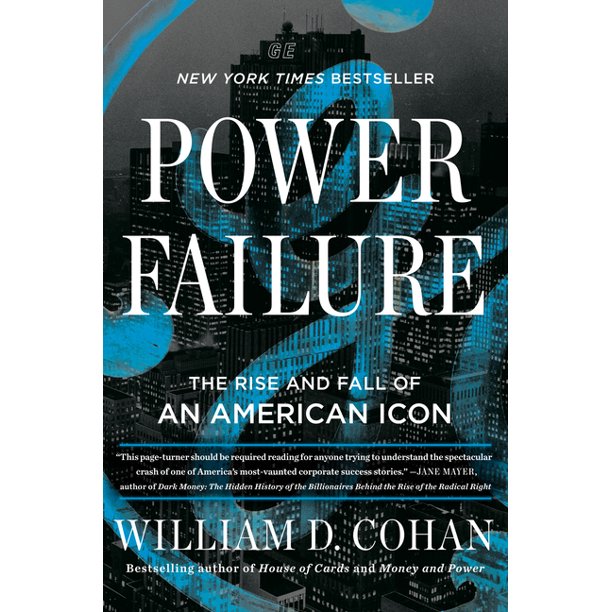
Power Failure: The Rise and Fall of an American Icon (Book Review)

Summary: Written by William D. Cohan, this book chronicles the birth and demise of General Electric. The author focuses specifically on the CEO administrations of Jack Welch and his successor, Jeff Immelt. GE was the premier American business model in the 20th century. With operations worldwide and a diverse line of operations and businesses, GE was a business powerhouse and the CEO title there was competitively sought.

This book read like a novel. Greed, hubris, deception, scandal, paybacks and crime were found at the highest ranks of the company. Did Jack Welch “cook the books” to satisfy his promise of reaching quarterly earning projections? It appears he did utilize assets from GE Capital when there were operation shortfalls. Welch laid off tens if not hundreds of thousands of employees. He closed business lines that had operated successfully for decades. Business operations, employees and products were chess pieces for GE CEOs.

Welch more than Immelt had the respect of GE employees and certainly senior management of the corporation. Welch personally managed the careers of many of the men who moved up in the organization. Welch also listened to objections to his thinking, something that Immelt refused to do.

Both Welch and Immelt made poor business decisions. There were businesses and companies that each man should not have merged with or purchased. Immelt generally did not solicit comments or potential objections from his senior officers before a major business decision. This was a major cause in his downfall and GE’s fortunes.

Welch was a complex figure. His loyalty to men who worked for him did not extend to women he married. He appeared to find solace with his third wife, Susie.

Cohan spent time within the book describing the personalities and lifestyles of not only Welch and Immelt but other men of ambition and power in the GE organization. How GE did or did not develop a succession plan for their next CEO is a topic worthy of study by MBA classes.

Rating: ★★★★★

One of the best business books that I have read.

Review: Trust by Hernan Diaz

Taken from my review on Goodreads

My rating: 3 of 5 stars


I was anxious to read this book because of the excellent reviews and buzz surrounding it. I was not aware of the structure of the book where it was basically four novellas that presented different viewpoints and perspectives from different writers. I enjoyed the first novella and was somewhat disappointed and shocked that the story was about to change. Nonetheless I continued to read but found that my interest had lessened.

I am glad that I finished the book as I was able to find out the “secret” of how Benjamin became rich. And it struck me that this secret was somewhat plausible.

The book did provide one of the most interesting and provocative aphorisms that I have read.

“God is the most uninteresting answer to the most interesting questions.”

I did not find that the lifestyles of the characters were particularly interesting – – in fact they were a bit boring. Nonetheless, the book did provide some surprises and the ending justified my efforts in finishing it. I’m not sure how attractive this book would be for readers who have no interest in finance or in the period around the great depression.

A modest start to my new year of reading…


View all my reviews

Review: Running to the Mountain: A Journey of Faith and Change by Jon Katz

I bought and read this book over 20 years ago. I was about the same age as the author at the time and I had a sense of my advancing age, mortality and the need to make changes. I did not have a spiritual guru like Katz did with Thomas Merton. ( I do share his interest in the writings of HL Mencken.) While there were times when I would have liked to be alone, I had absolutely no desire to find and buy a distressed cabin in the woods and live there.

While Katz was a far more successful professional man, I fortunately did not share most of the childhood traumas that he experienced with his parents and siblings. His demons followed him from childhood to adulthood.

This book had far more influence on me when I read it at 50 years old than it did re-reading it at 70 years old. Maybe I am a bit wiser, maybe I am a bit more resigned at my current age. Plus I have very little enthusiam for change.

Interestingly, I read an update on Jon Katz and noticed that he divorced his wife Paula in 2008 and remarried in 2010. Reading between the lines in his book, I sensed that he may have had some dissatisfaction with his marriage. I guess that that was part of the change that he was looking to make.

This is an inspiring book for those on a spiritual search or reconciling their mid life crisis. Very good story…

Excerpts from the book I found interesting…

I am not nearly as afraid of dying as I am of the hinges inside my mind and soul rusting closed. I am desperate to keep them open, because I think that if they close, that’s one’s first death, the loss of hope, curiosity, and possibility, the spiritual death. After that, it seems to me, the second one is just a formality. I wanted to oil the hinges, force the doors to stay open.

I’ve struggled mightily to figure out how to be spiritual without having to be religious, how to find peace without bending my knee before an altar.

I’d lost close friends this way before, even abandoned a couple myself. When men are pressed, their friendships go to the bottom of the list.

There is huge risk involved whenever you seek to discover yourself. You might find that you’re not as happily married as you thought you were. That you’re growing older than you’ve permitted yourself to acknowledge. That you have few true friends, or the wrong ones. That you’re not happy with the place you’re living or fulfilled by the work you’re doing. That you’re not happy or fulfilled, period.

As with so many other boomers, death was suddenly in the air around me, the consciousness of mortality emerging as parents, older friends and mentors, and the first of my peers began to falter and fall. I was writing my own history. I wanted immortality, though not in the conventional religious sense. I wanted to live on in the fond memories of the people I left behind, to be recalled as a supportive father, a loving husband, a devoted friend, a man who struggled to be a good person.

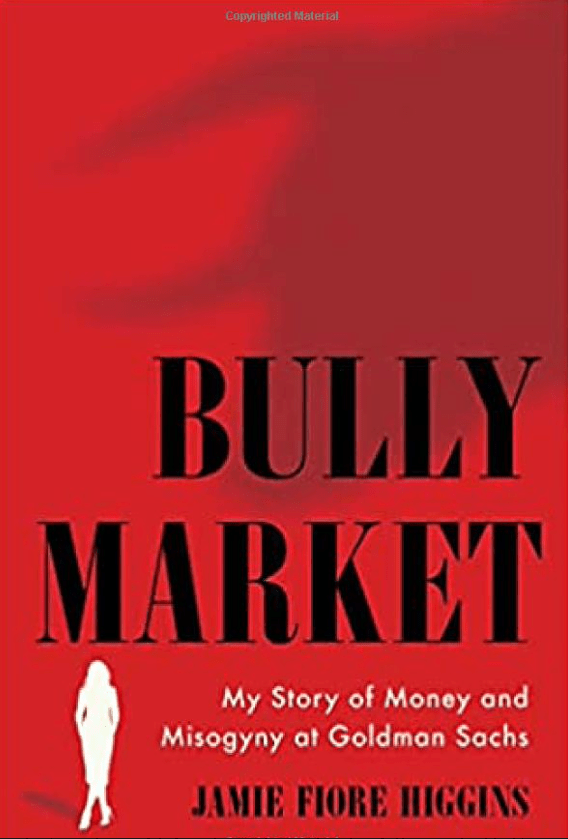
Bully Market: My Story of Money and Misogyny at Goldman Sachs by Jamie Fiore Higgins

This is the second book that I have read by an ex Goldman Sachs employee. The first book was Why I Left Goldman Sachs: A Wall Street Story by Greg Smith. I am more sympathetic to Mrs. Higgins as she did endure bullying, sexual harassment, juvenile behavior, unprofessionalism and was totally unsupported by management, human resources and fellow employees.

The author exposed the corrupt culture at Goldman Sachs. She could not beat the old boys network and despite an exemplary work record and performance, was never really taken seriously. I am happy to see that she finally resigned from Goldman Sachs but I think it was something that she should’ve done many years before. I think what confuses me is that this talented woman thought that the only place that she could work was Goldman Sachs. She never got any other offers from any other investment firms or companies? If she did, I missed it from the book.

She was extremely fortunate that she had a supporting husband, particularly after her brief affair with another Managing Director. To a significant degree she placed her marriage, her children’s upbringing and her health at extreme peril.

There were so many parts in the book that were cringing to me. Mrs. Higgins was treated so poorly that just about any other woman (or man) would have walked away from the job. The author did not disclose her financial status other than her significant bonuses that she received yearly. I would’ve thought that she had earned enough “fuck you” money to walk away much earlier than she did.

I am very sympathetic for those employees who have been treated harshly and unfairly by their managers and the company that they worked for. There are a significant number of assholes that work in senior management for many companies. And I understand that there may be very little recourse other than to leave when you are in a situation where you are being treated unfairly.

Kudos to Mrs. Higgins for her candor and her bravery. She truly exposed herself professionally and personally in this book. I read this book in less than two days. It is very compelling reading.

One of the best business books that I have read in 2022…

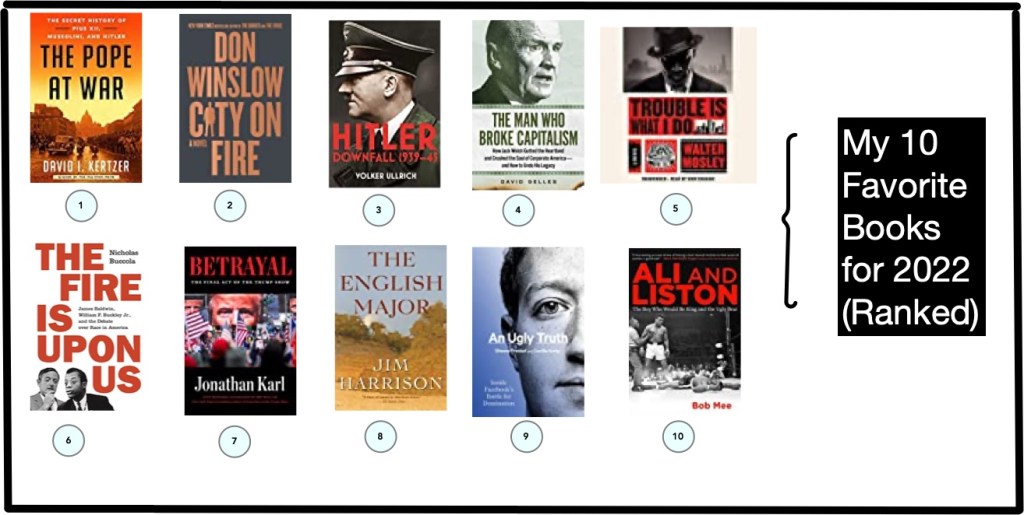
Thoughts after Reading The Pope at War by David Kertzer

  • Excellent book. Reads like a novel. Highly recommended for students, scholars and readers interested in World War II and specifically the Catholic Church’s role dealing with the leaders of Italy (Mussolini) and Germany (Hitler).
  • While understanding that the Pope needed to proceed cautiously on the diplomatic front to protect the Church and Catholics who lived in Italy and Germany, Pius XII generally caved to the demands of the Fascists and Nazis.
  • In pre-war Germany, there was evidence of abuse committed by Catholic priests. This was used as a negotiation card by the Nazis to get Pius XII to agree to their terms.
  • Pius XII’s reluctance to speak out against the atrocities committed against the Jews was an act of moral cowardice.
  • Pius XII did not address the Nazi bombings of London, Rotterdam and Warsaw as they occurred. However he lobbied the Americans and British not to bomb Rome and the Vatican.
  • Kertzer provided stories where priests and nuns refused to aid Jews seeking to hide or flee from Nazi pursuers.
  • Pius XII did lobby Nazi authorities to protect Jews who did convert to Catholicism. He did very little to protest the poor treatment and murder of Jews.
  • Pius XII was fully aware of what atrocities were occurring.
  • Many of the atrocities against Jews were committed by Nazi officers and soldiers who were Catholic.
  • Pius XII does not merit any consideration for canonization. He certainly was no saint.

Survival of the Richest by Douglas Rushkoff

Subtitle: Escape Fantasies of the Tech Billionaires

What the top .1 of 1% think and how they look to control their lives and how they want to control the lives of the rest of humanity.

My notes from this intellectually engaging book..

Taking their cue from Tesla founder Elon Musk colonizing Mars, Palantier‘s Peter Thiel reversing the aging process, or artificial intelligence developers Sam Altman and Ray Kurzweil uploading their minds into supercomputers, they were preparing for a digital future that had less to do with making the world a better place than it did with transcending the human condition altogether. Their extreme wealth and privilege served only to make them obsessed with insulating themselves from the very real and present danger of climate change, rising sea levels, mass migrations, global pandemics, nativist panic, and resource depletion. For them the future of technology is about only one thing: escape from the rest of us.

page 5

This Silicon Valley escapism– – let’s call it The Mindset – – encourages it’s adherents to believe that winners can somehow leave the rest of us behind.

page 10

Studies have shown that the more power a person has, the less “motor resonance“ or mirroring they do of others. Of course, people seeking power may be predisposed to this behavior. But further research has suggested that after people have gained power, they tend to behave like patients with damage to the brain‘s orbitofrontal lobes. That is, the experience of wealth and power is akin to removing the part of the brain “critical to empathy and socially appropriate behavior.” Poor people are much better than their wealthy counterparts at judging other people’s emotions. Their capacity to make “emphatic inferences“ based on facial muscle movements is far superior.

As NYU business professor Scott Galloway has explained, “we’ve decided that capitalism means being loved and empathetic to corporations, and Darwinistic and harsh towards individuals.“ Government readily bailed out banks and businesses in a 2008 recession, and the Covid crisis increased total billionaire wealth from 8.9 to 10.2 trillion in just the first year, despite the pandemic’s negative impact on everyone else. 

page 34

The reduction of reality to information and humans to genotypes all too conveniently dovetails with capitalism’s imperative to render everything into a suitable form for the marketplace. Everything is data, and everything has a price, and everything can scale. The described, codified object is all that matters; anything else falls away like junk DNA, inferior species, or the majority of human beings. The wealthy technologist makes it into the cloud, while the masses are left behind competing against one another in the realm of matter. Like Christ or any other saved figure, only the fully encoded individual can be transubstantiated to the next level. 

So goes the atheistic eschatology  of The Mindset.

page 95

Bernays wrote the book on propaganda – – literally, it was called Propaganda – – in which he explained that the manipulators of public opinion are the true, invisible power in any society. The masses are too stupid to make decisions for themselves, anyway, so their rise to power in a democracy must be steered by propaganda, a “mechanical, advanced and necessary” science of population control. At the time, many journalists and politicians spoke out against Bernay’s tactics and beliefs. He and his colleagues, however, saw themselves as conducting an essential social service. The elite, and even progressives among them, feared the potential power of the unchecked crowd to wreak havoc. They witnessed the madness of crowds in Nazi Germany and the Stalinist Soviet Union alike and wanted to prevent such crises from happening in America, much as Hillary Clinton feared the “basket of deplorables”, who might elect a demagogue as president, or those young technologists feared the insurrectionists at the Capitol. If one could only push a button and make that all go away.

page 101

Government emphasis on job training, high-tech skills and art general compatibility with a digital future has led schools to emphasize STEM—-science, technology, engineering and math – – over the softer, squishier subjects like English, Social Studies and Philosophy. Education has shifted away from liberal arts, which wrestle with those fundamental questions of purpose and dignity while also building the faculties required to think critically about media and messaging. Those skills are dangerous to leave behind.

page 146

Liberation from The Mindset…

Stop supporting their companies and the way of life they’re pushing. We can actually do less, consume less and travel less – – and make ourselves happier and less stressed in the process. Buy local, engage in mutual aid, and support cooperatives. Use monopoly law to break up anti-competitive behemoths, environmental regulation to limit waste, and organize labor to promote the rights of gig workers. Reverse tax policy so that those receiving passive capital gains on their wealth pay higher rates than those actively working for their income.

page 185