In Hot Water

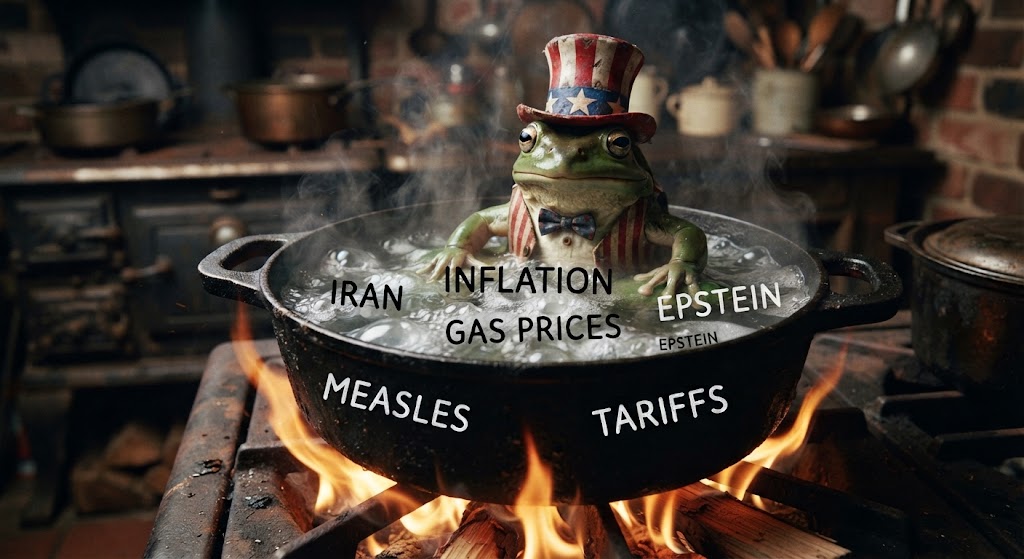
Many Americans, specifically most (?) Republican voters sit contently like frogs in boiling water. Trade war with our best ally, Canada? No problem! U.S. military running out of missiles and weapons? No problem! Americans unable to afford groceries, medication and buying gas? No problem! Measles outbreaks? No problem! American allies making new deals with China for trade and investments? No problem! Investors demanding increase in U.S. Treasury rates?No problem! American military bases in Middle East destroyed? No problem!

Idea by EAB, image by AI

Zibaldone

zibaldone (plural zibaldoni) is an Italian word that translates to a “heap of things,” “hodgepodge,” or “miscellany.”


Couldn’t care less about Natalie Harp and what she does or doesn’t do for a doddering and feeble 80-year-old man. Just another distraction. I’m much more interested in knowing about the stories of possibly unwilling young women in Trump’s past. The failure to release the entire Epstein files and to conduct a full and transparent investigation will be viewed in history as one of the great moral and ethical failures of this time.


Way too early, but the best Democratic candidates in 2028 appear to be Senator Jon Ossoff of Georgia, former Secretary of Transportation Pete Buttigieg, Governor Gavin Newsom of California, and Mark Kelly of Arizona. While I am impressed with Jon Ossoff, I would lean toward Mark Kelly of Arizona as the best Democratic presidential candidate today. Best VP candidate could be Alexandria Ocasio-Cortez.


Way too early, but I don’t think there are any particularly attractive Republican candidates for president. I think J.D. Vance and Marco Rubio are going to sink to the bottom of the Trump Titanic fiasco. I can’t think of a Republican who has shown backbone, integrity, and good judgment during the Trump presidential administrations. Both Vance and Rubio were highly critical of Trump in the past, and now both bow to him on their knees.

Lindsey Graham’s sister, Darline, was endorsed by Trump for the South Carolina Republican Senate nomination. She is a deer in the headlights. She confessed during a recent debate that she was not familiar with national security issues, and then I realized that neither was her brother when he was in the Senate.


Is anyone remotely competent in the Trump administration and cabinet? Every day, and in every way, you see a variety of issues and problems being mismanaged. Hard to believe that Robert F. Kennedy Jr. still has his job. Astounding things that he says and believes…


So there could be a perfect storm brewing…

Rising Treasury rates as investors seek higher returns because U.S. credit is not as reliable as it once was. This could further spike inflation and make it harder to buy homes, cars, etc. In addition, I’m concerned about the prospects for AI. So much money is being invested. Could there be a correction just like there was with Internet stocks 25 or more years ago? A huge correction in the stock market would also have cataclysmic effects on retirement portfolios, personal finances, etc. Just as our military assets are being depleted, so may our financial assets in the very near future!


Every year I look forward to summer, and just about every year summer disappoints me. Too damn hot to enjoy being outside. Summer hibernation with air-conditioning.


Favorite Sports to Watch on TV

  1. College football
  2. Men’s college basketball
  3. NFL football
  4. Pickleball
  5. Philadelphia Phillies baseball
  6. NBA basketball
  7. WNBA basketball — only when Caitlin Clark plays
  8. Men’s professional tennis
  9. 1970s heavyweight boxing

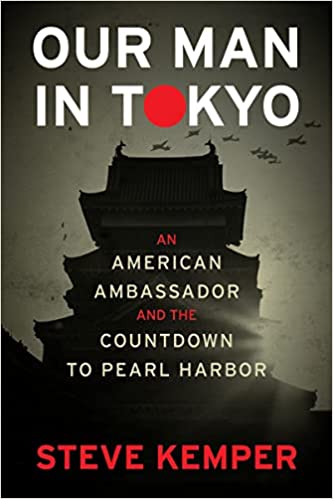
Review and Five Takeaways from Our Man in Tokyo by Steve Kemper

I am avidly interested in reading about the era surrounding World War II. While most of my reading has focused on Germany and the rise of Adolf Hitler, Steve Kemper’s Our Man in Tokyo shifts the lens to the Pacific. The book chronicles the efforts of U.S. Ambassador to Japan Joseph Grew from 1932 to 1941, a critical decade during which the Japanese military seized control of the country’s future. Kemper draws richly from the extensive diaries Grew maintained throughout his ambassadorship, as well as his correspondence, official reports, speeches, and personal reflections.

Grew believed his primary responsibility was to preserve peace between the United States and Japan, which proved to be a monumental and ultimately heartbreaking task. He received little help from his superiors in Washington, D.C., who frequently kept him in the dark regarding critical information and strategy, nor from members of the Japanese government, who repeatedly deceived him.

My Five Takeaways from the Book

  1. The Inevitability of Conflict: War between the United States and Japan was largely inevitable. Japan’s military was eager to expand its empire into China, Singapore, and the wider Far East, while the nation faced critical shortages of oil, food, and other vital resources. Japan’s relentless belligerence, particularly in China, forced the United States to employ trade embargoes and other economic measures to halt its aggression. Ultimately, these measures failed to deter Tokyo; instead, they angered Japanese leadership, who chose to pursue expansion through war.
  2. Intelligence vs. Preparedness: Through sophisticated secret intelligence efforts, the United States was well aware that Japan was planning military strikes and that Pearl Harbor was a potential target. It remains astounding that the U.S. military was so unprepared for the events of December 7, 1941.
  3. The Sidelining of Diplomacy: Washington largely ignored the advice and judgment of Ambassador Joseph Grew. Grew had earned the respect and trust of many influential Japanese leaders and deeply understood Japanese culture—particularly the crucial importance of “saving face.” This history underscores the immense value of diplomacy, a lesson of enduring relevance.
  4. FDR, Hull, and Divergent Strategies: President Franklin D. Roosevelt appeared to make every effort to maintain peace with Japan, though he was undoubtedly distracted by the European theater and the urgent need to support Great Britain against Germany. However, Secretary of State Cordell Hull and other State Department officials did not share Ambassador Grew’s strategies or his nuanced options for preserving peace. Compounding the tension, Japan consistently refused to take responsibility for hundreds of attacks on American citizens and businesses in both China and Japan.
  5. The Double-Edged Sword of Sanctions: Trade embargoes can be powerful tools of statecraft, but they can also provoke targeted nations into military retaliation. When a country is literally starved of the food, oil, and essentials required for survival, economic pressure will eventually drive the aggrieved nation to strike back.

Inventive Way to Win Iran War

According to various press reports, the United States military is running out of missiles and bombs. Just a suggestion, but why don’t we carpet bomb Iran with copies of Trump’s Art of the Deal book. I’m sure that we have a substantial inventory of those and if Iranian leaders read and follow the book, their unconditional surrender is guaranteed.

created with Gemini

Some Thoughts… Without a Lot of Thought

The attacks on Dr. Fauci… I don’t get it.

Judging by some politicians—and one aging quarterback—you’d think Anthony Fauci invented the coronavirus.

Yes, his journals reveal a measure of ego and an appreciation for the spotlight. So what? In 2020 there were no easy answers. Scientists, physicians, and government leaders were navigating a once-in-a-century crisis with imperfect information.

What I remember is not a villain, but a calm and reassuring public figure trying to make sense of chaos.


The attacks on Caitlin Clark… I don’t get it.

She may not be the WNBA’s best player, but she is unquestionably its biggest attraction.

Clark has elevated television ratings, attendance, and public interest, yet she often seems to receive less respect than she has earned—from opposing players, league officials, and at times even her own organization.

From everything I’ve seen, she has handled herself with remarkable composure while avoiding needless controversy. Whatever one thinks of her game, the label “coward” is as absurd as it is undeserved.


How is Trump still president?

People lose their jobs every day for poor performance, erratic behavior, or simply failing to meet expectations. Yet somehow the presidency appears exempt from the standards applied to almost every other occupation.


Political arguments

I’ve largely stopped discussing politics, especially with committed Trump supporters.

The experience reminds me of trying to shoo flies out of the house. You wave them away, they circle back, and after a while you realize you’re wasting more energy than they are.

The Age of Incongruity

A preening president, smiling from an air-conditioned luxury box at the World Cup final, enjoys the spectacle while American soldiers in the Middle East sit exposed to incoming missiles and artillery. The contrast is jarring: comfort and applause for those at the top, danger and sacrifice for those at the bottom.

The incongruities multiply.

The Secretary of Health and Human Services, whose public profile has long overshadowed his scientific credentials, dispenses medical advice while Dr. Andrew Fauci—an 85-year-old physician and career public servant who helped lead the nation’s response to COVID-19 and other infectious disease threats—is hauled before congressional critics more interested in campaign clips than sober inquiry. Washington has become a theater where expertise is booed from the stage while confidence, however unearned, receives a standing ovation.


If you are Donald Trump, a member of his family, a political insider, or the CEO of a corporation eager to flatter the administration, the economy may look quite favorable. Outside that circle, the picture is less rosy. Families contend with expensive gasoline, rising food and health-care costs, and for some, the growing anxiety that an expanding conflict could one day place their sons and daughters in uniform.


According to recent polling, only about one-third of Americans support military action against Iran. Yet the machinery grinds on while Congress performs its favorite civic duty: watching. It occasionally stirs itself—not to confront the nation’s most pressing problems, but to stage another hearing destined to produce more fundraising emails than useful legislation.


The nation may eventually run short of fuel, but there is no danger of running short of hot air. Washington produces it in inexhaustible quantities. I remember the gasoline rationing of the 1970s. At the current pace, one wonders whether history is preparing an encore.