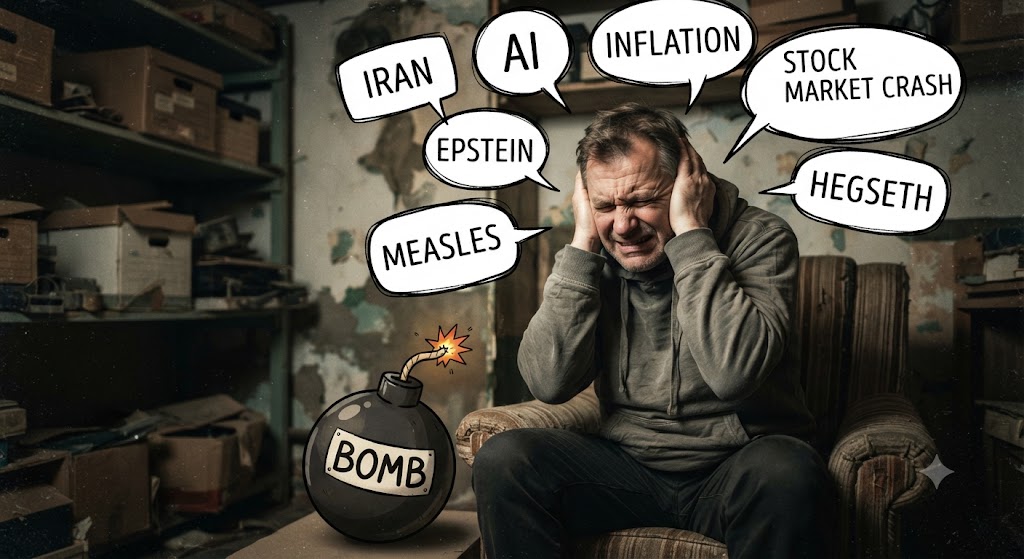
History will not be kind to the people of the United States. We scroll endlessly through our iPhones, binge stale entertainment, and anesthetize ourselves with online gambling, crypto speculation, and relentless consumerism while our culture erodes and our economic and political institutions decay. Future generations will curse us—not for what happened to our country, but for how little we cared.
Aphorisms below that caught my eye and mind and address the insanity of today…
I feel much better, now that I’ve given up hope.
Ashleigh Brilliant
Filling our pockets, we empty our hearts.
Dražen Jergović
Opinions, and not religion, are the opium of the people.
Being open-minded requires a lot of effort. Being narrow-minded is effortless.
Piotr Bardzik
The poor always fight the wars of the rich.
Never hire the best lawyer; the worst judge will be cheaper.
Andrzej Majewski
The truly strong are those who aren’t driven by the need to prove their strength.
Richard Greene
Judge us by how we treat the weak not by how we arm the strong.
Charles R. Castle
To close the deficit we need to raise taxes on 5 out of every 4 Americans.
Oleg Vishnepolsky
The men the American people admire most extravagantly are the most daring liars; the men they detest most violently are those who try to tell them the truth.
The United States turns 250 this year. As someone born in 1952, I can’t help but reflect on what I’ve witnessed over the past seven decades. These aren’t political conclusions so much as personal observations from someone who has watched this remarkable country evolve.
1. I believe I saw and experienced the best of America. My father enlisted in the armed services in 1942 at just 17 years old and fought in the European Theater during World War II. His generation accepted sacrifice as a duty rather than a burden. I sometimes wonder whether my Baby Boomer generation—and those that followed—have fully appreciated the price that was paid to build and preserve this nation.
2. Our citizens deserve better than their leaders. In my experience, most Americans are decent, hardworking people who want many of the same things: safety, opportunity, and a better future for their families. Too often, however, our political system rewards division instead of service. I suspect the Founding Fathers would be less surprised by disagreement than by the degree of partisanship, distrust, and self-interest that seems to dominate public life today.
3. Respect for America feels diminished. Perhaps every generation believes the nation’s standing has slipped, but it seems to me that America’s reputation—both at home and abroad—has become more fragile. Friends and allies who once looked to us with confidence now seem more uncertain. Whether deserved or not, that perception should concern all of us.
4. Even great nations can grow old. At 74, I’ve learned that age brings wisdom, but it can also bring rigidity and decline. Sometimes our country feels that way. We seem weighed down by old arguments, old grievances, and old ways of thinking. America doesn’t need to abandon its principles; it needs an infusion of fresh ideas, empathy, practical problem-solving, and leaders who place country above party.
5. Unity still exists—we just don’t see enough of it. One of the things that has encouraged me recently is watching Americans rally behind our national teams, particularly in international competitions like the World Cup. For brief moments, politics fades into the background, and we remember that we are cheering for the same flag. I wish those moments weren’t so rare.
6. Washington’s dysfunction has become contagious. Las Vegas has the saying, “What happens in Vegas stays in Vegas.” I sometimes wish Washington operated under a similar rule. Unfortunately, the anger, cynicism, and partisan warfare that dominate our nation’s capital seem to spill into every community, every family gathering, and every conversation. We would all be better served if more of that stayed inside the Beltway.
7. The years ahead matter more than we may realize. History reminds us that nations are rarely destroyed from the outside before they weaken from within. I don’t believe America’s greatest threat is another Civil War fought with armies. I worry more about a quieter conflict—one driven by cultural division, economic inequality, religious differences, and our growing inability to disagree without viewing one another as enemies. If we lose our willingness to listen, compromise, and respect one another, we risk losing something just as valuable as territory: our national identity.
As America celebrates its 250th birthday, I remain grateful to have lived here and optimistic enough to believe our best chapters have not necessarily been written. But optimism alone isn’t a strategy. The next generation will inherit the country we choose to build—or neglect—today.
Since retiring, one of the small pleasures my wife and I have enjoyed is going out for dinner. Whether it was a neighborhood diner, a favorite restaurant, takeout, or even the occasional fast-food stop, it was an easy way to enjoy an evening together.
Lately, however, I find myself going out less and less. Here are a few reasons why.
First—and probably most important—it has simply become too expensive. Even fast food is no longer inexpensive. A meal at Five Guys with two small cheeseburgers, regular fries, and two soft drinks recently cost us nearly $30. Sit-down restaurants are even more shocking, especially once taxes and a 20% tip are added.
Second, customer service has declined. I realize many restaurants struggle to hire and retain good employees, but that doesn’t make the experience any less frustrating. On more than one occasion I walked into a McDonald’s, stood at the counter ready to order, and waited five minutes without anyone acknowledging I was there. The staff seemed entirely focused on drive-through orders, so I simply left. Unfortunately, that experience is no longer unusual.
Third, portions continue to shrink. Restaurants still provide plenty of bread or salad, but many entrées seem noticeably smaller than they once were. If I’m paying $30 or more for an entrée, I expect it to satisfy my appetite—and perhaps even leave enough for tomorrow’s lunch.
Fourth, the food often isn’t memorable. Too often the quality and flavor fail to justify the price. Spending $70 or more for dinner before adding a tip should leave me thinking, “That was worth it.” Instead, I often leave wondering why I didn’t stay home.
Finally, too few restaurants seem interested in earning repeat business. Years ago it was common to receive coupons, loyalty rewards, or other incentives to return. Today, those offers are mostly limited to fast-food chains.
One notable exception is Chick-fil-A. Every location I’ve visited has been clean, efficient, and staffed by courteous, well-trained employees. Whether you like their food or not, they understand customer service.
Unfortunately, I can’t say the same about McDonald’s. There was a time when counter service was consistently friendly and efficient. Today, at several locations in my area, employees often seem disengaged, and I rarely see the same people working there from one visit to the next. The high turnover is hard to miss.
I don’t expect these trends to reverse anytime soon. Inflation, rising labor costs, and staffing shortages continue to challenge the restaurant industry. Here in South Jersey, I’ve already seen several restaurants and fast-food franchises close their doors. The internet and social media have also made it much harder for businesses to hide poor service or disappointing food. One bad experience can quickly become public knowledge.
For my wife and me, eating out has shifted from being an affordable pleasure to an occasional indulgence. More often than not, the best value—and frequently the best meal—is the one we prepare at home.
Maybe I’ve become more demanding with age. Or maybe restaurants have simply become less rewarding. Either way, this “Thought for Food” leaves me with one conclusion: the best table in town is increasingly the one in my own dining room.