
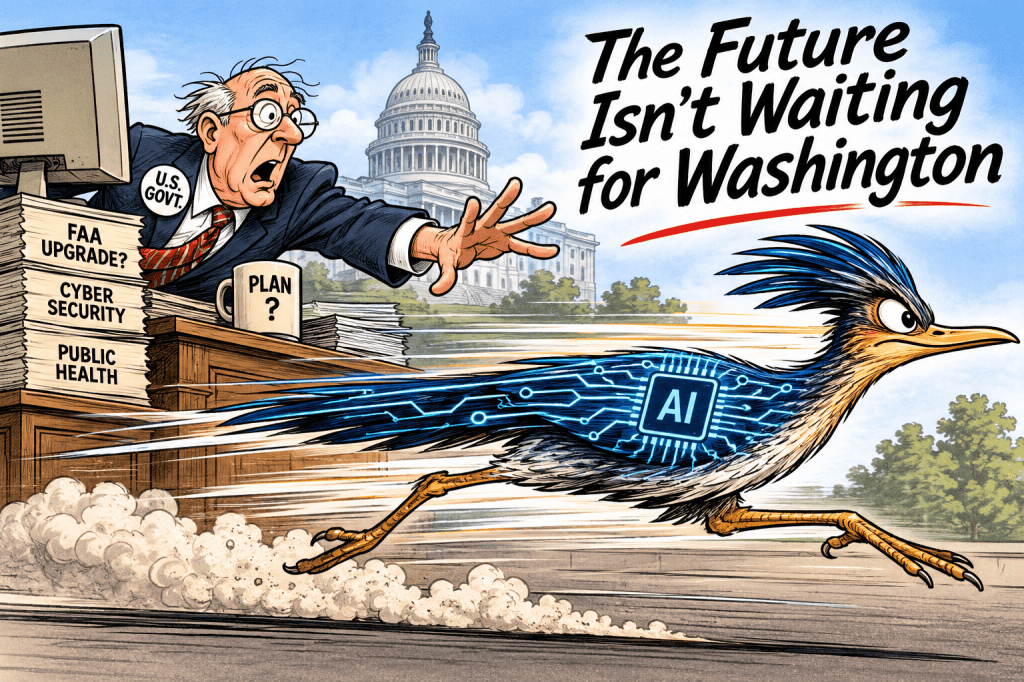
Maybe Our Time Is Running Out
On Friday, November 13, 2026, Transportation Secretary Sean Duffy held a news conference following a nationwide FAA ground stop caused by problems with the agency’s aging telecommunications and radar systems. FAA officials and Senator Markwayne Mullin also participated.
During questioning about why the FAA wasn’t prepared for such a significant system failure, Duffy responded:
“Well, I can’t anticipate every catastrophic failure that will happen with a TDM network, with an analog network.”
Asked why there wasn’t a backup plan for the aging system, Duffy added:
“I didn’t anticipate that we would have an outage like this. We’ve had small outages that I’ve mentioned previously. We didn’t think we would have this kind of outage.“
He also acknowledged the likelihood of future problems:
“You will have more of these.”
Perhaps our luck is running out.
During my lifetime, humanity has faced the threat of nuclear war, terrorism, pandemics, extreme weather, Y2K, financial collapse, and a seemingly endless list of potential catastrophes.
What has helped us survive these threats is the work of intelligent, knowledgeable and competent people assessing risks and developing solutions. Scientists, physicians, military officials, diplomats, engineers and countless others have contributed their expertise. Equally important has been leadership willing to recognize potential dangers, listen to those experts and make preparedness a priority.
The most fundamental responsibility of any national government is to protect its citizens from harm. In my 74 years, I have rarely seen such a troubling combination of questionable judgment, inadequate preparation and apparent indifference to expertise in a presidential administration.
I believe Secretary Duffy’s comments reflect a broader problem within this administration and, potentially, other levels of government. There appears to be insufficient emphasis on anticipating problems, evaluating risks and preparing for circumstances that may not be immediately foreseeable.
I don’t expect cabinet officials or even the president to spend their days contemplating every imaginable catastrophe. I do expect them to surround themselves with qualified people who can identify risks, evaluate potential consequences and bring those concerns to the attention of decision-makers.
Consider the nation’s public health challenges. As measles cases have surged across the country, we should expect Health and Human Services Secretary Robert F. Kennedy Jr. to rely on experienced medical and scientific professionals and to make evidence-based public health policy a priority. The United States has now lost its measles elimination status. This is a serious public health setback that demands competent leadership and a credible response.
Vice President JD Vance recently offered the following observation about preparedness:
“But you have to be prepared for everything. What we want to do is make sure that we prevent the worst outcome, but we’re also prepared for the worst outcomes.”
I agree with the sentiment. The question is whether the administration is actually putting that principle into practice.
Meanwhile, the country and the world are struggling to understand and manage the implications of artificial intelligence. Its development is moving at extraordinary speed, creating challenges for government, business, national security and society that we are only beginning to understand.
The recent disruptions involving the FAA, Microsoft, major banks and Apple are reminders of how dependent we have become on increasingly complex technology. These incidents have not been shown to be connected, nor is there evidence that AI caused them. But they illustrate a broader vulnerability: the consequences when critical systems fail and the difficulty of anticipating every possible failure.
The technology industry is racing to develop and commercialize AI. Government has an equally important responsibility to establish appropriate safeguards, assess the risks and consider the broader consequences. Unfortunately, the public discussion often seems more focused on economic competition, corporate profitability and stock market performance than on the potential costs to society.
At the local and state levels, we have seen a similar tension surrounding the rapid expansion of data centers. Politicians and communities have been attracted by the promise of investment, jobs and tax revenue. But residents and environmental advocates have also raised legitimate concerns about electricity consumption, water usage and the impact on local communities. In some instances, public opposition has forced elected officials to reconsider their enthusiasm.
Our government has been described as a kakistocracy: a system of government run by the least qualified or most unscrupulous individuals. It is a harsh description, but one that becomes increasingly difficult to dismiss when competence, experience and sound judgment appear to take a back seat to political loyalty and personal interests.
Too much is at stake to accept complacency as a substitute for leadership. Preparedness isn’t about predicting every possible disaster. It’s about recognizing that things can go wrong, having qualified people identify the risks, and putting plans in place before a crisis occurs.
The hope that intelligent life and responsible leadership will return to Washington, D.C., may be at least two years away.
That’s a long time.
And too much damage can be done in the meantime.

