The United States turns 250 this year. As someone born in 1952, I can’t help but reflect on what I’ve witnessed over the past seven decades. These aren’t political conclusions so much as personal observations from someone who has watched this remarkable country evolve.
1. I believe I saw and experienced the best of America. My father enlisted in the armed services in 1942 at just 17 years old and fought in the European Theater during World War II. His generation accepted sacrifice as a duty rather than a burden. I sometimes wonder whether my Baby Boomer generation—and those that followed—have fully appreciated the price that was paid to build and preserve this nation.
2. Our citizens deserve better than their leaders. In my experience, most Americans are decent, hardworking people who want many of the same things: safety, opportunity, and a better future for their families. Too often, however, our political system rewards division instead of service. I suspect the Founding Fathers would be less surprised by disagreement than by the degree of partisanship, distrust, and self-interest that seems to dominate public life today.
3. Respect for America feels diminished. Perhaps every generation believes the nation’s standing has slipped, but it seems to me that America’s reputation—both at home and abroad—has become more fragile. Friends and allies who once looked to us with confidence now seem more uncertain. Whether deserved or not, that perception should concern all of us.
4. Even great nations can grow old. At 74, I’ve learned that age brings wisdom, but it can also bring rigidity and decline. Sometimes our country feels that way. We seem weighed down by old arguments, old grievances, and old ways of thinking. America doesn’t need to abandon its principles; it needs an infusion of fresh ideas, empathy, practical problem-solving, and leaders who place country above party.
5. Unity still exists—we just don’t see enough of it. One of the things that has encouraged me recently is watching Americans rally behind our national teams, particularly in international competitions like the World Cup. For brief moments, politics fades into the background, and we remember that we are cheering for the same flag. I wish those moments weren’t so rare.
6. Washington’s dysfunction has become contagious. Las Vegas has the saying, “What happens in Vegas stays in Vegas.” I sometimes wish Washington operated under a similar rule. Unfortunately, the anger, cynicism, and partisan warfare that dominate our nation’s capital seem to spill into every community, every family gathering, and every conversation. We would all be better served if more of that stayed inside the Beltway.
7. The years ahead matter more than we may realize. History reminds us that nations are rarely destroyed from the outside before they weaken from within. I don’t believe America’s greatest threat is another Civil War fought with armies. I worry more about a quieter conflict—one driven by cultural division, economic inequality, religious differences, and our growing inability to disagree without viewing one another as enemies. If we lose our willingness to listen, compromise, and respect one another, we risk losing something just as valuable as territory: our national identity.
As America celebrates its 250th birthday, I remain grateful to have lived here and optimistic enough to believe our best chapters have not necessarily been written. But optimism alone isn’t a strategy. The next generation will inherit the country we choose to build—or neglect—today.
Retirement has changed many things in my life, including what I read. These days, I’m more interested in books that feature older protagonists or explore topics such as health, aging, money, purpose, and mortality. I look for books that not only entertain but also help me better understand this stage of life.
The 16 books that follow are titles I’ve read and would gladly recommend to fellow retirees. Most book lists seem aimed at younger readers, so I wanted to share a few works that resonate with those of us navigating the Medicare and Social Security years. Although these books have something to offer readers of any age, each provided insights, perspective, or enjoyment that felt particularly relevant to retirement.
Titles displayed in bold type are especially recommended…
Fiction:
A Man Called Ove by Fredrik Backman Winter Journal by Paul Auster The Old Man by Thomas Perry The Remains of the Day by Kazuo Ishiguro The English Major by Jim Harrison Autumn Light: Season of Fire and Farewells by Pico Iyer The Sense of an Ending by Julian Barnes Our Souls at Night by Kent Haruf
Financial Die with Zero: Getting All You Can from Your Money and Your Life by Bill Perkins
Health: Lifespan: Why We Age―and Why We Don’t Have To by David A. Sinclair
Keep Sharp: Build a Better Brain at Any Ageby Sanjay Gupta
Natural Causes: An Epidemic of Wellness, the Certainty of Dying, and Killing Ourselves to Live Longer by Barbara Ehrenreich
Inspiring:
Late to the Ball: A Journey into Tennis and Aging by Gerald Marzorati Ageless Soul: The Lifelong Journey Toward Meaning and Joy by Thomas Moore Somewhere Towards the End by Diana Athill Tuesdays with Morrie: An Old Man, a Young Man, and Life’s Greatest Lesson by Mitch Albom
Excellent essay in today’s New York Times How to Be Old by Roger Rosenblatt. He offers some advice to seniors that I have excerpted a portion below…There are thousands of articles, videos and media offering life advice to those whose vast experience and life lessons should make them invulnerable to unnecessary guidance.
Don’t forget to bestow confidence. It’s the best thing you can give someone you love. Saying “You can do it” to a loved one in a situation in which that person has self-doubt — taking an exam, making a speech, writing a poem — means more than any sweet profession of affection.
Don’t share despair. Not even with your friends. Not that they won’t sympathize. It’s just too much to ask of someone dear to you to bear your burdens.
Look only at the rim. Disregard the impediments to your well-being — a noisy neighbor, a treacherous colleague — and concentrate instead on where you are headed.
Turning 74 next month, here is my philosophy guiding my actions and thinking for the next few years (?) or decade (?)
1. Close the circle. Stay in touch and communicate with family members and friends who reciprocate with their interest. If possible, visit them or call. If your relationship is based on text messages and infrequent e-mails. Close friendships are like marriage, “till death do us part.”
2. Avoid nursing homes, hospitals and doctors in that order. Their focus is not so much on improving your life but treating you as if you are on your way to death.
3. Watchmovies and TV shows produced before 2020. Listen to the music made before the 1990s. Feeling patriotic, read about American history that occurred before 1945.
4. If I watch a sporting event, movie or TV show that lasts more than two hours from my recliner, I should expect to miss half of it.
5. Don’t vote! I have probably voted 55 times or more. Given the state of our country and the lack of leadership nationally and locally, I can’t think of any activity that has produced less desired results. I would also recommend that at a certain point, seniors avoid being involved in politics, or even having a great interest in them. Now, I speak as someone with no heirs or grandchildren, so my opinion is a bit self-serving.
6. Avoid most advice on money, diets, exercise, life insuranceandaging. Including this one..
Aging has a way of humbling even the most optimistic among us.
Next month I turn 74, and for years I quietly congratulated myself on holding up pretty well. I could still move easily, climb stairs without thinking about it, keep my balance, and stay mentally sharp. On the pickleball courts, I was competing three or four times a week with players much younger than I was. More than a few people kindly told me I looked younger than my age, and I was happy to believe them.
It is easy, when things are going well, to assume the good years will simply continue.
But somewhere in your late 60s or 70s, you begin to understand that aging is rarely dramatic at first. It arrives in increments. A little stiffness here. A slower recovery there. An ache that stays longer than it should. Then one day you realize something that once seemed temporary may now be part of the landscape.
People often describe retirement in three stages: go-go, slow-go, and no-go. The transition between them can be subtle. You do not wake up one morning suddenly old. Instead, certain abilities quietly begin negotiating their exit.
Recently, my right knee decided to begin those negotiations.
After weeks of soreness that I stubbornly diagnosed myself as tendonitis, I finally visited a sports doctor. The X-rays showed moderate osteoarthritis. Nothing catastrophic. No immediate talk of knee replacement. But still, it felt like an announcement: the machinery is wearing down.
For someone who depends on pickleball and walking not simply for exercise, but for emotional balance, that diagnosis carried weight.
With unexpected free time from not playing pickleball, I found myself taking inventory of other signs of aging that I usually keep in the background.
Image by ChatGPT
A dental cap came loose and revealed a badly decayed tooth underneath. At my age, even dental decisions begin sounding like financial planning meetings. A root canal, implant, and crown can cost thousands of dollars, and older people inevitably start doing quiet actuarial math in their heads. How much repair makes sense? How long do we plan for? Younger people rarely think this way. Older people almost always do.
Then there is the mirror.
The thick brown curly hair of my youth has surrendered to gray, thinning strands and a growing bald spot my barber diplomatically works around. The vanity of youth fades eventually, partly by wisdom and partly by necessity. Thankfully, age gives us permission to laugh a little more gently at ourselves.
Sleep has also become an unpredictable companion. I may spend eight hours in bed, but much of it is restless. The afternoons often require a long nap that steals time from walks, errands, conversations, and sunlight. Leg cramps arrive without invitation. Energy has become something to manage instead of something to assume.
My hearing is not what it once was either, likely the accumulated result of decades spent playing music too loudly. I know hearing aids are probably in my future, although I keep hoping technology will improve while prices come down. In the meantime, selective hearing has certain advantages, especially during television news broadcasts.
The larger fear, however, is not physical decline. It is cognitive decline.
My mother spent the final years of her life slowly losing her memory, orientation, and independence. Watching someone you love drift away mentally while remaining physically present leaves a permanent impression. Many people my age carry similar memories of parents, spouses, siblings, or friends.
That experience changes how you look at your own aging.
At 74, I occasionally catch myself wondering whether I am forgetting too much, concentrating less effectively, or slowing down mentally. Some slowing is normal, of course. Aging is not a disease; it is simply life continuing forward. Still, the fear of losing oneself mentally remains one of the shadows that follows many older people quietly through their days.
And yet, perspective matters.
I live among many people my age facing challenges far greater than mine — walkers, surgeries, chronic pain, serious illnesses, loss of spouses, and profound limitations. Compared to many, I remain fortunate. I still have mobility, independence, friendships, and moments of joy that arrive unexpectedly and regularly.
That realization tempers self-pity.
Aging, I am learning, is partly about adaptation. Over the years I have already surrendered running, basketball, and tennis. Perhaps more losses will come. But there is still pleasure in movement, conversation, books, music, laughter, and ordinary mornings that begin without catastrophe.
Pickleball and walking remain especially important to me because they provide more than exercise. They create rhythm, structure, companionship, and peace of mind. Losing some ability does not necessarily mean losing oneself entirely, although it can feel that way in moments of frustration.
Perhaps the real challenge of growing older is learning how to hold gratitude and grief in the same hand.
We mourn what the body once did effortlessly. But we also gain perspective, patience, and a sharper awareness that time is precious. The days matter more because we know they are finite.
David Bowie was right. Time changes us all.
The trick, maybe, is not resisting those changes with bitterness, but facing them with as much grace, humor, realism, and appreciation as we can manage.
Of the last fifty books I’ve read, forty came from my local library and ten from Kindle. I didn’t buy a single physical book in 2025. When I do purchase a Kindle title, I rarely pay more than $2.99. That number feels less like thrift and more like a verdict on how I now value books: still important, but no longer precious objects.
I wandered into Barnes & Noble twice this past year. Both times I walked out empty-handed. The books that were heavily discounted held no appeal, and the books I might have been interested in weren’t discounted at all. The store felt less like a literary crossroads and more like a museum gift shop—pleasant to browse, but disconnected from my reading life.
When I’m looking for something new to read, I rely on a small, familiar circle: The New York Times Sunday Book Review, Kirkus Reviews, or Goodreads review.
1929: Inside the Greatest Crash in Wall Street History–and How It Shattered a Nation by Andrew Ross Sorkin is the only current New York Times nonfiction bestseller I’ve read. I have no interest in the other titles on the list. The hardcover fiction list holds even less appeal; I haven’t read—and don’t intend to read—any of those books.
What surprises me most is not my indifference to bestseller lists, but how little conversation books generate anymore. I honestly can’t remember the last time someone recommended a book to me, or when I had a real discussion with another person about something we’d both read. Books seem to have slipped quietly out of our shared conversations.
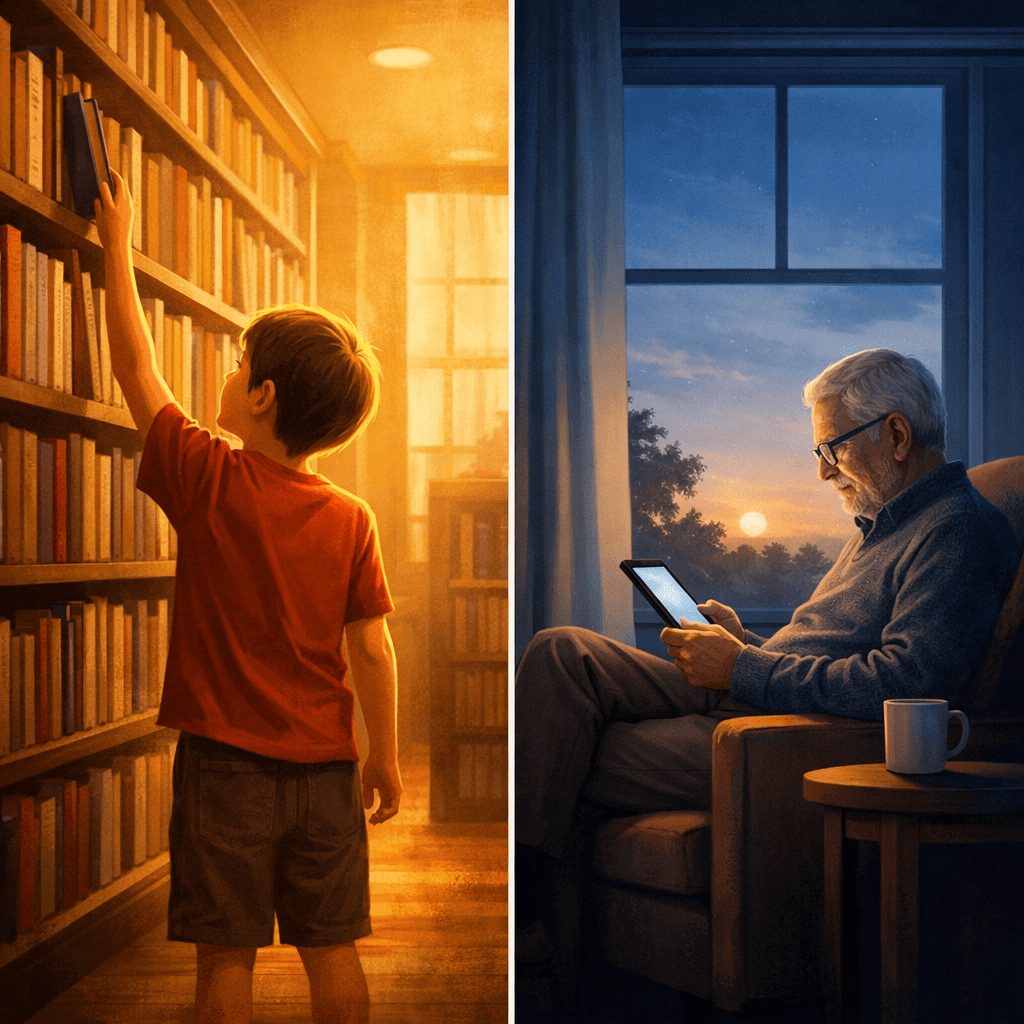
That feels especially strange when I think back to being ten or eleven years old, roaming the Pennsauken Library in search of the next Hardy Boys, Tom Swift, or Chip Hilton book. I wish I had even a quarter of the excitement I felt then—the sense of urgency, discovery, and possibility that came with finding the next volume in a series. Reading was once a small, private adventure that somehow felt enormous.
At seventy-three, reading is harder in ways that have nothing to do with motivation. My mind doesn’t focus for long stretches. My eyes tire quickly. Cataracts and floaters dull the sharpness of the page. And beyond the physical changes, there’s the persistent feeling that many books now trigger: been there, done that. As one gets older, interest naturally drains from subjects that once felt endlessly compelling—politics, sports, business, self-improvement, psychology, religion. Not because they don’t matter, but because their patterns repeat.
There’s also the sense that books—especially those about current events, politics, or celebrities—have lost some of their gravity. So much of their content is given away in advance through interviews, podcasts, op-eds, and promotional appearances that the book itself feels like an afterthought, a bound summary of things already half-known.
And yet, despite all of this, I keep reading. Maybe not with the hunger of a child or the ambition of a younger adult, but with a quieter persistence. The library card still works. The Kindle still lights up. And every now and then, a book manages to cut through the fatigue and familiarity, reminding me why reading mattered in the first place—and why it still does, even now.
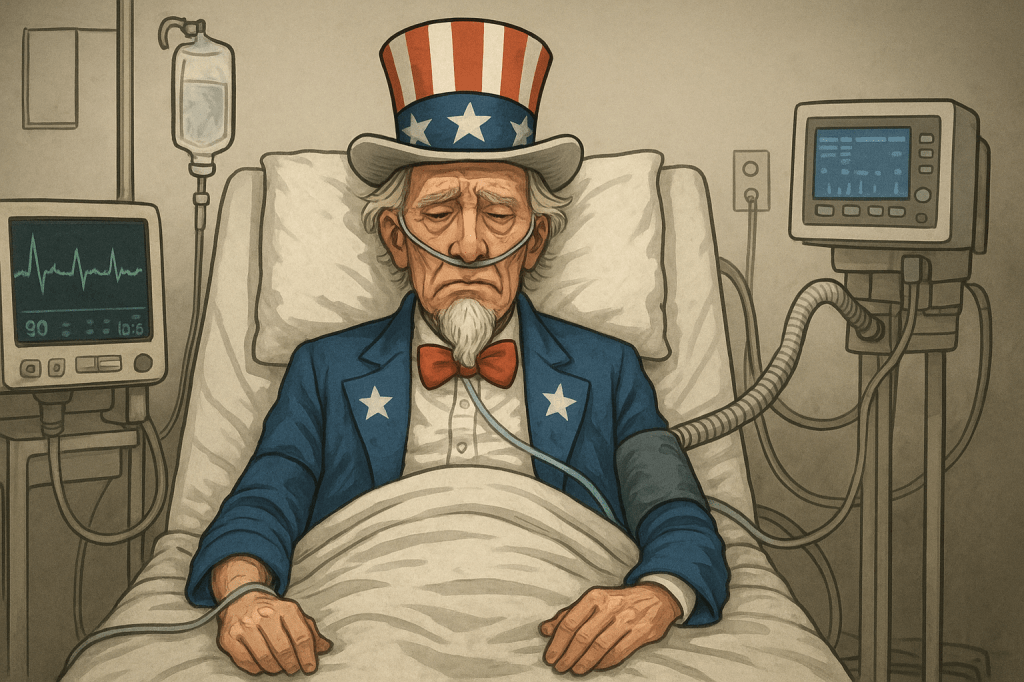
Patient Name: Uncle Sam Age: 249 years Date of Birth: July 4, 1776 Location: United States of America
Chief Complaint:
Progressive systemic decline characterized by political arrhythmia, social inflammation, moral neuropathy, and chronic division.
Medical History:
Patient presents with metastatic ideological cancer, first detected in 2017 following years of untreated inflammation from greed, corruption, and truth decay. A brief remission was noted, but malignancy has since spread to vital organs including the Judicial System, Congress, and National Conscience.
Patient also suffers from acute historical amnesia, with repeated lapses in memory regarding equal rights, freedom of the press, and separation of church and state. Increasing episodes of selective recall noted, often triggered by political self-interest and social media exposure.
In 2020, the patient contracted COVID-19, complicated by political co-infection. Though vaccinated, his recovery was hampered by widespread disinformation and refusal among many cells to follow treatment protocols. Residual scarring remains in the respiratory and trust systems.
Patient also exhibits chronic income disparity, hypertension of hostility, and arteriosclerosis of empathy, limiting blood flow to compassion and understanding.
Psychiatric History:
Patient demonstrates paranoid delusions, convinced that enemies lurk within rather than abroad. Displays mood instability, alternating between manic displays of nationalism and depressive bouts of self-loathing.
Once socially active, the patient is now increasingly isolated from former allies and global partners. Exhibits projection, blaming others for self-inflicted wounds.
Recent assessments reveal addiction to misinformation and dopamine dependency on outrage-based media. Sleep cycle disrupted due to 24-hour news exposure and endless campaigning.
Family History:
Descended from immigrants, now expresses hostility toward relatives of similar lineage. Strained relationship with younger generations due to generational and cultural disconnect.
Current Medications:
Denial (high dosage)
Partisan rhetoric (administered hourly)
Corporate lobbying (self-prescribed)
Occasional dose of hope and activism, though compliance inconsistent
Vital Signs:
Pulse: Erratic (divided between left and right chambers)
Blood Pressure: Elevated due to constant internal conflict
Temperature: Rising globally
Vision: Impaired by polarization
Hearing: Selective—responds mainly to echo chambers
Heart: Enlarged historically, now showing signs of hardening
Prognosis:
Guarded to poor. Survival depends on:
Aggressive treatment of ideological malignancy
Coronary transplant (restore compassion and moral circulation)
Rehabilitation therapy to strengthen backbone and restore balance
Cognitive behavioral therapy to reverse chronic denial and historical amnesia
Detoxification from greed, fear, and misinformation
Long-term infusion of education, empathy, and critical thinking
Summary:
Patient remains in critical but not terminal condition. Though his immune system of democracy is weakened, the antibodies of truth, courage, and civic duty still circulate—albeit faintly. Immediate intervention is required to prevent full organ failure of the Republic.
At 73, this Labor Day weekend makes me wonder: How many summers do I have left?
I don’t miss the heat or humidity of summer. I miss the sunlight—the early sunrises, the lingering evenings. A metaphor, perhaps, for life’s stages.
Leisure reading is fading. Only 16% of Americans read regularly for pleasure—down from 28% in 2003. In the UK, just 41% of parents read daily to toddlers, compared with 64% in 2012.
I wandered into a Barnes & Noble last week, my first visit in over a year. Chairs and cozy nooks were gone—B&N is all business now. I left without a book. Even their sale couldn’t entice me; I balk at paying more than $20 for a hardcover.
On my nightstand:
King of Kings: The Iranian Revolution—A Story of Hubris, Delusion and Catastrophic Miscalculation by Scott Anderson
Miracles and Wonder: The Historical Mystery of Jesus by Elaine Pagels
Haruki Murakami once wrote:
“If you only read the books that everyone else is reading, you can only think what everyone else is thinking.”
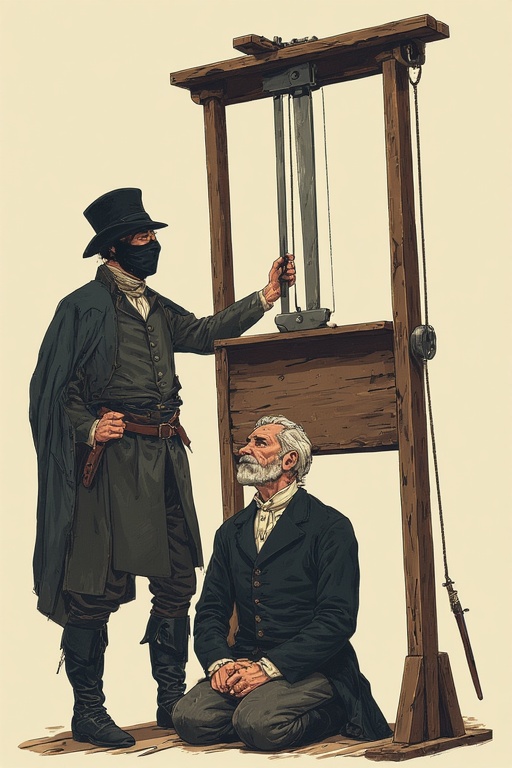
Mortality hovers. I don’t fear death, but I do fear dying. Sometimes I feel like a man with his head beneath a guillotine, staring at the blade. I’ve been fortunate with health, but around me I see friends whose luck has run out. The blade will fall on me too.
Meanwhile, the U.S. falters. Ineptitude, cowardice, hubris—displayed daily. A recent New York Times photo showed India’s Modi with Putin and Xi, a tableau of shifting power. It captured the failure of American diplomacy and leadership. One man bears much of the blame: Donald Trump. As summer declines, so does America as it retreats further into the darkness.