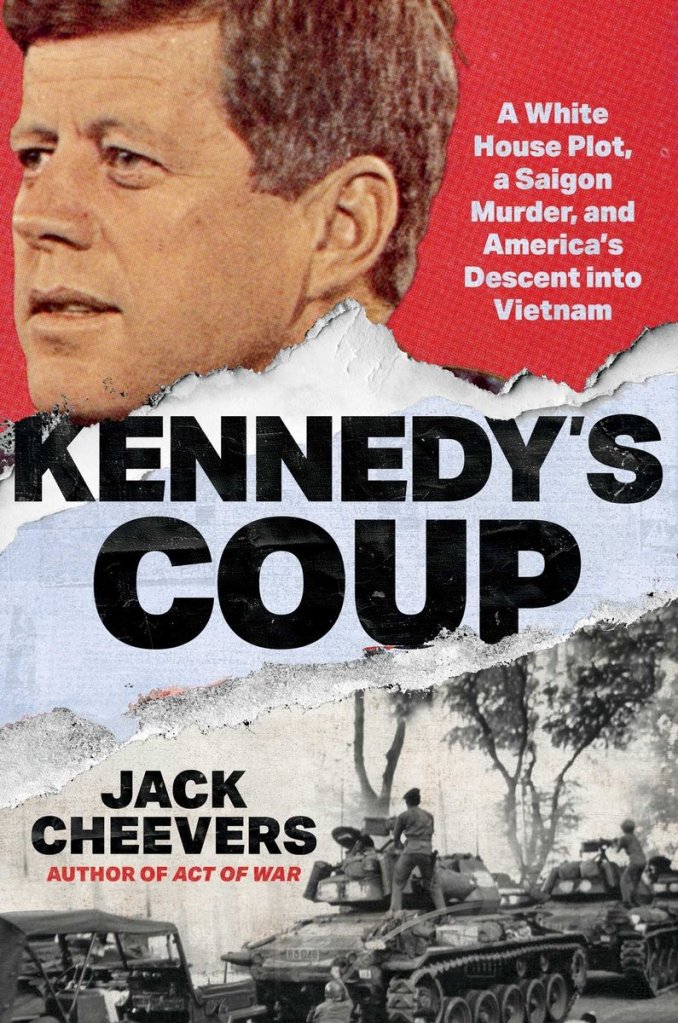
Review of Kennedy’s Coup: A White House Plot, a Saigon Murder, and America’s Descent into Vietnam by Jack Cheevers

This is the best book I have read this year. Although it is more than 600 pages long, it was a surprisingly quick and engaging read because the stories and characters are so compelling. Rather than feeling like a dry history text about the origins of the Vietnam War, it reads more like a well-crafted historical novel.
Eight Observations

  1. The Role of Journalists The book highlights the remarkable influence and adventures of journalists such as David Halberstam, Malcolm Browne, and Neil Sheehan. They took significant professional and personal risks to uncover and report what was actually happening in Vietnam, often in the face of official denials and misinformation.
  2. Failures of American Intelligence The CIA and other intelligence agencies repeatedly failed to adequately understand the political, cultural, and social turmoil unfolding in Vietnam. Their reports often painted an overly optimistic picture that differed sharply from realities on the ground.
  3. Corruption Within the Diem Regime The extraordinary corruption of President Ngo Dinh Diem, his brother Ngo Dinh Nhu, and Madame Nhu is thoroughly documented. The book raises troubling questions about why the United States tolerated and supported this regime for so many years.
  4. Kennedy’s Information Problem President Kennedy struggled to obtain reliable information about events in Vietnam. Conflicting reports came from intelligence agencies, military leaders, cabinet members, journalists, and members of Congress returning from fact-finding trips.
  5. A Turning Point in American Policy According to the book, Kennedy intended to reduce American military involvement and foreign aid following his anticipated reelection in 1964. After Kennedy’s assassination, Lyndon Johnson chose a different path, eventually committing large numbers of American troops to Vietnam. The result was a war that claimed the lives of 58,220 Americans and left more than 300,000 wounded.
  6. A Pattern of Deception The book documents a steady stream of exaggerations, misleading statements, and outright falsehoods from the Diem government, military officials, diplomats, and various so-called experts. These distortions made it difficult for policymakers to make informed decisions.
  7. Misjudging the Enemy One of the recurring themes is the failure of American leaders to anticipate how their adversaries would react. Despite overwhelming military superiority, the United States consistently underestimated the determination, adaptability, and long-term strategy of its opponents.
  8. The Consequences of Regime Change The overthrow of Diem is presented as a critical mistake. American policymakers failed to consider what would follow his removal, and there was no obvious or widely supported successor capable of providing stable leadership.

Jack Cheevers has written a deeply researched and highly readable account of one of the most consequential foreign-policy failures in American history. For readers interested in Vietnam, the Kennedy presidency, Cold War politics, or the dangers of flawed intelligence and political miscalculation, this book is highly recommended.

An Unfinished Love Story: A Personal History of the 1960s by Doris Kearns Goodwin (Review)

My rating: 5 of 5 stars

Memoir…history…love story… Prior to reading this book, I was vaguely aware of the name, Richard Goodwin, and his involvement in politics and in the Kennedy and Johnson administrations. I was not aware of his specific roles. as it turns out, he was a man of certain influence working for both John F, Kennedy and Lyndon Johnson. Turns out he was a great speechwriter, wordsmith and political strategist. He was described as a “generalist”, a man who could fill a lot of roles and responsibilities.

Growing up in the 60s, I, of course, was interested in the nostalgic trip during that decade. Goodwin was a huge fan of the Kennedys. This created significant issues when he worked for Lyndon Johnson. Goodwin was involved to a certain degree in the discussions around civil rights, Vietnam, the Great Society etc.

Based on the book, it seems that Goodwin did not receive the credit he should’ve gotten for his effective communication of both JFK’s and LBJ’s’s policies and goals. Goodwin seem to find himself in hot water, often inadvertently, with people he worked for. In 1968 Goodwin worked for Eugene McCarthy, prior to RFK’s entry into the presidential race. Goodwin had quite a balancing act and at the same time, he did not wish to undermine the policies of Lyndon Johnson.

Doris Kearns Goodwin is an excellent writer. I have seen her on new shows on television where she is a thoughtful and effective communicator. This is an excellent book. If a reader has an interest in 1960’s history, politics or wishes to know more about the Kennedy and Johnson administrations, this book is an excellent resource.

Dick Goodwin had an interesting career and he seems motivated to achieve as much good as he could in the various roles he had in government. This is definitely a five star book!

View all my reviews

Thoughts from the Bunker

As I write, I am reading stories of people unable to get needed medical care. A 73 year old woman has been sitting in a chair for over 29 hours with a high fever, coughing and experiencing breathing issues in  a New York City hospital emergency room. Hospitals are overrun with patients like her and do not have the beds and staff to help her.

At 67, I can’t promise wisdom but I can offer perspective and a little history. I remember times before computers, cell phones, the Internet, 24 hour news, cable TV and e-books. Back in 1960s, our biggest fear was an atomic war with Russia. School children endured air raid drills which was basically huddling under your desk and closing your eyes. I wax nostalgic as I now huddle at home and my worry is not radiation from an atomic bomb from Russia but catching a virus from China. Unfortunately this is not a drill and casualties are rising every day.

In 1960, I remember a young President who suffered some early growing pains like The Bay of Pigs fiasco in Cuba but grew steadily competent in the job. Even though I was only 10 at the time of the Cuban Missile crisis, I understood how his leadership and good judgment pulled us out of a major nuclear confrontation. He was assisted by a number of very smart people like his brother, Bobby Kennedy. Donald Trump is now being assisted by his inept son-in law Jarrod Kushner, who inspires as much confidence as Barney Fife in a fire fight. From JFK to Trump, how did this country deteriorate this fast in sixty years!

How did we slide downwards from a President who pushed this country to land a man on the moon by the end of the decade (and succeeded) to one whose major campaign promise (other than a tax cut for the rich) was to build an ineffective wall? Kennedy’s program landed astronauts on a target 238,900 miles away. Trump can’t deliver masks, breath equipment and other needed medical supplies to a battered New York City 225 miles to his north.

In our current crisis, we have a President more concerned about his television ratings than the number of people suffering and dying from coronavirus. His press conferences are replete with self praise, false information and dangerous life and death advice that his medical experts are forced to quickly disavow. He uses press conferences as replacements for his public campaign appearances in front of fawning audiences. At a recent news conference, he had a pillows huckster lecture the press instead of using the time to have a doctor or scientist provide guidance to a fearful public. Trump describes himself as a “war time President.” Trump is, like Mussolini.

Though Trump has garnered and deserved most of my ire, there are also too many in the public disregarding social isolation guidelines. Maybe if they can imagine themselves, their parent or other loved ones in a desperate plight like the 73 year old woman above, maybe they will act responsibility and Americans can start to move out of their self imposed bunkers and into the Spring sunshine.