Book Review of 1929: Inside the Greatest Crash in Wall Street History – and How It Shattered a Nation by Andrew Ross Sorkin

I’ve been an admirer of Andrew Ross Sorkin’s financial reporting for years, particularly through his work on CNBC, and I previously enjoyed his book Too Big to Fail, a definitive account of the 2008–2009 financial crisis. With that bias admitted upfront, I found 1929 to be an engaging and illuminating read. Though the book is lengthy—about 444 pages—it never feels like a dry history textbook. Instead, it flows with the narrative tension of a novel, making complex financial events accessible and compelling.

A background or interest in finance, economics, or banking certainly enriches the reading experience, but Sorkin’s storytelling makes the material approachable even for those who aren’t steeped in economic jargon.

A Rich, Relevant History

What makes this book especially resonant is how closely the late 1920s echo aspects of our present moment. The U.S. had recently emerged from a pandemic; optimism about growth and technological change was widespread; and the stock market appeared unstoppable. Investors—large and small—took on unprecedented leverage, borrowing heavily to chase rising share prices.

But economic momentum is fragile. Once confidence cracked, the market’s collapse was swift and devastating. The crash wiped out fortunes, triggered a steep economic downturn, and led to widespread unemployment. The government and the Federal Reserve lacked a clear or unified strategy, and their responses were often reactive, hesitant, or contradictory.

Sorkin offers a nuanced view of Herbert Hoover, depicting him not as the caricature of incompetence found in some earlier accounts, but as a leader who recognized the depth of the crisis and attempted—albeit imperfectly—to stem the damage. It’s a more sympathetic portrait than many readers might expect.

Vivid Personalities and Power Players

The book is populated with fascinating figures from finance, government and politics, including:

  • Charles Mitchell, chairman and CEO of National City Bank (a central figure in the era’s excessive speculation)
  • Winston Churchill
  • Franklin Delano Roosevelt
  • Senator Carter Glass
  • Evangeline Adams
  • Herbert Hoover
  • Ferdinand Pecora
  • and many others

Sorkin demonstrates how the interplay of personalities, policies, and economic forces created the conditions for both the boom and the crash. His research is broad, and his interpretations are measured yet insightful.


Reflections on Today’s Economy

Reading about 1929 inevitably led me to think about the state of the economy today. Although history doesn’t repeat itself exactly, the parallels are difficult to ignore.

  • Policy and leadership concerns: I have deep concerns about the current administration’s economic management. Policies such as tariffs continue to ripple through the U.S. and global economies, often harming consumers and industries rather than helping them.
  • Social and economic inequities: Decisions to cut or withhold food aid and other social supports can create long-lasting harm. Tax structures continue to favor the wealthy, while those with the least must rely on charity to meet basic needs.
  • Economic data skepticism: I find it increasingly hard to trust official numbers—whether on inflation, unemployment, or growth—given how politicized and selectively interpreted economic data has become.
  • Uncertain impact of AI: Artificial intelligence is propping up portions of the stock market, but the long-term effects on employment, productivity, and corporate earnings remain unclear. Few leaders or analysts can articulate what the next decade will really look like if the hype fizzles.
  • Declining trust in corporate leadership: Watching CEOs—particularly in tech and finance—publicly defer to political power has shaken my confidence in their judgment. Elon Musk is the most visible example, but he is not alone.
  • The culture of greed: Increasingly, it feels as if greed has become our national creed. Even institutions that purport to offer moral guidance seem more interested in fundraising than fostering compassion or community.
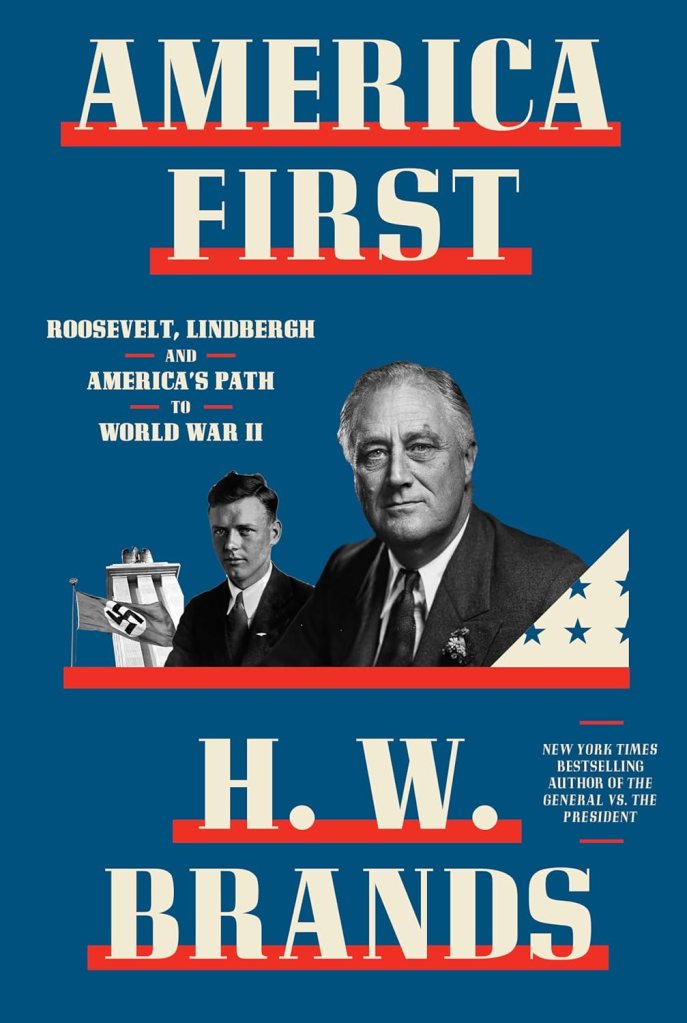
America First: Roosevelt vs. Lindbergh in the Shadow of War by H.W. Brands (Review)


My rating: 4 of 5 stars


On September 1, 1939, fighting broke out in Europe. After the invasion of Poland by Germany, both France and England declared war against the Nazis. Many, if not most Americans, were resistant to participating in a European war. Indeed, there was resistance to even supplying military supplies and other goods to Britain while they basically fought Germany on their own. There was also significant support for the Germany and Hitler’s regime at this time.

Franklin D. Roosevelt managed a fine line. He wished to be re-elected for a third term, but he also understood that Hitler’s goals were not only the conquest of Europe, but world conquest. Charles Lindbergh was an American hero for his exploits about flying across the Atlantic on his own. He and his wife Anne endured the kidnapping and murder of his son in 1932 and this endeared him more to the American public.

Lindbergh opposed US involvement in any war overseas. Lindbergh felt that America was invincible as it was protected by oceans and not vulnerable to air attacks. Lindbergh saw no reason for America to sacrifice its sons in European wars and spoke out strongly against any intervention.

How FDR positioned the United States to prepare for World War II is an interesting story of great judgment and leadership. FDR coordinated closely with Winston Churchill to ensure that Britain had the necessary weapons and materials to survive German assaults. Roosevelt had to skillfully maneuver his aid to Churchill under the watchful eye and some time opposition of a reluctant Congress.

Charles Lindbergh was accused of being an agent and dupe of the German government. There seems to be a little evidence of that. Lindbergh firmly believed that United States could stand on its own and ably defend itself against any foreign attack or invasion. Circumstances and events proved that Lindburgh was incorrect in his analysis but he did volunteer to help the military in any capacity once United States entered the war.

Today there are isolationist policies still being supported. There are many Americans and people in Congress, who do not feel that we should be supporting Ukraine in its battle against Russia and Putin. Are they guilty of being short sighted too? There are some interesting historical similarities there.

This book was well researched and an excellent read. It quotes from Lindbergh’s diaries and provides a good measure of the man and his ambitions. I think that Lindbergh was largely circumspect and responsible in his criticism over American foreign policy. FDR happened to be right in his judgement about Hitler and America’s role in stopping tyranny.


Clearing My Mental Cache (Part 3)

My Top 12 SNL skits:

  1. Alec Baldwin as Donald Trump
  2. Celebrity Jeopardy with Will Ferrell as Alex Trebek, Darrell Hammond as Sean Connery, Norm McDonald as Burt Reynolds
  3. Mr. Robinson’s neighborhood with Eddie Murphy
  4. Close Encounters/Paranormal skits with Kate McKinnon and Cecily Strong
  5. Tina Fey as Sarah Palin
  6. Word Association (1975) with Richard Pryor and Chevy Chase
  7. Meet your Second Wife with Tina Fey and Amy Poehler
  8. Taran Killam as Jebediah Atkinson (cultural and political critic)
  9. Dan Aykroyd and Jane Curtin Point/counterpoint (“Jane, you ignorant slut”)
  10. More Cowbell (Will Ferrell and Christopher Walken
  11. Toonces the Cat with Steve Martin and Victoria Jackson
  12. The Continental (Christopher Walken)

****

I would not be shocked if the winner of the next Presidential election is not determined by voters but by the military.

****

Why does the re-opening of MLB, NBA and NHL along with the proposed start of NFL football seem like the start of an extended exhibition season for all sports? Does Las Vegas have an over/under of how many games each sport will have before they are forced to close down?

****

Donald Trump may not have airports, government buildings or ships named after him as he leaves office but there will be wings of libraries stocked with shelves of books written about him and his presidency. Forget books written by those who worked with Trump or are historians, teachers and news analysts. The most incisive and reveling book will come from his third and recently divorced wife, Melania.

****

Pornography is now better regulated on the internet than political propaganda and is often less obscene. (So I hear)

****

What is more dangerous? Not wearing a mask in a crowded bar or being an attractive female working at Fox News?

****

Capitalism-an economic and political system in which a country’s trade and industry are controlled by private owners for profit, rather than by the state. Can someone explain to me how we are a capitalist economy when the Federal Reserve is propping up the stock market with zero interest rates, while billionaires, large corporations and certain “churches” are receiving financial handouts even though many do not need the money?

****

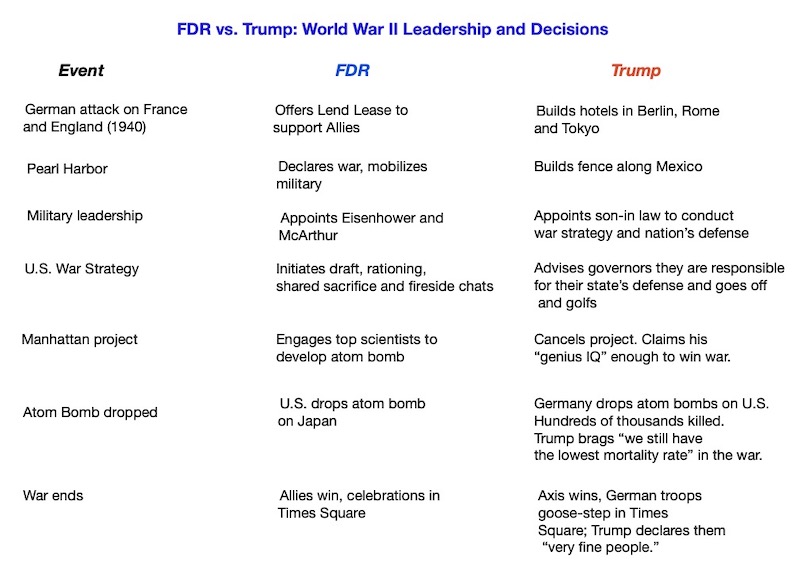
There has already been a lot of discussion about Trump’s presidency relative to his standing with that of his predecessors. Trump, himself feels a kinship to Abraham Lincoln. I decided to take a historical scenario and based on how Trump has handled current crises and project how he would have handled a crisis in the past. I am comparing how FDR actually handled events in WWII to how Trump may have handled them. (Depending on your point of view, you may think my comparison an amusing parody or you may think, “Yeah, you got it right.”)

FDR vs Trump


How to Reason with a Die Hard Trumpster

You can’t.

I am somewhat sympathetic to those Never Trumpsters who try on social media, news show, tweets, Facebook posts or in private conversations to convert their family, friends, fellow employees or others to convert from the Darkside. I sense your frustration but you are largely doomed to failure. Unless you can magically transform yourself into a Fox talk show host wearing a flag pin and/or the obligatory crucifixion on a cross, your message will not get through.

Now you could try various arguments to convince a Trumpster that DJT is incompetent, ineffective or worse. For example, you could point out that our self professed “war president” has inflicted over 433,000 casualties on his troops and over 14,000 deaths (as of 4-8-20) by his refusal to act over warnings provided by members of his own administration. Regrettably the numbers will become much larger. You might also point out that our “war president” has sent many of his troops out to war without the necessary armament and protection that they need to stay alive. Doctors, nurses and other medical personnel have treated coronavirus patients without the adequate protections of masks, gloves and protective gear. Not surprisingly many of these front line soldiers are being infected and some have died. Imagine FDR before committing troops to Guadalcanal in World War II sending soldiers out without rifles, helmets and and other needed armaments to fight a battle. Or imagine FDR saying that the nation’s governors, not he, have the responsibility to ensure that our frontline soldiers are provided adequate gear. You could point out that our self professed “war president” measures his success in this war by his television ratings from his daily banal news conferences, how the stock market goes up in a given day or if he can keep deaths below a certain projected number. For him that’s “winning.”

Convincing argument? Not to the Trumpster!

You could change your strategy and suggest that the overall economy will probably not recover under DJT. There are no magic bullets left to combat a deep recession much less a potential depression. At Trump’s insistence, interest rates are already near zero. Many companies took advantage of the low interest rates to borrow but now they are over-leveraged and unable to pay. Regrettably this is also the fate of many American consumers. Businesses can’t pay their rents, consumers can’t pay their rents so the mortgages supporting these properties can’t be paid either. Delinquencies rise and banks begin to suffer. Credit markets close suffocating the abilities of mostly small businesses to recover. Trump does not have a record of success in bringing back failing companies or industries. (USFL, Trump University, Trump casino’s etc.) The government does not have the luxuries of defaulting or declaring bankruptcy. The Chinese have outmaneuvered him on trade talks and are becoming closer financial partners with our once friendly allies.

Convincing argument? Again, not to the Trumpster!

You might offer as an argument the horrendous chaos, lies, inabilities to deliver on promises, senseless fights with the press, rampant corruption and mediocre appointees that pervade the Trump administration. When you take time in a news conference in a middle of  national health crisis to bring up a pillow huckster pumping the Bible and prayer instead of Dr. Fauci offering science and possible solutions, you have demonstrated that you have no feel for the moment. When a reporter provided the President an opportunity to address Americans who were fearful and needed reassurance, Trump lambasted the reporter. FDR provided soothing Fireside Chats for Americans suffering through depression and war. Trump promotes his sagging re-election campaign to those who have not tuned out his meandering news conferences replete with misinformation on coronavirus treatments, testing capabilities and actual results.

Convincing arguments? Again, not to the Trumpster, but to everyone else who wants to see this nation and its citizens become healthy, economically secure and whole again, they are.

Ruminations in Social Isolation

Just about every idea, plan, opinion, prediction, projection, analysis, budget, wish, timeline, piece of advice and future consideration that was made a month ago (or even yesterday) is no longer relevant.

For years anti-terrorist experts were concerned about the destruction and deaths associated with a dirty bomb being exploded in a major city like New York. Not sure anyone envisioned how much more destructive and deadly the coronavirus is compared to a dirty bomb.

The fleet at Pearl Harbor in 1941 was more prepared than we are today. At least the country had FDR in 1941 for leadership, today we have Trump. For point of comparison, listen to FDR’s speech to Congress declaring war on Japan and Trump’s feeble speech from the Oval Office on the coronavirus outbreak.

How useless is money when there is nowhere to spend it and with the exceptions of food and other household necessities, no compelling rationale to buy anything?

The wise are focused on their health, families and friends. Fools are worried about their portfolios.

Does anyone else other than me find it macabre that Wall St analysts and other investors rejoice when the Dow swings upward at the same time deaths climb exponentially?

Doctors, nurses, grocery clerks, truckers, assembly workers, mail carriers and others have been drafted into a war they did not seek. Facing an invisible enemy in a front line of a battle, they are susceptible to experiencing the most casualties.

When will we start seeing ads on TV from lawyers soliciting lawsuits for coronavirus treatments and testing?

I can appreciate the prayers of the faithful asking God to help the sick recover from coronavirus and to protect doctors and nurses. But if God is all Good and Loving, shouldn’t He/She have spared tens of millions from infection and millions from death and destitution?