
I will not be alive when historians begin to write definitively about the United States during the Trump era. In truth, I would much rather read about it twenty years after it has ended than live through it as it unfolds. Standing in 2026, I find myself trying to imagine what scholars in 2046 might identify as the defining themes, causes, and consequences of this period. I have no time machine—only conjecture.
My assumption is that the central question historians will grapple with is not simply who Donald Trump was, but how and why American voters enabled the Trump era to occur. Inevitably, comparisons will be drawn to other moments in history when democratic systems elevated leaders who later proved deeply polarizing or destructive. Germany in the 1930s will be one such reference point, though careful historians will also emphasize key differences: Germany’s economic collapse, political fragility, and social despair far exceeded conditions in the United States in 2016.
Several lines of inquiry seem likely to dominate future assessments:
- Congressional Enablers
Trump’s support did not emerge in isolation. Historians will likely examine the role of Republican members of Congress who, with few exceptions, aligned themselves with Trump despite repeated controversies, ethical questions, and institutional challenges. Whether motivated by ideology, fear of political retaliation, or electoral self-preservation, their collective restraint—or lack of resistance—will invite comparison with earlier moments when legislators faced tests of independence and conscience, including those explored in John F. Kennedy’s Profiles in Courage. - The Supreme Court and the Long View
A twenty-year gap may provide a more balanced framework for evaluating the Trump-era Supreme Court. With time, historians will be better positioned to assess whether the Court’s decisions strengthened constitutional principles, reshaped social norms, or produced unintended consequences that only became visible over decades. - Corporate Power and Quiet Support
Many business leaders offered tacit or indirect support for Trump’s agenda, particularly where deregulation and tax policy aligned with their interests. Future researchers will likely scrutinize financial records, lobbying efforts, and private communications to better understand the extent to which economic power influenced public policy—details that were not always transparent in real time. - The Press and the Meaning of Truth
The so-called mainstream press positioned itself largely in opposition to Trump, yet it did so while facing financial decline and growing competition from social media platforms. One enduring issue of the era was the erosion of shared definitions of “truth” and “fact.” Even well-sourced reporting was frequently dismissed as “fake news,” raising long-term questions about public trust, epistemology, and the role of journalism in a fragmented media environment. - Ideological Media and Political Identity
Conservative media outlets—most notably Fox News, along with a network of right-leaning digital platforms—played a significant role in shaping how events were interpreted by audiences seeking reinforcement of political and cultural identities. Historians may study this ecosystem as a case study in modern persuasion, examining how narrative repetition, grievance framing, and selective information proved highly effective. - Immigration Enforcement and Historical Comparison
Immigration policy and enforcement will remain one of the most contested aspects of the Trump era. Some commentators drew historical parallels to authoritarian practices of the past, while others argued such comparisons were exaggerated or inappropriate. With the benefit of distance, historians will likely focus on legality, implementation, humanitarian impact, and rhetoric—allowing future generations to judge the fairness and proportionality of those comparisons.
History rarely delivers simple verdicts. It weighs context, consequences, and contradictions. When the Trump era is finally written about with the benefit of time and distance, the most enduring lesson may not center on one man alone, but on the resilience—or fragility—of democratic institutions and the citizens who sustain them.
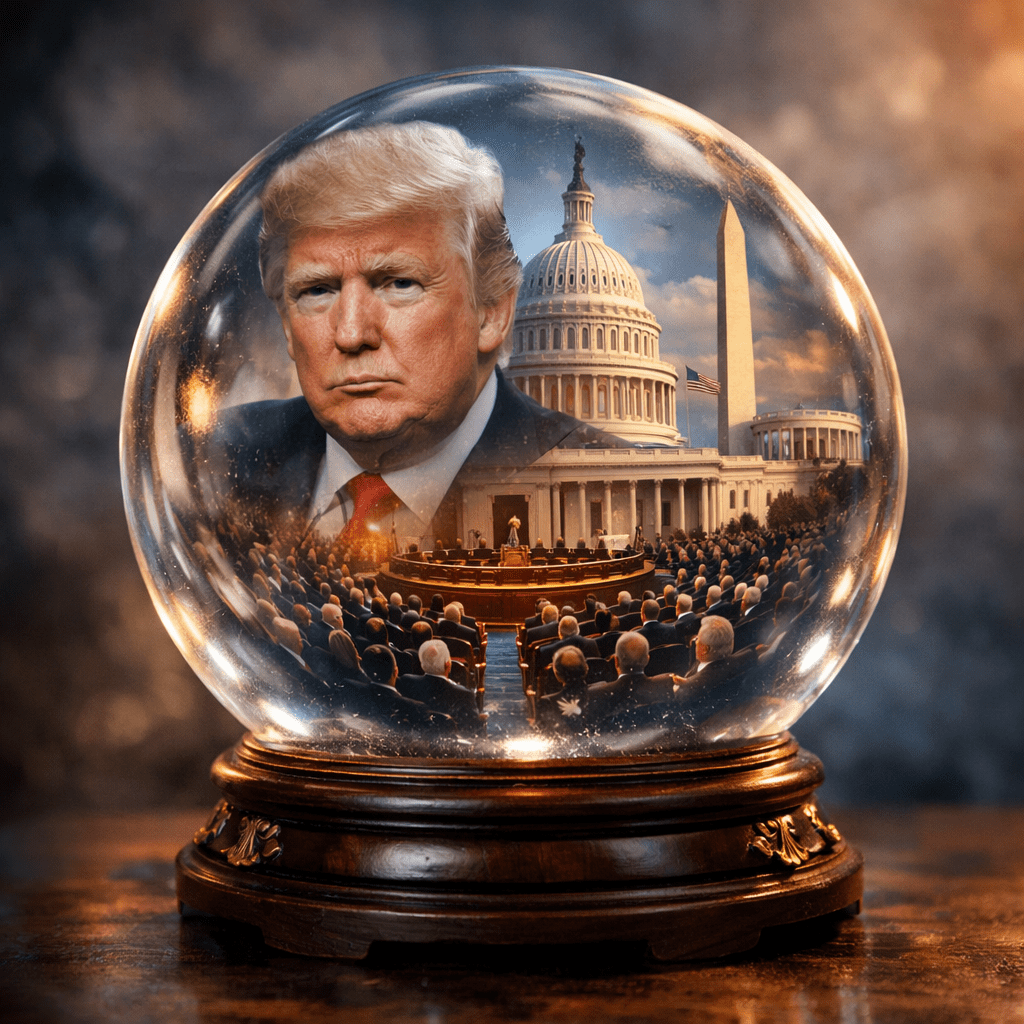
Image by Chat GPT; content by EAB
 Esot-eric
I’ll be long gone as well and I wonder will we all really be here in 2046, considering climate change and the state of the world right now and the danger, as long as the Republicans are in control, there may be no history in 2046.
And even if there’s lots of study, books, written essays renown history professors teaching about it, vowing all this will never happen again, we all know it will, in some form or another. Humans appear to be very gullible and easily swayed, especially if it affects their own personal prejudices, of which there are many.
Power corrupts and absolute power corrupts absolutely. This is an age old story that will only change if our brains were to evolve, which is doubtful.
LikeLike