
In just about any time in American history, this type of story would end a presidency and anyone involved in this disgusting treatment of American sailors would be investigated, indicted, and removed from office. We have become so inured to incredible imcompetence that not even a story of this magnitude makes a dent in the American psyche.
Tag: Trump
Troubled Waters
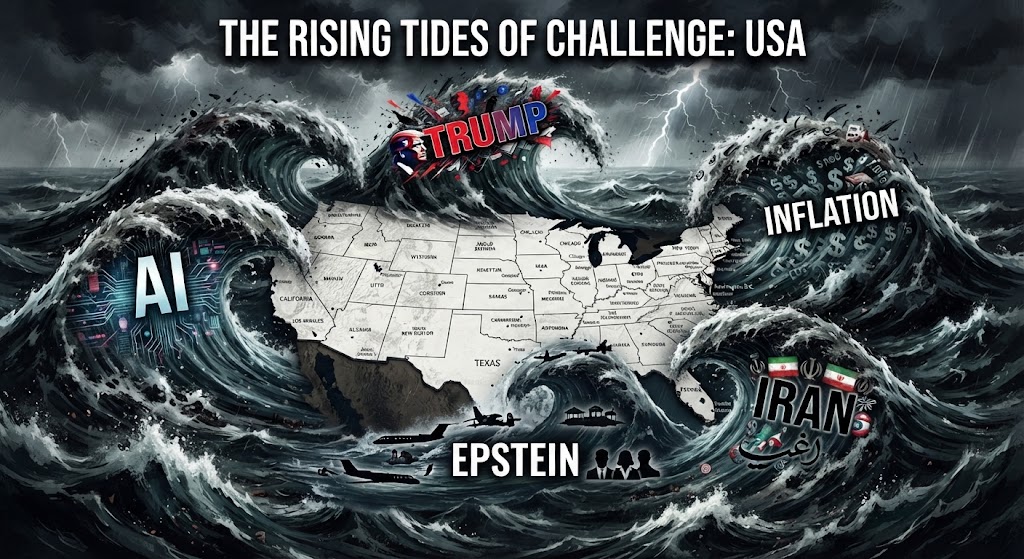
For the last two weeks, I was on a cruise ship, traveling the rather calm waters of the North Atlantic and the St. Lawrence River. However, back home, I continued to see the deleterious effects of the tsunami that is Trump.
I spoke to a few Canadians on the cruise who asked me: “How is Donald Trump still president? And how did you Americans allow—and keep allowing—Trump to be president?”
As one travels through Canada, one senses a certain civility and calmness among the population, seemingly satisfied with its leadership, culture and government.
Normalcy!
I’d be hard-pressed to think of many Republicans who deserve to be reelected—or elected in the first place—particularly in the House of Representatives. As far as I am concerned, most of them are cowards.
I don’t believe in the polls. I have been sorely disappointed by what I expected in 2016 and 2024. The only way I will be happy with the results of the 2026 elections is if the Democrats control both the House and the Senate. I am not sure that this will necessarily save the state of our union, but maybe it will at least limit the clown show currently performing.
I’m pretty sure that the last chance to save the country occurred in November 2024. So much damage has been done, and much of it may be unrecoverable—especially when it comes to the trust we once had with our allies and neighbors.
That’s gone for decades!
I’m stunned that Darline Graham, Lindsey Graham’s sister and, in my opinion, one of the least capable candidates for elective office, is leading in the polls for the South Carolina Senate race. Yeah, I know. It’s South Carolina!
It’s also concerning that James Talarico does not have a 20-point lead in the Texas Senate race over Ken Paxton.
Yeah, I know. It’s Texas!
I’m still waiting for the press to make a demonstrable stand against the White House—and, in particular, against the administration’s exclusion of CNN, Politico and MS NOW from the White House. Trump announced on September 18 that he was banning the three organizations from the White House, and the following day reporters from all three were denied access, with press credentials being deactivated or confiscated.
Just to be spiteful, why don’t these news outlets document the many lies and false claims of the Trump administration? It’s probably a more useful exercise than actually covering stories from Trump or any of his Cabinet.
I’m not sure what they can do to limit appearances or interviews with Republican candidates or officials, but I would sure as hell make it very uncomfortable for any of them to come on those venues without having to answer questions about their views on freedom of the press.
I confess that I get most of my news from so-called liberal or mainstream media. Every now and then, I take a quick peek at Fox News. I don’t do it for long, as my brain cells begin to decline within minutes of listening to any of their news or programming.
One would think that a network that incurred millions of dollars in legal liabilities over its coverage of the 2020 election would have a little more humility.
A researcher from Anthropic recently warned that AI could destroy humanity by the end of the decade. Evan Hubinger, Anthropic’s alignment-science lead, said he personally believes there is a greater-than-10% chance that AI could kill all humans within the next decade.
I wish that the huge concern and apprehension about this possible event four years from now could somehow be translated into more immediate concern about how our inept president could create a lot of economic and financial damage within the next year.
Maybe four months.
Maybe four days?
In Hot Water
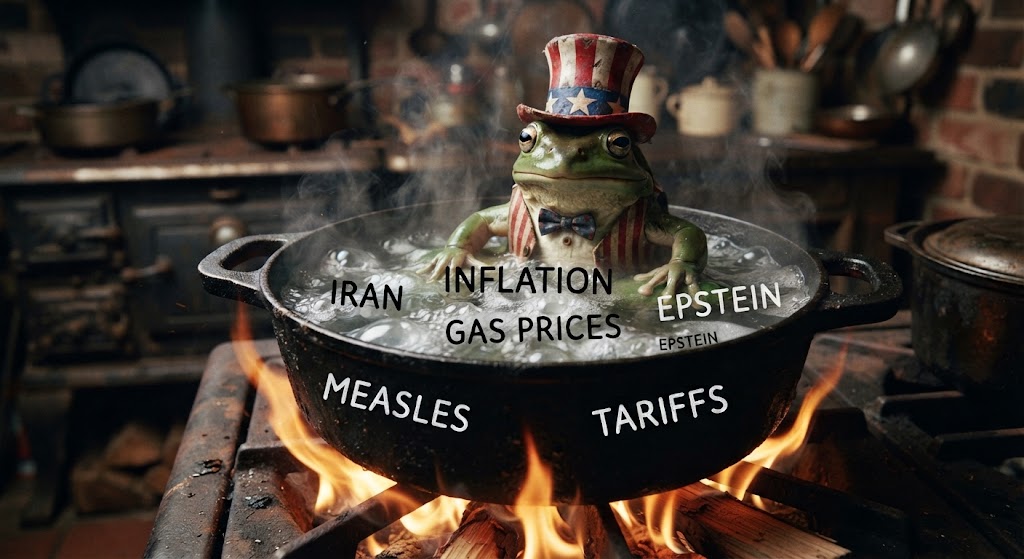
Many Americans, specifically most (?) Republican voters sit contently like frogs in boiling water. Trade war with our best ally, Canada? No problem! U.S. military running out of missiles and weapons? No problem! Americans unable to afford groceries, medication and buying gas? No problem! Measles outbreaks? No problem! American allies making new deals with China for trade and investments? No problem! Investors demanding increase in U.S. Treasury rates?No problem! American military bases in Middle East destroyed? No problem!
Ability of the Trump Administration and Congress to responsibly handle and resolve these issues: Huge problem!
Zibaldone
A zibaldone (plural zibaldoni) is an Italian word that translates to a “heap of things,” “hodgepodge,” or “miscellany.”
Couldn’t care less about Natalie Harp and what she does or doesn’t do for a doddering and feeble 80-year-old man. Just another distraction. I’m much more interested in knowing about the stories of possibly unwilling young women in Trump’s past. The failure to release the entire Epstein files and to conduct a full and transparent investigation will be viewed in history as one of the great moral and ethical failures of this time.
Way too early, but the best Democratic candidates in 2028 appear to be Senator Jon Ossoff of Georgia, former Secretary of Transportation Pete Buttigieg, Governor Gavin Newsom of California, and Mark Kelly of Arizona. While I am impressed with Jon Ossoff, I would lean toward Mark Kelly of Arizona as the best Democratic presidential candidate today. Best VP candidate could be Alexandria Ocasio-Cortez.
Way too early, but I don’t think there are any particularly attractive Republican candidates for president. I think J.D. Vance and Marco Rubio are going to sink to the bottom of the Trump Titanic fiasco. I can’t think of a Republican who has shown backbone, integrity, and good judgment during the Trump presidential administrations. Both Vance and Rubio were highly critical of Trump in the past, and now both bow to him on their knees.
Lindsey Graham’s sister, Darline, was endorsed by Trump for the South Carolina Republican Senate nomination. She is a deer in the headlights. She confessed during a recent debate that she was not familiar with national security issues, and then I realized that neither was her brother when he was in the Senate.
Is anyone remotely competent in the Trump administration and cabinet? Every day, and in every way, you see a variety of issues and problems being mismanaged. Hard to believe that Robert F. Kennedy Jr. still has his job. Astounding things that he says and believes…
So there could be a perfect storm brewing…
Rising Treasury rates as investors seek higher returns because U.S. credit is not as reliable as it once was. This could further spike inflation and make it harder to buy homes, cars, etc. In addition, I’m concerned about the prospects for AI. So much money is being invested. Could there be a correction just like there was with Internet stocks 25 or more years ago? A huge correction in the stock market would also have cataclysmic effects on retirement portfolios, personal finances, etc. Just as our military assets are being depleted, so may our financial assets in the very near future!
Every year I look forward to summer, and just about every year summer disappoints me. Too damn hot to enjoy being outside. Summer hibernation with air-conditioning.
Favorite Sports to Watch on TV
- College football
- Men’s college basketball
- NFL football
- Pickleball
- Philadelphia Phillies baseball
- NBA basketball
- WNBA basketball — only when Caitlin Clark plays
- Men’s professional tennis
- 1970s heavyweight boxing
Inventive Way to Win Iran War
According to various press reports, the United States military is running out of missiles and bombs. Just a suggestion, but why don’t we carpet bomb Iran with copies of Trump’s Art of the Deal book. I’m sure that we have a substantial inventory of those and if Iranian leaders read and follow the book, their unconditional surrender is guaranteed.

Some Thoughts… Without a Lot of Thought
The attacks on Dr. Fauci… I don’t get it.
Judging by some politicians—and one aging quarterback—you’d think Anthony Fauci invented the coronavirus.
Yes, his journals reveal a measure of ego and an appreciation for the spotlight. So what? In 2020 there were no easy answers. Scientists, physicians, and government leaders were navigating a once-in-a-century crisis with imperfect information.
What I remember is not a villain, but a calm and reassuring public figure trying to make sense of chaos.
The attacks on Caitlin Clark… I don’t get it.
She may not be the WNBA’s best player, but she is unquestionably its biggest attraction.
Clark has elevated television ratings, attendance, and public interest, yet she often seems to receive less respect than she has earned—from opposing players, league officials, and at times even her own organization.
From everything I’ve seen, she has handled herself with remarkable composure while avoiding needless controversy. Whatever one thinks of her game, the label “coward” is as absurd as it is undeserved.
How is Trump still president?
People lose their jobs every day for poor performance, erratic behavior, or simply failing to meet expectations. Yet somehow the presidency appears exempt from the standards applied to almost every other occupation.
Political arguments
I’ve largely stopped discussing politics, especially with committed Trump supporters.
The experience reminds me of trying to shoo flies out of the house. You wave them away, they circle back, and after a while you realize you’re wasting more energy than they are.
The Age of Incongruity
A preening president, smiling from an air-conditioned luxury box at the World Cup final, enjoys the spectacle while American soldiers in the Middle East sit exposed to incoming missiles and artillery. The contrast is jarring: comfort and applause for those at the top, danger and sacrifice for those at the bottom.
The incongruities multiply.
The Secretary of Health and Human Services, whose public profile has long overshadowed his scientific credentials, dispenses medical advice while Dr. Andrew Fauci—an 85-year-old physician and career public servant who helped lead the nation’s response to COVID-19 and other infectious disease threats—is hauled before congressional critics more interested in campaign clips than sober inquiry. Washington has become a theater where expertise is booed from the stage while confidence, however unearned, receives a standing ovation.
If you are Donald Trump, a member of his family, a political insider, or the CEO of a corporation eager to flatter the administration, the economy may look quite favorable. Outside that circle, the picture is less rosy. Families contend with expensive gasoline, rising food and health-care costs, and for some, the growing anxiety that an expanding conflict could one day place their sons and daughters in uniform.
According to recent polling, only about one-third of Americans support military action against Iran. Yet the machinery grinds on while Congress performs its favorite civic duty: watching. It occasionally stirs itself—not to confront the nation’s most pressing problems, but to stage another hearing destined to produce more fundraising emails than useful legislation.
The nation may eventually run short of fuel, but there is no danger of running short of hot air. Washington produces it in inexhaustible quantities. I remember the gasoline rationing of the 1970s. At the current pace, one wonders whether history is preparing an encore.
Nothing to “Crowe” About?
Band booed for shutting down ‘U.S.A.’ chant. ‘Don’t know what you have to be so proud of right now.’
Rock band The Black Crowes drew loud boos and fans left a recent concert after frontman Chris Robinson mocked audience members who started “U.S.A.” chants.
“Thanks for the geography lesson, I don’t know what you have to be so proud of right now,” Robinson told the crowd, according to reports.
When fans began booing, Robinson said, “For those of you f—ing booing us, some of us are not afraid, and we most assuredly are not f—ing ignorant, so thank you.
Gas prices can easily rise to over $6 per gallon in the next week or so as our oil reserves are at a very low level. Iran continues to pull the chains of Trump, Hegseth and Rubio in negotiations to end the war. The White House, between the UFC fight stage and the ballroom, looks like one of the deserted Atlantic City casino buildings Trump left by Steel Pier. Trump officials stonewall on Epstein files, Trump’s insider stock trades and proposed $1.8 billion for reparations for January 6 vandals.
There still exists a sizable part of the population who supports Trump for reasons that I can’t fathom at this stage.
Snipes, Sneers and Asides
No One Wants to Work for Trump
Roughly one in five lawyers who worked in the government at the end of 2024 had left by March of this year, according to a New York Times analysis of federal employment data.
Along with the usual retirements and turnover in the federal work force, the last year saw deep staffing cuts and the resignations of some staff members who objected to Mr. Trump’s policies. Their departures show how rapidly the president has eroded the image of the federal government as the gold standard for lawyers seeking public service roles.
Trump Administration Sees Striking Exodus of Legal Talent NY Times
*****
Trump Urges Canceling Freedom 250 Concerts After Artists Drop Out
At the moment, the United States is negotiating with a regime that President Trump claimed we had already changed, to open a strait that was supposed to be open last month, and to end a nuclear program that we said we had obliterated… Not only was Iran able to immediately and decisively close the Strait of Hormuz; it’s now clear that the Iranian regime inflicted significant damage on American bases in the region and significant damage on oil and natural gas production around the Persian Gulf. In addition, in spite of U.S. air superiority, the Islamic republic was able to damage or destroy at least 42 manned and unmanned American aircraft.
The President Is Giving a Master Class in What Not to Do by David French
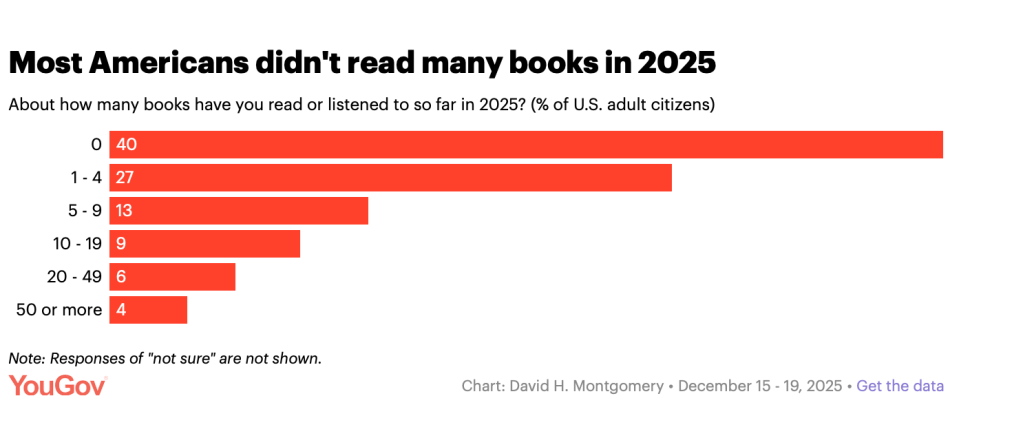
Six in 10 Americans (59%) say they read at least one book in 2025, a new YouGov survey finds. That’s in line with similar YouGov surveys in 2024 and 2023. Most Americans who did read books only finished a handful of books, while a minority of Americans were plowing through the pages. Here’s what YouGov found about Americans’ 2025 book-reading habits:
Besides the 40% of Americans who didn’t read any books in 2025, another 27% read one to four books. And 13% read five to nine books. That leaves 19% of Americans who read 10 or more books, including 9% who read 10 to 19 books, 6% who read 20 to 49 books, and 4% who say they read 50 or more books.
(I am surprised that 10% of Americans read more than 20 books per year. I don’t know many in my circle of friends and acquaintenances who have read even five books a year.)
American Backbone?
Science is going to have to research whatever happened to the American backbone. Was it removed from many U.S. babies beginning in the 1950’s? Someone who has been away from this country in the past two years would not recognize or understand what has happened. Total capitulation by the Congress and many of the American public!
I.R.S. to Drop Audits of Trump and Family
Prison to Pardons to Payouts: Jan. 6 Rioters Are Elated at Trump’s $1.8 Billion Fund
Trump’s Spring Revenge Tour Routed G.O.P. Foes.
Trump Blurts Stunning Gas Price Rant Amid Sinking Polls: ‘This is Peanuts!

