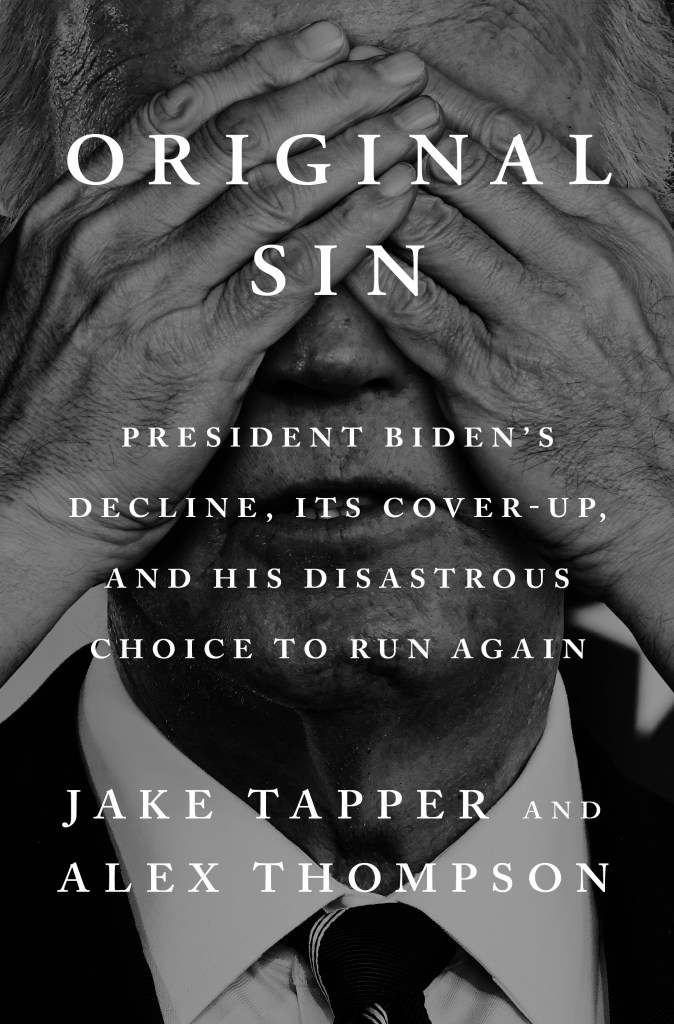
Book Review: Original Sin: President Biden’s Decline, Its Cover-Up, and His Disastrous Choice to Run Again by Jake Tapper and Alex Thompson

This book is well-written, compelling, and—most notably—largely uncontested. I’ve read and heard very little pushback on the specific facts or episodes it reveals, which suggests that authors Alex Thompson and Jake Tapper did their journalistic homework. The anger it has generated seems not to concern the accuracy of its content, but rather the timing of its release—particularly among Biden loyalists, who view it as a betrayal during a time when the President is reportedly battling stage four colon cancer.

Others, more detached, wonder aloud why this information wasn’t brought to light sooner—why major media outlets, especially CNN, did not explore or disclose the full extent of President Biden’s physical and cognitive decline during his time in office. That is perhaps the most damning question of all.

This is an important book. It speaks to an uncomfortable truth that extends far beyond one man: the American political establishment, across all branches, has proven remarkably inept at addressing questions of age, health, and capacity among its senior-most officials. From the silent frailty of Dianne Feinstein to the vanished vigor of Ruth Bader Ginsburg, we’ve seen what happens when ego and denial—both personal and institutional—take precedence over public responsibility.

Perhaps the quintessential case of this phenomenon was Woodrow Wilson’s second term. After a debilitating stroke, Wilson was essentially incapacitated. His wife, Edith, barred access to him, managed his communications, and in effect acted as President. It was a quiet coup by pillow and teacup. The Republic endured, but barely.

There are shades of Edith Wilson in Jill Biden. She appears to have acted as her husband’s chief protector—controlling access, managing his schedule, shielding him from the press, and preserving the illusion of a functioning presidency. In her role as spouse, that’s understandable. In her unelected role as a shadow gatekeeper to the Commander-in-Chief, it is far more problematic. One might say she acted out of love; but in doing so, she may have done a grave disservice not just to Joe, but to the country.

The book should be read not as a political hit job, but as a cautionary tale—a sobering account of what happens when the reality of aging is denied, hidden, or downplayed in a role where vitality, decisiveness, and mental clarity are non-negotiable. The tragic erosion of strength and cognition in old age is painful to witness in any context. But when the individual in decline is the President of the United States, the stakes are exponentially higher.

Being President is not a part-time job. And yet, this administration’s inner circle seemed intent on turning it into a 10 a.m. to 4 p.m. desk duty—often with questionable results. The staff’s attempts to mask or manage the President’s decline weren’t just misguided; they were reckless. Shame on them. Shame on the senior Democrats who knew the truth and said nothing. And shame, too, on the partisans who savaged the few journalists who dared to report what millions of Americans could plainly see.

Modest Proposals for Reform

The republic deserves better than this. Here are a few modest proposals to restore some measure of honesty and responsibility to our political gerontocracy:

  • Mandatory retirement at 78 for all members of Congress and Supreme Court justices. This would mean the last year someone could run for the Senate would be age 73; for the House, age 76.
  • Presidential retirement at 78. If a sitting President reaches that age during their term, the Vice President should assume office.
  • Lower the minimum age to run for President to 32. Why 35, anyway? If you’re old enough to command a drone strike, you’re old enough to command the White House.
  • Annual cognitive testing starting at age 68 for any sitting President, Supreme Court justice, or member of Congress, with results made public. Transparency, like sunlight, is the best disinfectant.

And What of Donald Trump?

Let us not delude ourselves. The other septuagenarian (now octogenarian) candidate is not immune to the same questions. A similar book could be written—perhaps will be written—about Donald Trump’s own health, mental acuity, and fitness for office. The signs are there, albeit in a different key.

One would hope that, should Trump become clearly unfit for office due to health reasons, the wise and the decent would persuade him to step aside. But hoping for wise and decent behavior in American politics is a bit like hoping the Mississippi River will reverse course out of courtesy.

We are a nation now ruled by its elders, but without the wisdom such a gerontocracy is supposed to confer. Instead, we cling to figureheads and fictions, while truth sits ignored in the wings—sometimes until it’s too late. Original Sin may not be a comfortable read, but it is a necessary one.

Notes on Democracy by H.L. Mencken Still Relevant Today

H.L. Mencken’s Notes on Democracy was written about 100 years ago, yet the reader will be struck by how sharply his observations on 1920s politics and culture mirror the political landscape of today.

Mencken’s caustic style and biting sarcasm run throughout the book. He held little confidence in the judgment and wisdom of his fellow citizens, particularly regarding politics and voting, as evidenced by this remark:

“Democracy is a pathetic belief in the collective wisdom of individual ignorance. No one in this world, so far as I know—and I have researched the records for years, and employed agents to help me—has ever lost money by underestimating the intelligence of the great masses of the plain people. Nor has anyone ever lost public office thereby.”

Mencken’s disdain was not reserved solely for the electorate. He was equally unforgiving when it came to the judgment and competence of elected leaders, describing their primary motivation with brutal clarity:

“It is his business to get and hold his job at all costs. If he can hold it by lying, he will hold it by lying; if lying peters out, he will try to hold it by embracing new truths.

One quote in particular struck me—written a century ago, yet hauntingly apt in describing the Trump administration’s approach to governance:

“No man would want to be President of the United States in strict accordance with the Constitution. There is no sense of power in merely executing laws; it comes from evading or augmenting them.”

The relevance of Mencken’s skepticism and critique of American democracy is both startling and disheartening. His writing is a reminder that the flaws he saw in the democratic process and its leaders are not new—they are simply dressed in the colors of each era. We could certainly use more writers and journalists like Mencken today: fearless in their observations, unyielding in their criticism, and unafraid to expose the flaws in both our political culture and the electorate that sustains it.

Murder the Truth by David Enrich: Brief Review and Recommendation

There is little doubt that investigative reporting, journalism, and legacy media are under full-scale assault. When politicians or public figures are confronted with articles or reporting that challenge their narratives, they are quick to sneer, “fake news.” In Murder the Truth: Fear, the First Amendment, and a Secret Campaign to Protect the Powerful, David Enrich details the escalating legal and political efforts to undermine press freedoms in the United States. These efforts, he explains, are largely initiated and financed through right-wing groups and MAGA followers.

One glaring example of this shift is the recent resignation of Bill Owens, executive producer of 60 Minutes. Owens cited that “over the past months, it has become clear that I would not be allowed to run the show as I have always run it, to make independent decisions based on what was right for 60 Minutes, right for the audience.” This resignation is symptomatic of a larger fear permeating newsrooms. Newspapers like The Washington Post and The Los Angeles Times have even become hesitant to make political endorsements. Fear of lawsuits, loss of subscriptions, and dwindling advertising revenue have left many media organizations wary of publishing anything that might stir controversy. As a result, crucial stories and investigations—those that expose government corruption, public official malfeasance, and corporate irresponsibility—often remain buried, locked away in the dead files of an editor’s desk drawer.

More than 2500 newspapers in the United States have stopped publishing in the past two decades, a rate of about two per week. Most counties in the United States are no longer home to any daily papers, and many surviving outlets have been gutted by layoffs and other cost-cutting. 70 million Americans live in what researchers have dubbed “news deserts.”

As staffing at local newspapers, declines, mayoral races, become less competitive, and voter turnout wins. Misinformation spreads. Politicians and other public figures are rarely held to account for lies and misdeeds. Today, state, legislators, city Council members, and small town mayors – – not to mention companies that pollute or mistreat workers or sell dangerous products – –are operating with a degree of invisibility and impunity that they have not enjoyed in a century

This book contains interesting stories and analysis of several free speech battles including:

Sarah Palin vs. The New York Times
Donald Trump’s Lawsuits Against Media Entities
Dominion Voting Systems vs. Fox News
Hulk Hogan vs. Gawker
Melania Trump vs Daily Mail

Enrich’s book may come too late to reverse this tide, but it serves as critical research for future historians who will undoubtedly question how a nation that once prided itself on free speech allowed censorship and political pressure to erode First Amendment guarantees.

An excellent read. Highly recommended for anyone who values a free and independent press.

More Notes and Asides

I can understand Trump’s desire to have the title of Pope. It would confirm at least in his own mind, his infallibility.

Recommend listening to Is the Sun Setting on America’s Financial Empire? | The Ezra Klein Show for an interesting discusssion between Ezra Klein and Kenneth Rogoff, a former chief economist at the International Monetary Fund and a professor of economics at Harvard University on Trump’s tariff policy and its implications for the U.S. dollar and economy. Rogoff is rather blunt about how moronic the current economic path is.

Also suggest a listen to Where in the World Is Trump Taking Us? | TED Explains the World with Ian Bremmer. Bremmer is articulate, candid and very conservant about global affairs, the world economy, geopolitics and U.S. domestic policy. Like a professional referee, he calls them like he sees them.

I believe that our freedoms include the right to die with dignity. If an individual who is cogent and psychologically stable believes that she has lived life well, that her life is complete and that her future will not bring improvement or joy, she should have the right to make the decision to terminate her life. Period.
Joan Temko Anyon
San Francisco

Daniel Kahneman’s Decision: A Debate About Choice in Dying NYT

For those who have not seen it, I hardly recommend viewing Four Seasons, a romantic comedy movie from 1981 starring Alan Alda, Carol Burnett, Jack Weston and Rita Marino. I looked forward to the reprise of Four Seasons, 2025 Netflix version starring Steve Carell, Tina Fey, Will Forte and Kerri Kenney-Silver. However, I found the 2025 version to be dark, depressing and not very funny. The one bright spot in the movie was the acting of Steve Carell, whose character in the movie was most entertaining of the seven characters featured.

Maybe the most irritating commercials that I see on TV come from injury lawyers who probably boast of exorbitant cash settlements they get for their injured clients. Who winds up paying for these exorbitant cash settlements? The insurance companies? Not really. Consumers are on the hook for paying huge cash settlements as our annual auto insurance premiums continue to rise exponentially.

“Changing your mind once about a theory, an investment, or a person, is healthy. Changing your mind twice is not.” Nassim Nicholas Taleb

Under the Influence…

Shown below is a short list of journalists, writers and media types, whose opinions I value. I may not agree with all their conclusions or analysis, but I will take the time to consider them.

Late additions to my Political Influencers list: Jon Meacham, Chrystia Freeland, George Will, Jessica Tarlov, Kaitlyn Collins, Garry Trudeau and Jennifer Griffin (sole Fox News journalist).

President Trump is systematically severing America from the globe. This is not simply a shift in foreign policy. It is a divorce so comprehensive that it makes Britain’s exit from the European Union look modest by comparison.

Consider the breadth of this effort. Allies have been treated like adversaries. The United States has withdrawn from international agreements on fundamental issues like health and climate change. A “nation of immigrants” now deports people without due process, bans refugees and is trying to end birthright citizenship. Mr. Trump’s tariffs have upended the system of international trade, throwing up new barriers to doing business with every country on Earth. Foreign assistance has largely been terminated. So has support for democracy abroad. Research cuts have rolled back global scientific research and cooperation. The State Department is downsizing. Exchange programs are on the chopping block. Global research institutions like the U.S. Institute of Peace and the Wilson Center have been effectively shut down. And, of course, the United States is building a wall along its southern border.

100 Days. That’s All It Took to Sever America From the World. Ben Rhodes NYT 4/27/25

In a poll from Washington Post-ABC News-Ipsos, Trump’s standing was the lowest of any president in the first 100 days of his term since 1945, with 39% saying they approve of his job performance while 55% disapprove. As much as I am upset about Trump’s poor performance, as president, I am even more angry that 39% of Americans could possibly approve of his job performance. What kind of grading curve are these people on!? However, I am reminded that even in the ruins of Germany in April 1945 that many Germans still supported Adolf Hitler.

Playing with “White House” Money

I’ll admit it: I wasn’t the most attentive economics student in college. But recent events have forced me into a crash course in tariffs, trade, the stock market—and most urgently—the U.S. Treasury market.

These aren’t abstract terms anymore. I’ve been following the conversations—some sober, some frantic—coming from economists, traders, financial analysts, and CEOs. What stands out is how few of them support our current approach to tariffs. I hesitate to call it a “policy.” It feels more like something made up on the fly.

President Trump has been lucky in the past. He was rescued by his father’s money and banks willing to take risks that didn’t always pan out. He wasn’t so lucky in the casino business, and I don’t think he realizes he’s holding a weak hand in the high-stakes game of tariffs. When countries like China and Japan begin offloading U.S. Treasuries, it’s not just a financial maneuver—it’s a warning. They’re saying loud and clear: you’re not playing with our house money.

Let’s be honest: America is losing friends. Longtime allies are distancing themselves. They were stunned when Trump won reelection last November—and outright furious when “Liberation Day” was declared weeks ago. While Congress, the courts, and much of the press seem hesitant to challenge him, our international allies are not. They’re making new economic and diplomatic arrangements—and the U.S. is no longer on the guest list.

This has consequences. If foreign investors stop buying U.S. Treasury bonds—or worse, start selling them—our ability to fund government programs, including Social Security, is at risk. No one will be spared the fallout. It’s hard to believe our leaders don’t grasp how dangerous this path is.

And it may already be too late. Confidence in the U.S. has taken a major hit. There are reports of Canadian tourists canceling trips here—more signs of the growing unease.

If you’re a CEO or business owner, how can you plan with any confidence when the rules of the game keep shifting? The White House seems deaf to the frustration coming from both abroad and increasingly from within our own borders.

Democrats and critics are pinning their hopes on the 2026 midterms. But if this trajectory continues, I worry about what condition the country will be in by then.

And what about the seniors who voted for Trump? How do they feel now that Social Security offices are closing and workers are being laid off? When the Commerce Secretary brushed off concerns about late checks—suggesting a delay of a week or so would be no big deal—I wanted to shout: Wanna bet?

There’s a lot of noise out there. A lot of shouting, marching, hand-wringing. But not a lot of clarity or direction. Sometimes, it feels like we’ve passed the point of no return. Judging by the way our allies are behaving, they seem to think we already have.

Faking It (on the Mat and at Your Job)

I have been a pro wrestling fan since I was 10 years old. Don’t get me wrong, I know that the results are predetermined, but I still admire the athleticism of many of the professional wrestlers. I have also been intrigued with the narratives and storylines that are so important in professional wrestling. An excellent professional wrestler needs to be a great athlete, but he also must be able to tell a story or have his or her manager tell their story in order to get over with the fans. Donald Trump has participated in a number of WWE storylines and skits in the past. He is still able to get over with his MAGA fans.

Education Secretary Linda McMahon speaking at the 2025 ASU+GSV Summit, an annual gathering of education and learning leaders, where she mistakenly referred to AI (artificial intelligence) as A1 a number of times. I think that Linda, an owner of the WWE with her husband. Vince took a few too many “stunners” from Stone Cole Steve Austin at her old job. In a WWE skit, Linda once portrayed a comatose wife, (rather convincingly,) while her husband was portrayed hitting on beautiful Divas. It’s embarrassing that she is Education Secretary.

WrestleMania takes place this weekend. It is the biggest show for the WWE. Let’s see how well I do in figuring out the winners based on my interpretation of the existing storylines.

MatchWinnerDegree of Certainty
Jacob Fatu
LA Knight
Jacob Fatu98%
Jade Cargill
Naomi
Jade Cargill88%
Logan Paul
AJ Styles
Logan Paul60%
Drew McIntyre
Damian Priest
Drew McIntyre65%
Rey Mysterio
El Americano Grande
El Americano Grande52%
The New Day
The War Raiders
The New Day65%
Dominik Mysterio
Penta
Bron Breakker
Finn Balor
Dominik Mysterio51%
Bianca Belair
Iyo Sky
Rhea Ripley
Iyo Sky51%
Raquel Rodriguez and Liv Morgan
Bayley and Lyra Valkyria
Raquel Rodriguez and Liv Morgan90%
Tiffany Stratton
Charlotte Flair
Tiffany Stratton51%
Jey Uso
Gunther
Jey Uso60%
John Cena
Cody Rhodes
John Cena70%
CM Punk
Seth Rollins
Roman Reigns
Seth Rollins52%

Irreconcilable Differences

I recommend the recent and well written articles from Maureen Dowd, David Brooks and Thomas Friedman on the insanity and stupidity of the Trump Administration.

What happens when people lose the ability to reason or render good judgments? Ladies and gentlemen, I present to you Donald Trump’s tariff policy. I’ve covered a lot of policies over the decades, some of which I supported and some of which I opposed. But I have never seen a policy as stupid as this one. It is based on false assumptions. It rests on no coherent argument in its favor. It relies on no empirical evidence. It has almost no experts on its side — from left, right or center. It is jumble-headedness exemplified. Trump himself personifies stupidity’s essential feature — self-satisfaction, an inability to recognize the flaws in your thinking. And of course when the approach led to absolutely predictable mayhem, Trump, lacking any coherent plan, backtracked, flip-flopped, responding impulsively to the pressures of the moment as his team struggled to keep up.

David Brooks Producing Something This Stupid Is the Achievement of a Lifetime New York Times 4/10/25

So I watched Bill Maher last night on his HBO show. Maher described his recent visit to the White House and conversation with Donald Trump. Sounded like a Kumbaya moment. Trump asked Maher about his opinions on various topics, including Iran, and he even laughed at some of Maher’s jokes. Maher found Trump to be personable and focused on the conversation. It almost sounded like a reassuring segment until one realizes how Trump has ruined the economy and has absolutely no clue on how to conduct policy or run the government. I have read that Hitler had a hypnotic effect on people that he met. I assume that Maher had a similar experience with Trump. I have no issue with Maher meeting with Trump, but I sense that there is no real benefit for either guy though Bill might find a more receptive MAGA audience for the future.

This writer has a high school reunion scheduled. The last one (five years ago) was canceled due to Covid. There were also issues with some of my classmates regarding politics. My class has a significant core of Trump supporters. And strangely enough, political passions may have an effect on whether people want to attend this year’s reunion or not. I try not to engage in political discussions with just about everyone. Regrettably earlier this week, I was involved in a “conversation” with a Trump supporter of my advanced age and I found myself losing my temper. He was wrapped around women in the military, abortion, trans rights, LGBQT and was totally oblivious to the current administration’s poor handling of the economy, foreign policy, national security, cabinet selections, DOGE, compliance to law, etc. Prior to 2008, I was happy to engage in a discussion about politics and current events. But when Obama came in, civility went out. I don’t write to engage in debate. I write to clarify my thinking and for someone hopefully 20 or 30 years from now will read this and conclude there was one sensible man in an era of continual tumult.

Times Out

The Sunday New York Times remains one of life’s pleasures. I do miss reading the enormous print edition of the paper with the magazine but at least the online edition still suffices. Shown below are a book I’d like to read and useful analysis and advice from various columnists.

Flesh

by David Szalay

Szalay’s new novel traces the life of a young man in Hungary who eventually makes his way to England, following him from troubled youth to immigrant success to tragic fall. Each chapter provides glimpses of the major stages of adulthood — first love, marriage, parenthood — interwoven with intervals of aimlessness, reinvention and grief. With cool detachment, Szalay offers observations on both the complicated self and the unpredictable world surrounding it.

***

Our current antiglobal moment could last for a long time. Illiberalism is alive and strong. Comparisons that once seemed incendiary or irresponsible now seem obvious. As in the 1930s, minority groups are being scapegoated as symbols and causes of globalization’s ills. For Jews then, read migrants or trans people now. Mr. Trump’s imminent betrayal of Ukraine suggests that we are moving rapidly through the 1930s and have already arrived in 1938. That’s when Western leaders in Munich decided to allow Hitler to dismember one of Europe’s few remaining democracies, Czechoslovakia. It was not worth risking lives over “a quarrel in a faraway country, between people of whom we know nothing,” reasoned the dangerously reasonable Neville Chamberlain. Less than one year later, Hitler browbeat the president of what remained of Czechoslovakia into accepting a complete occupation of his country.

Russia’s invasion of Ukraine was a déjà vu moment for historians of World War II. Will Greenland and Canada become the next Czechoslovakia and Poland?

Globalization Is Collapsing. Brace Yourselves.
By Tara Zahra
Dr. Zahra is a professor of history at the University of Chicago and has written extensively about globalization’s first collapse.

***

A 20 minute agility workout to improve balance

***

Instead of following the standard guidance to keep withdrawals to 4 percent of the balance in your retirement account, then adjust annually for inflation, you might forgo the inflation raise when stock prices are falling, Dr. Pfau said. Or you can install so-called guardrails, limiting withdrawals to, say, 3 percent in bad years for stocks but taking out, perhaps, 5 percent when the market is surging.

How to Protect Your Retirement Savings Now as Markets Plunge by Diane Harris

***

My problem is with Trump’s magical thinking that you just put up walls of protection around an industry (or our whole economy) and — presto! — in short order, U.S. factories will blossom and make those products in America at the same cost with no burden for U.S. consumers.

For starters, that view completely misses the fact that virtually every complex product today — from cars to iPhones to mRNA vaccines — is manufactured by giant, complex, global manufacturing ecosystems. That is why those products get steadily better and cheaper. Sure, if you are protecting the steel industry, a commodity, our tariffs might quickly help. But if you are protecting the auto industry and you think just putting up a tariff wall will do it, you don’t know anything about how cars are made. It would take years for American car companies to replace the global supply chains they depend on and make everything in America. Even Tesla has to import some parts.

I Just Saw the Future. It Was Not in America. Thomas L. Friedman