Tending My Fish: Reflections on a Republic in Decline 

As I contemplated last week’s election results, with all their dreary portents for the years ahead, I was reminded of the lament of a Roman senator—his power fading, his influence diminished, as Caesar’s star ascended:  

“I shall tend my fish, study philosophy, and comport myself for death. This republic holds no place for me any longer.”  

(Conspirata: A Novel of Ancient Rome, Robert Harris)  

And then I asked myself, “Does this country hold a place for me? 

The question is not rhetorical. At this late point in my life, I find myself at odds with the culture, principles, and trajectory of the nation I once revered. My beliefs—anchored in reason, history, and an old-fashioned sense of duty—seem increasingly alien in a land preoccupied with spectacle over substance.  

A Discontented Creed  

Consider, for example:  

Religion in Politics: As an agnostic, I believe that the pulpit should stay far away from the podium. Ministers and pastors claiming divine insights on policy strike me as charlatans with better wardrobes. Faith should inspire personal virtue, not dictate public policy.  

Loyalty to Allies: In diplomacy and in life, I value loyalty. A true ally stands by you in both triumph and trial. Yet we seem to cast off old friends—countries and principles alike—as if they were expired coupons.  

Science and Competence: I favor facts over feelings, competence over pretense. But ours is an age where bombast outweighs expertise, and the loudest voice is mistaken for the wisest.  

Reckoning with Our Past: This country’s history is a patchwork of greatness and failure. We have saved nations and crushed dreams, built monuments to liberty and ignored the cries of the oppressed. I believe in confronting our flaws honestly, not whitewashing them with comforting myths—or worse, erasing them entirely in the name of “offense.”  

Respect for Women: Here is a simple proposition: anyone who assaults, demeans, or dehumanizes women is unfit for public office. Full stop. Yet, 52% of white women voters apparently find this a negotiable standard. I am baffled—and disgusted.  

Character Matters: Good judgment, responsibility, empathy, and moral clarity—these should be the cornerstones of a person’s character. Increasingly, though, they are dismissed as relics of a bygone era, sacrificed on the altar of “winning at all costs.”  

A Nation Entertained to Death  The deepest cut of all, perhaps, is that we have traded informed citizenry for the hollow thrills of reality-show governance. Americans now crave entertainment over enlightenment. The morning chatter of Joe and Mika or the smirking commentary of Bill Maher may pass for insight, but to me, they feel like reruns of Neville Chamberlain in Munich, mistaking platitudes for policy while calamity looms.  

The Final Reckoning  

So here I am, like that Roman senator, contemplating my fish and philosophy. The republic of my youth—the one I fought to believe in—is unrecognizable.  

It is a strange thing to feel like an exile in one’s own country, but perhaps the true patriots are always exiles. We stand apart, unwilling to settle for the tawdry spectacle on offer, and dream of something better—a nation of character, competence, and courage.  

Until then, I will tend my fish.

The Myth of American Idealism: How U.S. Foreign Policy Endangers the World by Noam Chomsky and Nathan J. Robinson (Review)

The received wisdom insists that the United States is the tireless champion of democracy and human rights—a paragon of “Wilsonian idealism” and “American exceptionalism.” Noam Chomsky’s and Nathan J. Robinson’s The Myth of American Idealism: How U.S. Foreign Policy Endangers the World eviscerates this comforting narrative. The authors argue that U.S. foreign policy aligns not with noble ideals but with the strategic and economic interests of domestic elites. The result? A history marred by moral indifference, lawlessness, and a ruthless adherence to what Adam Smith once called “the vile maxim of the masters of mankind: All for ourselves and nothing for other people.”

This is not a book for the faint of heart or those who prefer their history wrapped in the star-spangled illusions of Hollywood. It is a damning indictment of U.S. actions abroad, examining case studies from Vietnam to Iraq, Chile to Palestine. The authors spare no sacred cow, exposing the contradictions between America’s lofty rhetoric and its sordid realpolitik.

I approached this book with some skepticism. Chomsky’s political ideology leans further left than my own, and I was wary of polemics. Yet his analysis aligns uncomfortably well with historical evidence. Take, for instance, his examination of U.S. support for Israel. The one-sided nature of American backing—military aid, UN vetoes, and tacit approval of Israeli excesses—has devastated Palestinians while fueling anti-American animus across the Middle East. Chomsky is clear-eyed about the complexities: there are cruel men on both sides of the Israeli-Palestinian divide. But the suffering of millions of innocent Palestinians, bombed, maimed, and displaced, is a humanitarian tragedy in which the United States is deeply complicit.

Equally scathing is his treatment of the Vietnam War—a blunder of monumental proportions. The authors chronicle how leaders lied to the public, sent thousands of soldiers to die needlessly, and plunged the nation into chaos. As someone who lived through that era, I can attest to the war’s divisive impact. For younger readers, this history is essential reading, a sobering reminder of how disastrously foreign policy can go astray when guided by hubris and deceit.

The prose is not exactly uplifting, but it is brutally clarifying. Are we, as Americans, driven by democracy and justice—or by greed and oil? The book challenges readers to reckon with a less flattering version of our heritage, one that calls for reflection rather than whitewashing.

No matter where you fall on the political spectrum, The Myth of American Idealism will provoke thought, discomfort, and perhaps a much-needed reckoning. If you prefer fairy tales about America’s benevolence, look elsewhere. For those willing to confront uncomfortable truths, this book is indispensable.

Today’s NBA Players “Soft?”

NBA players in the 1960s and 1970s did not have access to trainers, machines, whirlpools, massages, and other current technologies to recover from games. Plus travel was not as comfortable or as convenient for players 50 or 60 years ago. However, despite an 82 game schedule, like today, they did not take days off and they played through minor injuries. There was no “load management” if you played for Red Auerbach or Bill Russell.

Character Limit: How Elon Musk Destroyed Twitter by Kate Conger and Ryan Mac (Rview


**One of the best-researched and well-written business books I have read, *Character Limit: How Elon Musk Destroyed Twitter* by Kate Conger and Ryan Mac is a compelling exploration of Elon Musk’s controversial purchase of Twitter. The book offers a rich narrative populated by a cast of hundreds of Twitter employees and executives, each bringing a unique perspective. Readers may find heroes and villains among them, all presented in vivid, humanizing detail. With a length far exceeding a tweet at 436 pages, it still keeps the reader engaged from start to finish.

At the heart of the book is Elon Musk, whose reputation as a visionary, eccentric, and often self-centered figure is fully displayed here. Musk is depicted as the center of Twitter’s universe, around which all other stories orbit. His personality and decisions drive the narrative, illustrating his complex and, at times, erratic leadership style.

As a reader, I found myself feeling sympathetic for the executives and employees who had to work with Musk. Many were caught in a difficult position, needing their jobs to support themselves and their families. Musk, however, was a challenging boss, setting impossible deadlines, frequently changing his mind, and often requiring flattery before he would listen to advice. This environment, as described in the book, made for a grueling workplace experience.

The book also draws comparisons between Musk and Donald Trump, noting both men’s tendencies to act impulsively, seeking adulation and approval without considering the full consequences of their decisions. This parallel underscores the irony that Musk, who initially sought to reduce misinformation on Twitter, ended up frequently sharing and amplifying misinformation himself.

After reading this book, I would not want to work with Elon Musk. The book notes that there has been speculation Musk could take on efficiency reforms in the federal government by cutting expenses and staff. However, his approach at Twitter—firing over half the staff without a clear strategy—highlights the dangers of indiscriminately cutting headcount without considering the broader ramifications.


The Death Rattle of American Democracy

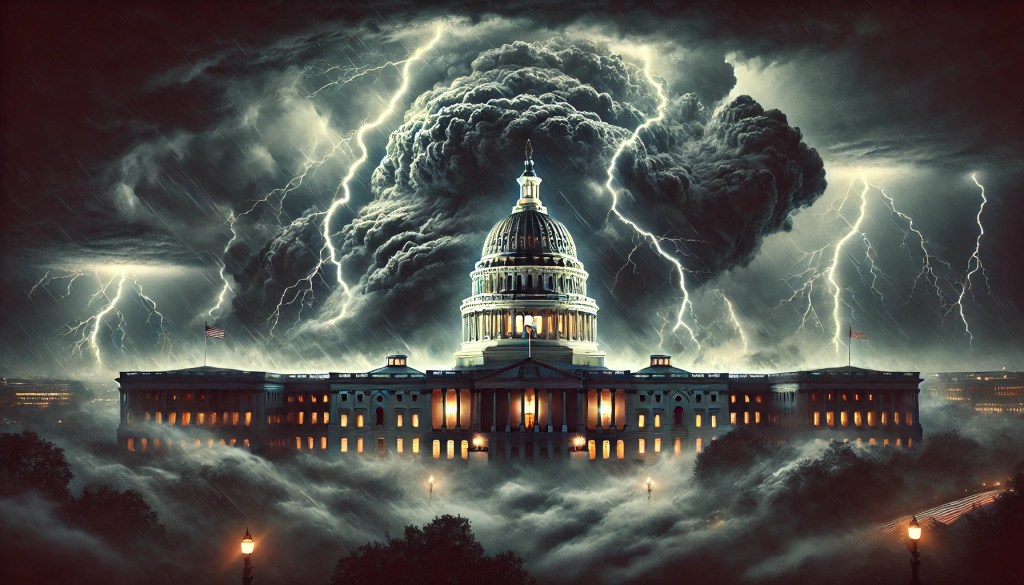
Photo by AI

For decades, America’s democratic process has shown signs of decline. On November 5, 2024, that decline may have reached a fatal turning point. Donald Trump was re-elected as President, marking—some would say—the final blow to a weakened democracy, neglected by its stewards and estranged from its founding principles.

Three pillars are essential for democracy: (1) a transparent, fair election process, (2) qualified candidates, and (3) an informed electorate, capable of choosing wisely. Yet, in today’s climate, who genuinely trusts the judgment of the American voter?

Consider this: The stock market is booming, unemployment is at a historic low, and gas prices are stable. The Biden administration was handling critical issues from Middle Eastern conflicts to Russian aggression against Ukraine. But in this era, good governance and stability didn’t win the day.

Trump’s victory stunned many, especially with his support among white women—53% of whom preferred Trump over Harris, despite his controversial record. These female voters chose a candidate from a party poised to limit their rights, including access to abortion. How did we arrive here?

Leading up to election night, the media portrayed Trump’s campaign as a dwindling force, with sparse rally turnouts and low energy, contrasted by the enthusiastic crowds at Kamala Harris’s events. Yet, in the end, reality defied expectations. Were these rallies misreported, or did the media miss the sentiment driving Trump’s base?

For those disappointed by the outcome, here’s a light-hearted note: maybe it’s time to book a one-way ticket before January 20, 2025. Think Liz Cheney, Robert De Niro, Jimmy Kimmel, Hillary Clinton, and others at odds with the new direction of our country.

Hitler’s rise in 1933-34 has long fascinated historians. He exploited public discontent, channeling German frustrations into loyalty to his cause, much as Trump does today. As we brace for the next four years—or more—it’s clear that we are living in historic, if challenging, times.

National Election Forecast: Dark Clouds and Stormy

The best possible result from election day would be Kamala Harris winning the popular vote by greater than 4% and easily winning the electoral college. If that doesn’t happen, expect another 60 to 90 days of political turmoil from lawsuits, appeals, allegations of election fraud and sporadic acts of violence that will surpass the chaos of January 6, 2021.

***

I don’t need polls to tell me the definite “Losers” in this election: civility, truth, integrity, candor and self-respect.

***

This is the 18th presidential election of my lifetime. I don’t remember anything about my first two elections (Dwight Eisenhower in 1952 and 1956.) Certainly a different time regarding morals and acceptable behavior in politics in my youth. For example, I don’t think that a candidate who was found liable for sexual assault or being a convicted felon awaiting sentencing, would even get a whiff at being a candidate for national office in 1960.

***

If Kamala loses, I expect to read countless articles and criticisms on how she ran her campaign. Based on my observations, she ran a fairly positive campaign that exhibited a lot of enthusiam and energy.

***

Now we leave it up to the judgement of voters… why does this make me so apprehensive and discouraged?

America First: Roosevelt vs. Lindbergh in the Shadow of War by H.W. Brands (Review)


My rating: 4 of 5 stars


On September 1, 1939, fighting broke out in Europe. After the invasion of Poland by Germany, both France and England declared war against the Nazis. Many, if not most Americans, were resistant to participating in a European war. Indeed, there was resistance to even supplying military supplies and other goods to Britain while they basically fought Germany on their own. There was also significant support for the Germany and Hitler’s regime at this time.

Franklin D. Roosevelt managed a fine line. He wished to be re-elected for a third term, but he also understood that Hitler’s goals were not only the conquest of Europe, but world conquest. Charles Lindbergh was an American hero for his exploits about flying across the Atlantic on his own. He and his wife Anne endured the kidnapping and murder of his son in 1932 and this endeared him more to the American public.

Lindbergh opposed US involvement in any war overseas. Lindbergh felt that America was invincible as it was protected by oceans and not vulnerable to air attacks. Lindbergh saw no reason for America to sacrifice its sons in European wars and spoke out strongly against any intervention.

How FDR positioned the United States to prepare for World War II is an interesting story of great judgment and leadership. FDR coordinated closely with Winston Churchill to ensure that Britain had the necessary weapons and materials to survive German assaults. Roosevelt had to skillfully maneuver his aid to Churchill under the watchful eye and some time opposition of a reluctant Congress.

Charles Lindbergh was accused of being an agent and dupe of the German government. There seems to be a little evidence of that. Lindbergh firmly believed that United States could stand on its own and ably defend itself against any foreign attack or invasion. Circumstances and events proved that Lindburgh was incorrect in his analysis but he did volunteer to help the military in any capacity once United States entered the war.

Today there are isolationist policies still being supported. There are many Americans and people in Congress, who do not feel that we should be supporting Ukraine in its battle against Russia and Putin. Are they guilty of being short sighted too? There are some interesting historical similarities there.

This book was well researched and an excellent read. It quotes from Lindbergh’s diaries and provides a good measure of the man and his ambitions. I think that Lindbergh was largely circumspect and responsible in his criticism over American foreign policy. FDR happened to be right in his judgement about Hitler and America’s role in stopping tyranny.


Rhetorical Question??

Interesting question or admission from Fox News host Bret Baier in his “debate” with Kamala Harris yesterday…

At one point, Bret Baier asked Vice President Harris what she made of such a large number of Americans expressing support for former President Trump, while the two candidates remained largely close in polling, asking her, “Are they stupid?”