Notes from Ageless Soul by Thomas Moore

Stages in the aging process 

  1. feeling immortal, 
  2. first taste of aging, 
  3. settling into maturity, 
  4. shifting toward old age, 
  5. letting things take their course.

***

We can deal with this anxiety individually by living a day at a time, being present to what the day has to offer. If there is no sickness or any other problem, we can enjoy the day. Some people project themselves into a debilitating future and live in the anxiety of imagined woes to come.

***

I don’t care what the calendar says. I have a strong youthful component in me, and often that person in his 40s seems to inhabit my body. Even when I look in the mirror, I sometimes manage to see more of the 40 year old man than the one who is 76. I’ve always been a strong believer in illusions.

***

Simple, ordinary activities can improve your health and ease the black bile of melancholy that afflicts many older people. Take that walk in the woods, look for a sparkling lake or river, and don’t spend much time with negative people. We don’t realize how important it is to rely on nature for our health and mood, to think about the kind of people we have around us, and to understand the value of gardens and trees. 

***

The older years offer a perfect time to reflect more often, more deeply and more seriously on these important aspects of life. Of course, we need to begin this kind of reflection in our youth, but it can reach its depth in old age. Being part of a culture that has lost interest in profound ideas and intense reflection on experience makes aging more difficult.

***

Being an elder not only helps other people find guidance and wisdom, but it also gives the older person added reason for living. It may be the final act of a generous and thoughtful life. It is service taken to the last moment and done with a special authority and dedication it helps if the older person consciously adopts the role of elder. I could say from my own experience that a certain point people begin to treat you as an elder and look for benefits that you may be able to give them.

***

The poet Maya Angelou once wrote: “I’ve learned that people will forget what you said, people will forget what you did, but people will never forget how you made them feel.” Thus legacy is a matter of the heart. It’s not an idea but a feeling connected to largely invisible people, it’s a special way of loving, and if there is anything that could make growing old more pleasurable, it would be to discover new ways to love.

***

Reflection – – the first stage for an ordinary person is reading or listening to someone else offer an understanding of events. You listen or read and make those ideas your own in your own way. The second stage of reflection is conversation. You make a point to speak with people who have something worthwhile to say and with whom you enjoy speaking. A third stage of reflection is to find some effective mode in which you can express yourself it could be writing of various forms – – journals poems, essays, fiction…

***

My Review of the Book

I am a bit of a cynic. Books like these discussing getting older are often written with the goal to alleviate the concerns and fears of elderly people as they approach death. The objectives when you get into your 70s and 80s are to find interests and things that will motivate you to stay alive or at least maintain your enthusiasm for healthy living.

While one can try to maintain a healthy attitude about life in your 70s and 80s, what’s more important are the states of your mind and your body. It’s critically important that you are not alone and that you do have some type of social network that hopefully includes family and friends.

It’s a comforting book with some useful bromides about topics like overcoming melancholy and leaving legacies. I don’t think there is one philosophy or set of rules to follow in life after 70. One of the things that I try to adjust to is the declining control I have in the direction of my life. I don’t have the physical, intellectual or mental energy I had a year ago and I expect that to continue to decline.

My five worst fears as I get older:

  • Losing my wife
  • Loneliness
  • Dementia
  • Disabilities and loss of health
  • Running out of money

Senescence: Round 3

More reflections, thoughts, perspectives and broodings on being older. You can find earlier and similar posts here and here.

Old age: Current age + 10 years; Youth: Current age – 10 years.

***

You  can only break my heart, once.

***

The ratio of laughter to tears narrows as one ages.

***

2:00 a.m. : (age 18) = 10:00 p.m. : (age 60+)

***

The penultimate expression of acquired wisdom is when we value health over wealth.

***

The value of what we don’t know > the value of what we do know.

***

Britain’s greatest export was The Beatles.

***

Baseball is this nation’s passed time.

***

Picture by Keegan Houser (Pixels)

Many of our sweetest memories generally have a soundtrack playing in the recesses of our mind.

***

Investing today is like playing a game at the carnival fair. You know the odds are stacked against you but the allure of winning a proverbial stuffed animal is too strong.

***

I wish I had a penny for each time a person changed the channel or fast forwarded a program on their remote or Roku. Within a day or two, I would be richer than Jeff Bezos.

***

Mother’s and Father’s Day is “Memorial Day” for many of us.

***

Our portals in time travel include old polaroid pictures, a yearbook and ticket stubs from a decades old concert or sporting event.

***

Do we ever really “grow up”?

***

Not sure that this applies to many 1960’s era football stars, but Jim Brown definitely could have played into today’s NFL.

***

In addition to Medicare and Social Security, one of the unheralded benefits for seniors are naps.

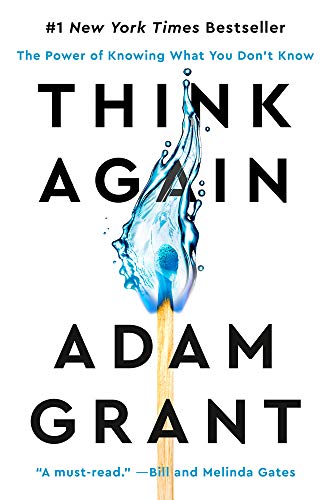
Book Recommendation: Think Again: The Power of Knowing What You Don’t Know by Adam Grant

This is a very useful book especially given the current fractious times that we live in. My guess is just about all of us needs to spend some time “re-thinking.” As the author correctly points out, “We live in an increasingly divisive time. For some people a single mention of kneeling during the national anthem is enough to end a friendship. For others a single ballot at a voting booth is enough to end the marriage. Calcified ideologies are tearing American culture apart.”

Re-thinking is not only useful for politics and debate but for every aspect of your life, including financial management, marriage, children, career, social relationships etc.

Grant provides a number of interesting people, scenarios and examples where re-thinking took place with very positive results. Probably the best example was the black musician Daryl Davis who persuaded white supremacists to abandon not only their membership in the Ku Klux Klan but more importantly their racist outlooks.

This is an important book that all of us could benefit from.

I have included some of my notes from the book:

This book is an invitation to let go of knowledge and opinions that are no longer serving you well, and to anchor your sense of self in flexibility rather than consistency.

Part of the problem is cognitive laziness. Some psychologists point out that we are mental misers: we often prefer the ease of hanging onto old views over the difficulty of grappling with new ones.

Most of us take pride in our knowledge and expertise, and in staying true to our beliefs and opinions. That makes sense in a stable world, where we get rewarded for having conviction and our ideas. The problem is that we live in the rapidly changing world, where we need to spend as much time rethinking as we do thinking. ( e.g. Mike Lazardis BlackBerry CEO)

Research reveals that the higher you score on an IQ test, the more likely you are to fall for stereotypes, because you’re faster at recognizing patterns. And recent experiments suggest that the smarter you are, the more you might struggle to update your beliefs.

When we are in scientific mode, we refuse to let our ideas become ideologies. We don’t start with answers or solutions; we lead with questions and puzzles.

We should all be able to make a long list of areas where we are ignorant. Recognizing our shortcomings opens the door to doubt.

In a meta-analysis of 95 studies involving over 100,000 people, women typically underestimated their leadership skills, while men overestimated their skills.

David Dunning and Justin Kruger published a modest report on skill and confidence that would soon become famous. They found that many situations, those who can’t… Don’t know they can’t. It’s when we lack confidence that we are most likely to be brimming with overconfidence.

Patient mortality rates in hospitals seem to spike in July, when new residents take over. It’s not their lack of skill alone that proves hazardous; it’s there over estimation of that skill.

“Arrogance is ignorance plus conviction.” Tim Urban

Achieving excellence in school often requires mastering old ways of thinking. Building an influential career demands new way of thinking.

Valedictorians aren’t likely to be the future’s visionaries education researcher Karen Arnold explains. They typically settle into the system instead of shaking it up.

Good teachers introduce new thoughts, but great teachers introduce new ways of thinking. Ultimately education is more than the information we accumulate in our heads. It’s the habits we develop as we keep revising our drafts and the skills we build to keep learning.

Takeaways:
Think like a scientist. When you start forming an opinion, resist the temptation to preach, prosecute or politick.
Define your identity in terms of values, not opinions.
Seek out information that goes against your views.
Embrace the joy of being wrong.
Build a challenge network, not just a support network.
Learn something new from each person you meet.
Ask “what evidence would change your mind?”
Make time to think again.

Profoundities

Insights, wisdom and thinking from books that I have read that resonate within me…

Autumn poses the question we all have to live with: How to hold one to the things we love even though we know that we and they are dying. How to see the world as it is, yet find light within that truth. 

Autumn Light by Pico Iyer

Religious and ideological dogmas are still highly attractive in our scientific age precisely because they offer us a safe haven from the frustrating complexity of reality. As we have zero scientific evidence that Eve was tempted by the serpent, that the souls of all infidels burn in hell after they die, or that the creator of the universe doesn’t like it when a Brahmin marries a Dalit—yet billions of people have believed in these stories for thousands of years. Some fake news lasts forever.

21 Lessons for the 21st Century by Yuval Noah Harari

But then again, I know very few people who have grown all the way up. The best most of us can do is manage intermittent maturity.

My Mistake by Daniel Menaker

People take sides in debates not on the basis of evidence or argument but on the basis of the side where they feel more at home.

However, just as you can lead a horse to water but you cannot make it drink, so you can lead a mind to reason but you cannot make it think.

The Edge of Reason: A Rational Skeptic in an Irrational World by Julian Baggini

Somebody once defined the meaning of life as “the interruption of an otherwise peaceful nonexistence.”

Seasons in Hell: With Billy Martin, Whitey Herzog and, “the Worst Baseball Team in History”—The 1973–1975 Texas Rangers by Mike Shropshire

Where you die, and who is around you at the end, is a strong signal of your success or failure in life.

Invest in experiences over things. Drive a Hyundai, and take your wife to St. Barts.

The Algebra of Happiness by Scott Galloway

If religion makes people more moral, then why is America seemingly so immoral in its lack of concern for its poorest, most troubled citizens, notably its children?

The Moral Arc by Michael Shermer

Nowadays, science provides better and more consistent answers, but people will always cling to religion, because it gives comfort, and they do not trust or understand science.

Brief Answers to the Big Questions by Stephen Hawking