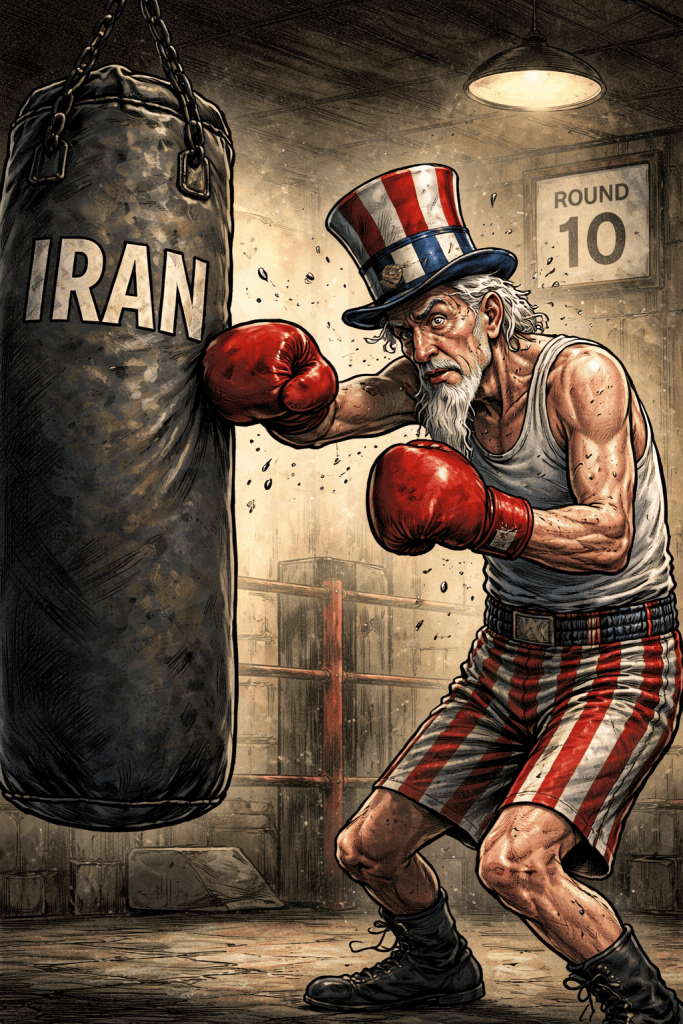
Mr. Trump prides himself on his sporting acumen, boxing included. He might profit from revisiting the old tactic known as rope-a-dope—absorbing an opponent’s early blows while allowing him to exhaust himself.
It increasingly appears that Iran, whether by design or by default, has let the United States and Israel expend their fury in the early rounds. The fantasy of a swift and decisive victory has already begun to fade. The later rounds, as history reminds us, are rarely kind to the overconfident
I am struck by how many baby boomers—people who lived through the long, humiliating unraveling of the Vietnam War—now sit mute as events in Iran unfold with eerie familiarity. Administration officials boast of battlefield successes, air superiority, and naval dominance, seemingly oblivious to the central truth: one can win engagements and still lose a war. We have seen this movie before, and it did not end well.
Robert McNamara and Pete Hegseth could scarcely be more dissimilar in intellect, temperament, or experience. Yet each, in his own way, has helped steer the nation toward costly and unnecessary entanglements—misjudgments dressed up as strategy.
Donald Trump’s reaction to the death of Robert Mueller—equal parts gloating and grievance—barely registered. The public has grown accustomed to his braying bombast. What future historians may judge more harshly is not the noise, but the silence: the quiet acquiescence of supporters and enablers to language that is scurrilous, conduct that is aberrant, and a worldview steeped in grievance and suspicion.
Who, then, is winning?
Perhaps it is the side whose propaganda is merely implausible rather than preposterous. A concealed—and possibly incapacitated—ayatollah now enjoys more perceived credibility than an American president. That alone should give pause.
And who will yield first?
The Israeli citizen huddled in a basement as drones darken the sky? The Iranian civilian surveying shattered streets and calling it survival? Or the American consumer, grumbling at the gas pump before heading to the shore or a matinee?
It is a curious coincidence that my current mood mirrors the title of our military operation in Iran: “Epic Fury.” The name suggests thunder, certainty, and righteous purpose. The reality, at least from the cheap seats, looks more like improvisation.
I have lived long enough to watch the United States march confidently into a number of foreign adventures—Vietnam, Afghanistan, Libya, Bosnia, and Iraq. Each was introduced with a sense of urgency and moral clarity. Most ended with a mixture of exhaustion, regret, and unanswered questions. Our present venture in Iran already shows signs of joining that distinguished club, perhaps even eclipsing it.
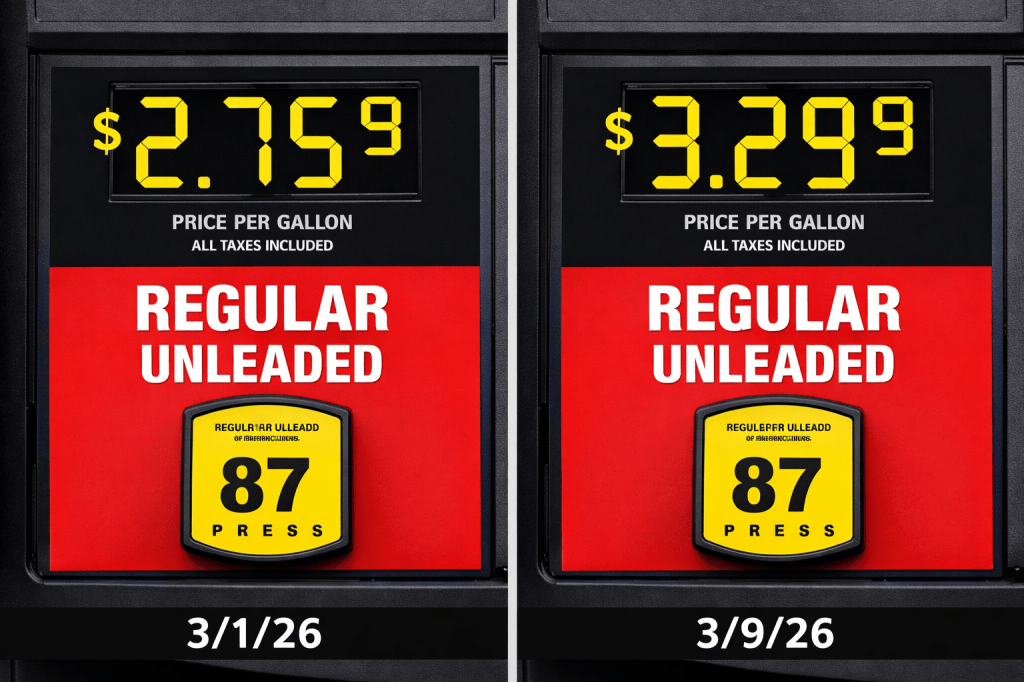
The consequences are beginning to show up in the most ordinary places. Less than two weeks ago, I was able to buy gasoline for $2.75 a gallon. Today the price stands at $3.29, nearly a 20 percent increase in a remarkably short time. If the conflict drags on—and poorly managed wars have a habit of doing just that—it is not difficult to imagine four- or even five-dollar gasoline within a couple of months.
Military operations also have political consequences beyond the battlefield. Whatever chance there might have been for ordinary Iranians to rise up against their government likely vanished with the bombing of a school that reportedly housed more than 160 girls. Matters were made worse when the President of the United States denied American responsibility for the strike, despite widespread evidence suggesting otherwise. In international affairs, credibility is a fragile currency; once spent, it is not easily replenished.
Meanwhile, reports have surfaced of American citizens stranded in the Middle East and struggling to return home. Many of them have publicly criticized the government’s response as slow and ineffective. European nations appear to have moved more quickly to assist their citizens. One might think that when preparing to launch military action in a volatile region, the vulnerability of civilians traveling there would be among the first considerations.
At home, the tone of official commentary has been oddly celebratory. President Donald Trump and Defense Secretary Pete Hegseth have spoken enthusiastically about the progress of the war, as though they were watching a football game and cheering for the home team. The president has even suggested that victory is already at hand. One cannot help recalling the moment when George W. Bush stood beneath a banner reading Mission Accomplished during the early days of the Iraq War—history’s way of reminding us that wars rarely consult our schedules.
Equally striking is the silence from United States Congress, which has shown little appetite for asserting its constitutional role in declaring war. In an odd twist, the make shift government of Iraq seems to have displayed more backbone than the legislative branch of the United States.
Nor does the rhetoric appear to be cooling. The president and Senator Lindsey Graham have already floated the possibility of confronting Cuba next. If this pace continues, the rest of the world may soon revive the old phrase “axis of evil,” this time with the United States awkwardly included in the lineup.
Yet the most unusual feature of this conflict may be the public reaction—or lack of it. There is little enthusiasm for the war. Outside of Fox News, vocal support seems muted. To be sure, few people mourn the death of Ruhollah Khomeini, but his successor—his son, widely described as even more militant—now stands ready to assume power. If the goal was regime change, the results remain unclear and may even prove counterproductive.
At the same time, there are no massive protests in the streets. My suspicion is that the country is suffering from a kind of national exhaustion—call it Trump fatigue. Americans have been through so many political convulsions in recent years that many seem to have retreated into weary silence. That quiet might evaporate quickly if the conflict expands into a ground war requiring a military draft.
History provides its own contrast. During World War II, the United States benefited from the leadership of Franklin D. Roosevelt and a formidable group of experienced military commanders. Today’s leadership—President Trump and Secretary Hegseth—presents a different picture. Comparisons are inevitable, though perhaps best left unstated.
Where all this leads is anyone’s guess. The conflict has already begun to ripple through the global economy and the delicate machinery of international politics. My own sense is that the outcome will prove costly for the United States in both arenas. At the moment, the only nation that appears satisfied is Israel. Elsewhere, goodwill toward America is becoming a scarce commodity.
For a country that prides itself on making friends and leading alliances, that may turn out to be the most serious casualty of all.

 Esot-eric