I feel like I am a family member whose father has gone on a drunken murder spree and murdered innocent women and children randomly in the streets. To make it worse, other members of my family support him and make excuses for his insane actions.
“We are on track to complete all of America’s military objectives shortly — very shortly,” he said. “We are going to hit them extremely hard over the next two to three weeks. We’re going to bring them back to the Stone Ages, where they belong.”
Donald J. Trump 4/1/26 Address to nation
Washington has become the court of Nero, a fiery emperor, submissive courtiers and a ketamine-fueled jester in charge of purging the civil service…Never in history has a President of the United States capitulated to the enemy. Never has anyone supported an aggressor against an ally. Never has anyone trampled on the American Constitution, issued so many illegal decrees, dismissed judges who could have prevented him from doing so, dismissed the military general staff in one fell swoop, weakened all checks and balances, and taken control of social media.
Claude Malhuet on the End of American Democracy, speaking in the French Senate, Tuesday, March 4, 2025.
Most of America is exhausted with all the lies, buffoonery, hypocrisy, incompetence and delusions in Washington. With all the firings (Bondi, Noem etc.) can we fire Donald Trump too? Then we must seriously question the judgment of the people who voted for and still support him.
There was a time when I could sit for hours and read without interruption—five or six books a month, fully absorbed. At 73, that kind of sustained attention has faded. I now struggle to finish three books a month, and even then, my focus isn’t what it once was.
Newport argues that technology—especially the ever-present phone—has rewired our attention. His advice is deceptively simple: keep your phone out of reach. When it’s not within arm’s length, it loses its power to hijack your thinking. A small habit, perhaps, but one that hints at a larger truth: we are living in an age of constant distraction.
That theme—diminished focus—feels like it extends beyond the personal and into the national.
I’ve been watching commentary from Paul Krugman on the current tensions involving the U.S. and Iran. In one particularly sharp observation, he contrasted the so-called “Best and the Brightest” of the Lyndon B. Johnson era—those who guided America into Vietnam—with what he jokingly calls today’s equivalent: “the worst and the dumbest.”
The remark is biting, but it reflects a deeper concern about competence in leadership. Krugman suggests that this problem may not be confined to politics alone but could extend into the military, where experienced leadership has reportedly been sidelined in favor of loyalty.
Watching recent confirmation hearings only reinforces that impression. Time and again, nominees evade straightforward questions—particularly those concerning January 6, 2021 United States Capitol attack and the outcome of the 2020 election. The refusal to engage plainly with basic facts is not just frustrating—it’s revealing.
All of this points to a broader unease: a sense that competence, once expected as a baseline, is now optional.
Leadership matters most in moments of uncertainty, and yet this is when clarity, judgment, and integrity seem in shortest supply. The handling of tensions abroad, particularly involving Iran, reflects not just strategic missteps but a deeper erosion of seriousness.
Even figures like Pete Hegseth—sometimes dismissed as more performative than substantive—have come to symbolize this shift. The comparison to “Baghdad Bob” may be harsh, but it captures a growing perception: rhetoric is replacing reality.
Perhaps Newport’s observation applies more broadly than he intended. When attention fragments, so does judgment. And when judgment falters at the highest levels, the consequences are no longer personal—they are national.
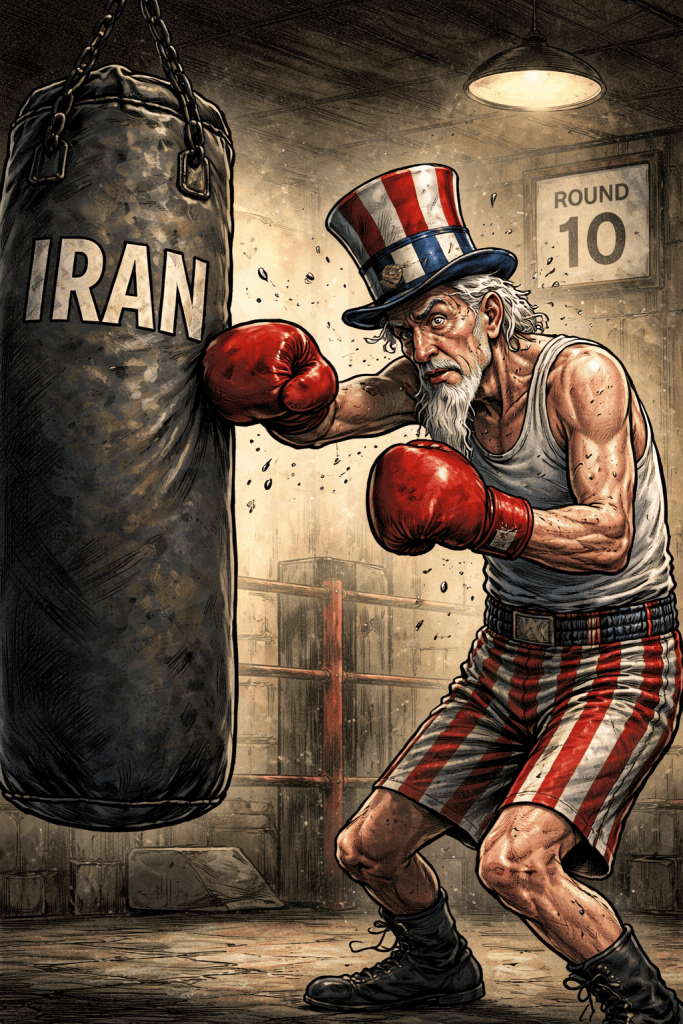
Mr. Trump prides himself on his sporting acumen, boxing included. He might profit from revisiting the old tactic known as rope-a-dope—absorbing an opponent’s early blows while allowing him to exhaust himself.
It increasingly appears that Iran, whether by design or by default, has let the United States and Israel expend their fury in the early rounds. The fantasy of a swift and decisive victory has already begun to fade. The later rounds, as history reminds us, are rarely kind to the overconfident
I am struck by how many baby boomers—people who lived through the long, humiliating unraveling of the Vietnam War—now sit mute as events in Iran unfold with eerie familiarity. Administration officials boast of battlefield successes, air superiority, and naval dominance, seemingly oblivious to the central truth: one can win engagements and still lose a war. We have seen this movie before, and it did not end well.
Robert McNamara and Pete Hegseth could scarcely be more dissimilar in intellect, temperament, or experience. Yet each, in his own way, has helped steer the nation toward costly and unnecessary entanglements—misjudgments dressed up as strategy.
Donald Trump’s reaction to the death of Robert Mueller—equal parts gloating and grievance—barely registered. The public has grown accustomed to his braying bombast. What future historians may judge more harshly is not the noise, but the silence: the quiet acquiescence of supporters and enablers to language that is scurrilous, conduct that is aberrant, and a worldview steeped in grievance and suspicion.
Who, then, is winning?
Perhaps it is the side whose propaganda is merely implausible rather than preposterous. A concealed—and possibly incapacitated—ayatollah now enjoys more perceived credibility than an American president. That alone should give pause.
And who will yield first?
The Israeli citizen huddled in a basement as drones darken the sky? The Iranian civilian surveying shattered streets and calling it survival? Or the American consumer, grumbling at the gas pump before heading to the shore or a matinee?
“We didn’t tell anybody about it because we wanted surprise,” he said. “Who knows better about surprise than Japan, OK? Why didn’t you tell me about Pearl Harbor, OK? Right?”
There was some laughter from the officials and journalists gathered in the room. “You believe in surprise, I think, much more so than us,” he added.
As Mr. Trump spoke, Ms. Takaichi (Japanese Prime Minister) widened her eyes and appeared to take a deep breath. She kept her arms crossed in her lap and did not speak.
My commentary:
Trump should be very careful about “Pearl Harbor references. The United States was in negotiations with Iran when it launched its attack. According to Oman diplomats who were facilitating the meetings, negotiations were going quite well and peace seemed reasonable as Iran had agreed to many of U.S. demands. Then the U.S. began to bomb Iran. In December 1941, the United States and Japan were also in the midst of diplomatic negotations and this provided confidence to the U.S. that no hostile acts from Japan were imminent. On December 7, 1941 Japan attacked Pearl Harbor
2. Any journalist or official who laughed at that remark is an idiot and not worthy of being in a room with the stature of the Japanese Prime Minister and she would be right to consider the laughter as an insult to her personally and Japan.
3. Trump desperately needs not to make any more enemies or to make enemies feel more embittered to the United States. Japan, like most of the world is getting screwed from rising oil prices. And Trump wonders why no one takes him seriously.
It is a curious coincidence that my current mood mirrors the title of our military operation in Iran: “Epic Fury.” The name suggests thunder, certainty, and righteous purpose. The reality, at least from the cheap seats, looks more like improvisation.
I have lived long enough to watch the United States march confidently into a number of foreign adventures—Vietnam, Afghanistan, Libya, Bosnia, and Iraq. Each was introduced with a sense of urgency and moral clarity. Most ended with a mixture of exhaustion, regret, and unanswered questions. Our present venture in Iran already shows signs of joining that distinguished club, perhaps even eclipsing it.
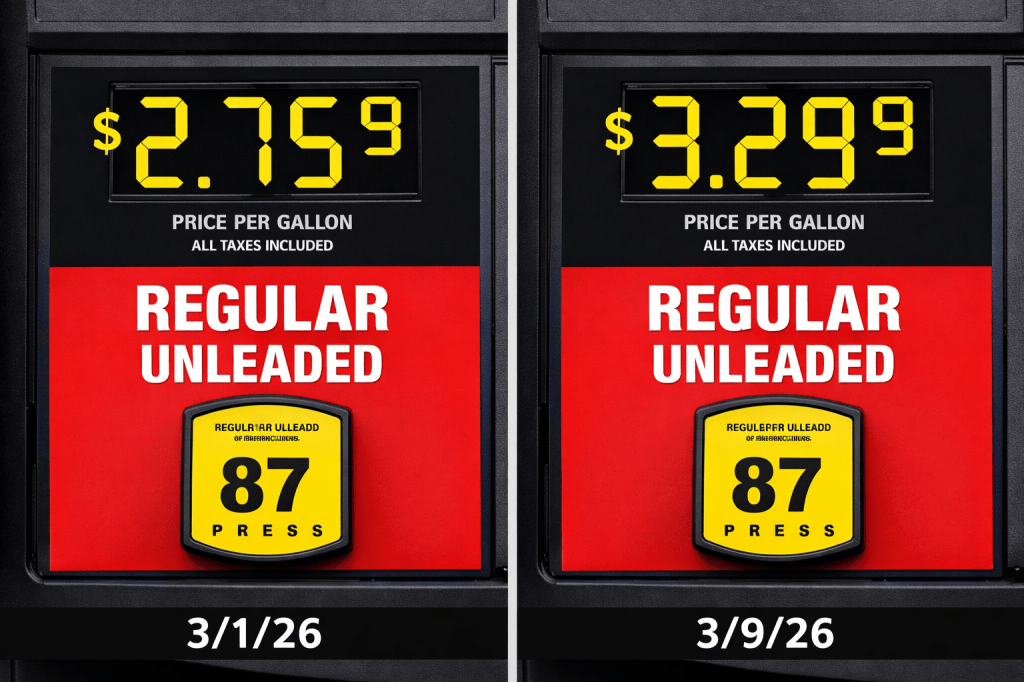
The consequences are beginning to show up in the most ordinary places. Less than two weeks ago, I was able to buy gasoline for $2.75 a gallon. Today the price stands at $3.29, nearly a 20 percent increase in a remarkably short time. If the conflict drags on—and poorly managed wars have a habit of doing just that—it is not difficult to imagine four- or even five-dollar gasoline within a couple of months.
Military operations also have political consequences beyond the battlefield. Whatever chance there might have been for ordinary Iranians to rise up against their government likely vanished with the bombing of a school that reportedly housed more than 160 girls. Matters were made worse when the President of the United States denied American responsibility for the strike, despite widespread evidence suggesting otherwise. In international affairs, credibility is a fragile currency; once spent, it is not easily replenished.
Meanwhile, reports have surfaced of American citizens stranded in the Middle East and struggling to return home. Many of them have publicly criticized the government’s response as slow and ineffective. European nations appear to have moved more quickly to assist their citizens. One might think that when preparing to launch military action in a volatile region, the vulnerability of civilians traveling there would be among the first considerations.
At home, the tone of official commentary has been oddly celebratory. President Donald Trump and Defense Secretary Pete Hegseth have spoken enthusiastically about the progress of the war, as though they were watching a football game and cheering for the home team. The president has even suggested that victory is already at hand. One cannot help recalling the moment when George W. Bush stood beneath a banner reading Mission Accomplished during the early days of the Iraq War—history’s way of reminding us that wars rarely consult our schedules.
Equally striking is the silence from United States Congress, which has shown little appetite for asserting its constitutional role in declaring war. In an odd twist, the make shift government of Iraq seems to have displayed more backbone than the legislative branch of the United States.
Nor does the rhetoric appear to be cooling. The president and Senator Lindsey Graham have already floated the possibility of confronting Cuba next. If this pace continues, the rest of the world may soon revive the old phrase “axis of evil,” this time with the United States awkwardly included in the lineup.
Yet the most unusual feature of this conflict may be the public reaction—or lack of it. There is little enthusiasm for the war. Outside of Fox News, vocal support seems muted. To be sure, few people mourn the death of Ruhollah Khomeini, but his successor—his son, widely described as even more militant—now stands ready to assume power. If the goal was regime change, the results remain unclear and may even prove counterproductive.
At the same time, there are no massive protests in the streets. My suspicion is that the country is suffering from a kind of national exhaustion—call it Trump fatigue. Americans have been through so many political convulsions in recent years that many seem to have retreated into weary silence. That quiet might evaporate quickly if the conflict expands into a ground war requiring a military draft.
History provides its own contrast. During World War II, the United States benefited from the leadership of Franklin D. Roosevelt and a formidable group of experienced military commanders. Today’s leadership—President Trump and Secretary Hegseth—presents a different picture. Comparisons are inevitable, though perhaps best left unstated.
Where all this leads is anyone’s guess. The conflict has already begun to ripple through the global economy and the delicate machinery of international politics. My own sense is that the outcome will prove costly for the United States in both arenas. At the moment, the only nation that appears satisfied is Israel. Elsewhere, goodwill toward America is becoming a scarce commodity.
For a country that prides itself on making friends and leading alliances, that may turn out to be the most serious casualty of all.
If the first casualty of war is truth, the second casualty is trust..
What if you throw a regime-change party and the people you’re “liberating” don’t come?
Iran is an example of intelligence failure, not that attributed to the CIA or military sources but specifically the lack of judgement, expertise and rationality from decision makers in Washington.
Trump supporters and enablers are learning or will soon find out that they will be held with the same regard as those associated with Jeffrey Epstein.
Past “credible war spokeswomen”: Tokyo Rose and Axis Sallie; today: Karoline Leavitt
Opportunity open for regime change in Iran= Khomeini killed; opportunity closed for regime change in Iran= Minab school bombing
Personal Note: What a mess! Not much rationality and reason getting through at this time. Iran’s drones are more successful penetrating our defense system.
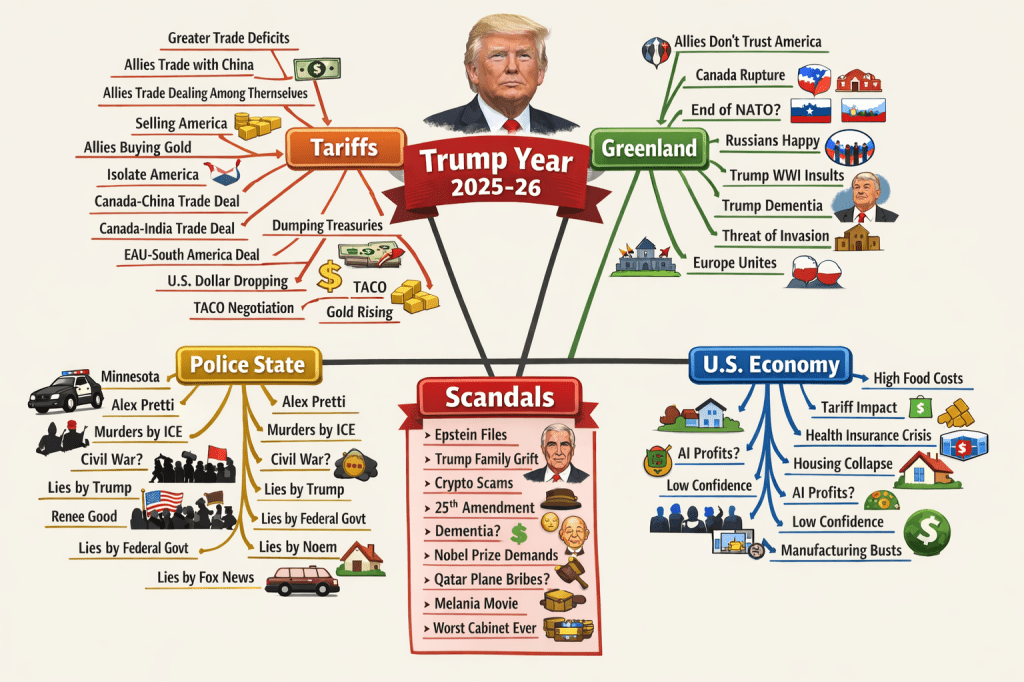
Tried to get CHAT GPT to create a mind map of the destructive whirlwind that is the Trump administration based on information I provided. It understood about 75% of what I was looking for. I enjoy infographics and illustrations and I will work to improve my efforts in those areas.
As an aside, very concerned around developments of the declining U.S. dollar. Shows declining confidence by investors inside and outside the United States. Treasuries provide the funds needed to fund our government and essentially, the American lifestyle.
Trump’s enduring legacy is not an institutional structure, but rather a highly toxic culture that has been adopted by many of the president’s followers and will live on after he is gone. Threats against Greenland, NATO, and individual European countries mean that no ally will be able to trust commitments made by the United States again.
Discourse by government officials has been degraded. Cabinet officers and press secretaries know that they don’t have to respond to questions they don’t like because they can simply insult the questioner. And companies will understand that they need to seek individual favors rather than general policies governing entire sectors.
I will not be alive when historians begin to write definitively about the United States during the Trump era. In truth, I would much rather read about it twenty years after it has ended than live through it as it unfolds. Standing in 2026, I find myself trying to imagine what scholars in 2046 might identify as the defining themes, causes, and consequences of this period. I have no time machine—only conjecture.
My assumption is that the central question historians will grapple with is not simply who Donald Trump was, but how and why American voters enabled the Trump era to occur. Inevitably, comparisons will be drawn to other moments in history when democratic systems elevated leaders who later proved deeply polarizing or destructive. Germany in the 1930s will be one such reference point, though careful historians will also emphasize key differences: Germany’s economic collapse, political fragility, and social despair far exceeded conditions in the United States in 2016.
Several lines of inquiry seem likely to dominate future assessments:
Congressional Enablers Trump’s support did not emerge in isolation. Historians will likely examine the role of Republican members of Congress who, with few exceptions, aligned themselves with Trump despite repeated controversies, ethical questions, and institutional challenges. Whether motivated by ideology, fear of political retaliation, or electoral self-preservation, their collective restraint—or lack of resistance—will invite comparison with earlier moments when legislators faced tests of independence and conscience, including those explored in John F. Kennedy’s Profiles in Courage.
The Supreme Court and the Long View A twenty-year gap may provide a more balanced framework for evaluating the Trump-era Supreme Court. With time, historians will be better positioned to assess whether the Court’s decisions strengthened constitutional principles, reshaped social norms, or produced unintended consequences that only became visible over decades.
Corporate Power and Quiet Support Many business leaders offered tacit or indirect support for Trump’s agenda, particularly where deregulation and tax policy aligned with their interests. Future researchers will likely scrutinize financial records, lobbying efforts, and private communications to better understand the extent to which economic power influenced public policy—details that were not always transparent in real time.
The Press and the Meaning of Truth The so-called mainstream press positioned itself largely in opposition to Trump, yet it did so while facing financial decline and growing competition from social media platforms. One enduring issue of the era was the erosion of shared definitions of “truth” and “fact.” Even well-sourced reporting was frequently dismissed as “fake news,” raising long-term questions about public trust, epistemology, and the role of journalism in a fragmented media environment.
Ideological Media and Political Identity Conservative media outlets—most notably Fox News, along with a network of right-leaning digital platforms—played a significant role in shaping how events were interpreted by audiences seeking reinforcement of political and cultural identities. Historians may study this ecosystem as a case study in modern persuasion, examining how narrative repetition, grievance framing, and selective information proved highly effective.
Immigration Enforcement and Historical Comparison Immigration policy and enforcement will remain one of the most contested aspects of the Trump era. Some commentators drew historical parallels to authoritarian practices of the past, while others argued such comparisons were exaggerated or inappropriate. With the benefit of distance, historians will likely focus on legality, implementation, humanitarian impact, and rhetoric—allowing future generations to judge the fairness and proportionality of those comparisons.
History rarely delivers simple verdicts. It weighs context, consequences, and contradictions. When the Trump era is finally written about with the benefit of time and distance, the most enduring lesson may not center on one man alone, but on the resilience—or fragility—of democratic institutions and the citizens who sustain them.
My thoughts to a friend about the Greenland situation…
I sometimes wonder whether people at the White House read the news, particularly the business and financial news. For example, they would see that China and Canada have entered major trade agreements, now viewed as a new strategic partnership. The European Union and various South American countries have also just entered into a landmark trade agreement. They might also want to check out who currently holds our US treasuries. After Japan and China, the next eight countries are European and the Cayman Islands. I don’t think you want to piss off people who are holding your paper. I don’t think you also want to piss off countries who will tell you to take your military bases and troops and get the hell out. The rest of the world, particularly our allies are moving on. They can’t trust us and by “us” I mean the government and the American voters who enabled all this. What moves this government is not diplomacy but money and finance and our leverage on those matters are thinning.

 Esot-eric