Playing with “White House” Money

I’ll admit it: I wasn’t the most attentive economics student in college. But recent events have forced me into a crash course in tariffs, trade, the stock market—and most urgently—the U.S. Treasury market.

These aren’t abstract terms anymore. I’ve been following the conversations—some sober, some frantic—coming from economists, traders, financial analysts, and CEOs. What stands out is how few of them support our current approach to tariffs. I hesitate to call it a “policy.” It feels more like something made up on the fly.

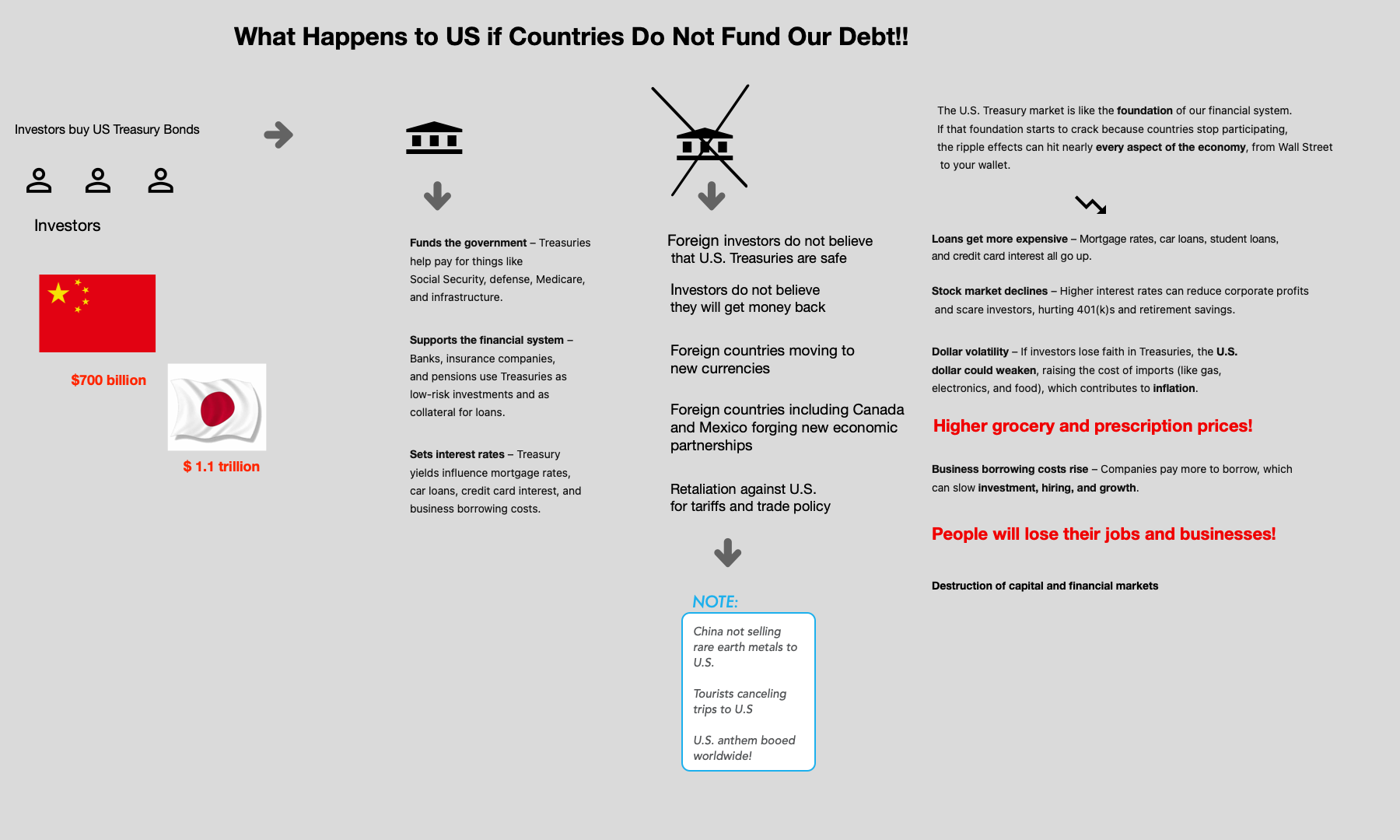
President Trump has been lucky in the past. He was rescued by his father’s money and banks willing to take risks that didn’t always pan out. He wasn’t so lucky in the casino business, and I don’t think he realizes he’s holding a weak hand in the high-stakes game of tariffs. When countries like China and Japan begin offloading U.S. Treasuries, it’s not just a financial maneuver—it’s a warning. They’re saying loud and clear: you’re not playing with our house money.

Let’s be honest: America is losing friends. Longtime allies are distancing themselves. They were stunned when Trump won reelection last November—and outright furious when “Liberation Day” was declared weeks ago. While Congress, the courts, and much of the press seem hesitant to challenge him, our international allies are not. They’re making new economic and diplomatic arrangements—and the U.S. is no longer on the guest list.

This has consequences. If foreign investors stop buying U.S. Treasury bonds—or worse, start selling them—our ability to fund government programs, including Social Security, is at risk. No one will be spared the fallout. It’s hard to believe our leaders don’t grasp how dangerous this path is.

And it may already be too late. Confidence in the U.S. has taken a major hit. There are reports of Canadian tourists canceling trips here—more signs of the growing unease.

If you’re a CEO or business owner, how can you plan with any confidence when the rules of the game keep shifting? The White House seems deaf to the frustration coming from both abroad and increasingly from within our own borders.

Democrats and critics are pinning their hopes on the 2026 midterms. But if this trajectory continues, I worry about what condition the country will be in by then.

And what about the seniors who voted for Trump? How do they feel now that Social Security offices are closing and workers are being laid off? When the Commerce Secretary brushed off concerns about late checks—suggesting a delay of a week or so would be no big deal—I wanted to shout: Wanna bet?

There’s a lot of noise out there. A lot of shouting, marching, hand-wringing. But not a lot of clarity or direction. Sometimes, it feels like we’ve passed the point of no return. Judging by the way our allies are behaving, they seem to think we already have.
Times Out

The Sunday New York Times remains one of life’s pleasures. I do miss reading the enormous print edition of the paper with the magazine but at least the online edition still suffices. Shown below are a book I’d like to read and useful analysis and advice from various columnists.

Flesh

by David Szalay

Szalay’s new novel traces the life of a young man in Hungary who eventually makes his way to England, following him from troubled youth to immigrant success to tragic fall. Each chapter provides glimpses of the major stages of adulthood — first love, marriage, parenthood — interwoven with intervals of aimlessness, reinvention and grief. With cool detachment, Szalay offers observations on both the complicated self and the unpredictable world surrounding it.

***

Our current antiglobal moment could last for a long time. Illiberalism is alive and strong. Comparisons that once seemed incendiary or irresponsible now seem obvious. As in the 1930s, minority groups are being scapegoated as symbols and causes of globalization’s ills. For Jews then, read migrants or trans people now. Mr. Trump’s imminent betrayal of Ukraine suggests that we are moving rapidly through the 1930s and have already arrived in 1938. That’s when Western leaders in Munich decided to allow Hitler to dismember one of Europe’s few remaining democracies, Czechoslovakia. It was not worth risking lives over “a quarrel in a faraway country, between people of whom we know nothing,” reasoned the dangerously reasonable Neville Chamberlain. Less than one year later, Hitler browbeat the president of what remained of Czechoslovakia into accepting a complete occupation of his country.

Russia’s invasion of Ukraine was a déjà vu moment for historians of World War II. Will Greenland and Canada become the next Czechoslovakia and Poland?

Globalization Is Collapsing. Brace Yourselves.
By Tara Zahra
Dr. Zahra is a professor of history at the University of Chicago and has written extensively about globalization’s first collapse.

***

A 20 minute agility workout to improve balance

***

Instead of following the standard guidance to keep withdrawals to 4 percent of the balance in your retirement account, then adjust annually for inflation, you might forgo the inflation raise when stock prices are falling, Dr. Pfau said. Or you can install so-called guardrails, limiting withdrawals to, say, 3 percent in bad years for stocks but taking out, perhaps, 5 percent when the market is surging.

How to Protect Your Retirement Savings Now as Markets Plunge by Diane Harris

***

My problem is with Trump’s magical thinking that you just put up walls of protection around an industry (or our whole economy) and — presto! — in short order, U.S. factories will blossom and make those products in America at the same cost with no burden for U.S. consumers.

For starters, that view completely misses the fact that virtually every complex product today — from cars to iPhones to mRNA vaccines — is manufactured by giant, complex, global manufacturing ecosystems. That is why those products get steadily better and cheaper. Sure, if you are protecting the steel industry, a commodity, our tariffs might quickly help. But if you are protecting the auto industry and you think just putting up a tariff wall will do it, you don’t know anything about how cars are made. It would take years for American car companies to replace the global supply chains they depend on and make everything in America. Even Tesla has to import some parts.

I Just Saw the Future. It Was Not in America. Thomas L. Friedman

Land of the Free? Home of the Brave?

It’s gutting—and deeply humiliating—to hear Canadians booing our national anthem at recent sporting events. But I don’t blame them. Not one bit.

Given the economic, political, and moral wreckage left behind by our twice-elected president, their disgust is understandable. The confusion and contempt from our allies aren’t aimed solely at the man in the Oval Office—they’re aimed at the people who put him there. Twice.

Let’s call it what it is: the United States has betrayed its friends, waged economic war on its own citizens, and devolved into a carnival of cowardice. The respect of our allies? That ship has sailed—and may not return in our lifetimes.

The Republican Party is a gelatinous mass of fear and sycophancy, devoid of courage or principle. The Democratic Party? A staggering monument to incompetence, still fumbling through the aftermath of letting a failed businessman and convicted felon stroll back into power.

And democracy? Please. We are no longer a beacon of anything. The Constitution has become a quaint relic, a yellowing parchment trotted out for ceremonial purposes while those in power treat it like a suggestion menu at a diner they never plan to pay for.

Maybe—just maybe—a sliver of Trump voters feel some remorse. But let’s be clear: 77 million people helped break this country. They owe their children, their neighbors, and the world an apology.

The red MAGA cap is no longer a slogan. It’s a symbol—loud, defiant, and chilling. Our allies don’t see us as brave. They see us as brainwashed. And in the eyes of much of the world, that crimson hat might as well be a swastika.

We have not simply lost our way. We’ve torched the map and handed the match to a mob.

Start of the Rout?

If America is a stock, is it time to dump it and sell?

Like the ouroboros, I believe Big Tech is eating itself alive with its component companies throwing more and more cash at investments in one another that are most likely to generate less and less of a return. Monday’s correction shows that our financial markets — and possibly your retirement portfolio — may be starting to reflect an understanding of this dynamic. New York Times 1/28/25 I Study Financial Markets. The Nvidia Rout Is Only the Start. Mihir A. Desai is a professor at Harvard Business School and Harvard Law School.

If Trump’s all-in-on-fossil-fuels, “drill, baby, drill” rallying cry — at the dawn of this era of artificial intelligence, electric vehicles, batteries and autonomous cars — really becomes our strategy, it will not make America great again. But it will definitely help make China great again. New York Times 1/28/25 Trump Is Going Woke Thomas Friedman

The bond market is telling us something about the dawn of the second Trump presidency, and it’s not pretty….Most of the policies proposed by President Trump, from tariffs to additional fiscal stimulus to deportations that tighten the labor market, are expected to add to inflation. And to the degree they are enacted, they will combine with an inflation rate that has declined rapidly, but which remains above the Federal Reserve’s target and is still higher than it was during most of the decade leading up to the pandemic. Rising long-term rates are bad for businesses and households that need to borrow, since the cost of loans such as mortgages and auto loans are directly linked to 10-year Treasury yields. New York Times 1/29/25 Trump’s Plans Are Already Making Your Life More Expensive Rebecca Patterson (is an economist and market strategist)