Outlive: The Science and Art of Longevity by Peter Attia (Review and Notes)

My rating: 3 of 5 stars (Goodreads)

It’s a very long book with some helpful background science and medical information. But I can’t say that I really learned anything new. It may or less reinforces things that I have read or heard previously. For someone younger than 40, it may be a cautionary tale and a more valuable read than for someone as old as me.

My notes from the book.

The odds are overwhelming that you will die as a result of one of the chronic diseases of aging that I call the Four Horsemen: heart disease, cancer, neurodegenerative disease, or type 2 diabetes and related metabolic dysfunction.

Exercise is by far the most potent longevity “drug.” No other intervention does nearly as much to prolong our lifespan and preserve our cognitive and physical function. But most people don’t do nearly enough—and exercising the wrong way can do as much harm as good.

Our tactics in Medicine 3.0 fall into five broad domains: exercise, nutrition, sleep, emotional health, and exogenous molecules.

So we will break down this thing called exercise into its most important components: strength, stability, aerobic efficiency, and peak aerobic capacity. Increasing your limits in each of these areas is necessary if you are hoping to reach your limit of lifespan and healthspan.

My point is that if you really stop to consider the kind of aerobic fitness that most people actually need in the course of their lives, it basically boils down to being really good at going slow for a long time, but also able to go hard and fast when needed.

The best science out there says that what you eat matters, but the first-order term is how much you eat: how many calories you take into your body.

You may have heard of this gene, which is called APOE, because of its known effect on Alzheimer’s disease risk.¨

The authors of the study, published in Nature, speculated that rapamycin might extend lifespan “by postponing death from cancer, by retarding mechanisms of aging, or both.”¨

This is not an atypical scenario: when a patient comes to me and says their father or grandfather or aunt, or all three, died of “premature” heart disease, elevated Lp(a) is the first thing I look for. It is the most prevalent hereditary risk factor for heart disease, and its danger is amplified by the fact that it is still largely flying under the radar of Medicine 2.0, although that is beginning to change.

¨This is why, if you have a history of premature heart attacks in your family, you should definitely ask for an Lp(a) test. We test every single patient for Lp(a) during their first blood draw.¨

The single most powerful item in our preventive tool kit is exercise, which has a two-pronged impact on Alzheimer’s disease risk: it helps maintain glucose homeostasis, and it improves the health of our vasculature.¨

Strength training is likely just as important. A study looking at nearly half a million patients in the United Kingdom found that grip strength, an excellent proxy for overall strength, was strongly and inversely associated with the incidence of dementia.¨

Sleep disruptions and poor sleep are potential drivers of increased risk of dementia. If poor sleep is accompanied by high stress and elevated cortisol levels, as in Stephanie’s case, that acts almost as a multiplier of risk, as it contributes to insulin resistance and damaging the hippocampus at the same time.¨

Studies have found that hearing loss is clearly associated with Alzheimer’s disease, but it’s not a direct symptom. Rather, it seems hearing loss may be causally linked to cognitive decline, because folks with hearing loss tend to pull back and withdraw from interactions with others.¨

In Medicine 3.0, we have five tactical domains that we can address in order to alter someone’s health. The first is exercise, which I consider to be by far the most potent domain in terms of its impact on both lifespan and healthspan.¨

Next is diet or nutrition—or as I prefer to call it, nutritional biochemistry. The third domain is sleep, which has gone underappreciated by Medicine 2.0 until relatively recently. The fourth domain encompasses a set of tools and techniques to manage and improve emotional health. Our fifth and final domain consists of the various drugs, supplements, and hormones that doctors learn about in medical school and beyond. I lump these into one bucket called exogenous molecules, meaning molecules we ingest that come from outside the body.¨

Think of the Centenarian Decathlon as the ten most important physical tasks you will want to be able to do for the rest of your life.¨

The three dimensions in which we want to optimize our fitness are aerobic endurance and efficiency (aka cardio), strength, and stability. All three of these are key to maintaining your health and strength as you age.¨

In San Millán’s view, healthy mitochondria are key to both athletic performance and metabolic health. Our mitochondria can convert both glucose and fatty acids to energy—but while glucose can be metabolized in multiple different ways, fatty acids can be converted to energy only in the mitochondria. Mitochondrial health becomes especially important as we grow older, because one of the most significant hallmarks of aging is a decline in the number and quality of our mitochondria.¨

Strength training, especially with heavy weights, stimulates the growth of bone—more than impact sports such as running…


View all my reviews
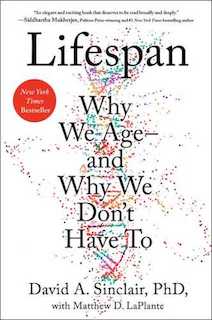
Lifespan: Why We Age and Why We Don’t Have To by David A. Sinclair (Review and Notes)

If you are over 50 years old, this book is an excellent resource related to your health, general fitness and quality of life.

I have included some excerpts for the book as my notes and reference:

I believe that aging is a disease. I believe it is treatable. I believe we can treat it within our lifetimes. And in doing so, I believe, everything we know about human health will be fundamentally changed.

There are some simple tests to determine how biologically old you probably are. The number of push-ups you can do is a good indicator. If you are over 45 and can do more than 20, you are doing well. The other test of age is the sitting rising test. Sit on the floor, barefooted, with the legs crossed. Lean forward quickly and see if you can get up in one move. A young person can. A middle-age person typically needs to push off with one of their hands. An elderly person often needs to get onto one knee.

There’s also a difference between extending life and prolonging vitality. We’re capable of both, but simply keeping people alive – – decades after their lives have been defined by pain, disease, frailty, and immobility – – is no virtue.

Multiple “hallmarks” of aging:
Genomic instability caused by DNA damage
Attrition of the protective chromosomal endocaps, the telomeres
Alterations to the epigenome that controls which genes are turned on and off
Loss of healthy protein maintenance, known as proteostatis
Deregulated nutrient sensing caused by metallic changes
Mitochondrial dysfunction
Accumulation of senescent zombielike cells that inflame healthy cells
Exhaustion of stem cells
Altered intercellular communication and the production of inflammatory molecules

Youth—broken DNA genome instability— disruption of DNA packaging and gene regulation (the epigenome)— loss of cell identity —cellular senescence— disease— death

The older we get, the less it takes for an injury or illness to drive us to our deaths. We are pushing closer and closer to the precipice until it takes nothing more than a gentle went to send us over. This is the very definition of frailty.

When we stay healthy and vibrant, as long as we feel young physically and mentally, our age doesn’t matter. That’s true whether you are 32, 52, or 92. Most middle-aged and older adults in the United States report feeling 10 to 20 years younger than their age, because they feel healthy. And feeling younger than your age predicts lower mortality and better cognitive abilities later in life.

After 25 years of researching aging and having read thousands of scientific papers, if there is one piece of advice I can offer, one sure fire way to stay healthy longer, one thing you can do to maximize your lifespan right now, it’s this: eat less often.

The important thing is not just what we eat but the way we eat. Many of the centenarians have spent their lives eschewing a morning meal. They generally eat their first small meal of the day around noon, then share a larger meal with their families at twilight. In this way, they typically spend 16 hours or more of each day without eating.

According to one study funded by the Centers for Disease Control and Prevention and published in 2017, individuals who exercise more – – the equivalent of at least a half hour of jogging five days a week – –have telomeres that appear to be nearly a decade younger than those who live a more sedentary life.

One recent study found that those who ran 4-5 miles a week – – for most people, that’s an amount of exercise that can be done in less than 15 minutes per day – – reduce the chance of death from a heart attack by 45% and all cause mortality by 30%.

It’s high intensity interval training (HIIT) the sort that significantly raises your heart and respiration rates— that engages the greatest number of health promoting genes and more of them in older exercisers.

A study of more than 41,000 metformin users between the ages of 68 and 81 concluded that metformin reduced the likelihood of dementia, cardiovascular disease, cancer, frailty, and depression, and not by a small amount.

People taking metformin were living notably healthier lives – – independent, it seemed, of its affects on diabetes.

The beauty of metformin is that it impacts many diseases. Through the power of AMPK activation, it makes more NAD and turns on sirtuins and other defenses against aging as a whole -– engaging the survival circuit upstream of these conditions, ostensibly slowing the loss of epi-genetic information and keeping metabolism in check, so all organs stay younger and healthier.

Like most people, I don’t want unlimited years, just ones filled with less sickness and more love. And for most of those I know who are engaged in this work, the fight against aging is not about ending death; it’s about prolonging healthy life and giving more people the chance to meet death on far better terms – – indeed, on their own terms. Quickly and painlessly. When they are ready.

Either by refusing the treatments and therapies at all for a prolong healthy life or accepting those interventions and then deciding to leave whenever the time is right, no one who has returned what they have been given should have to stay on this planet if he or she does not wish to do so. And we need to begin the process of developing the cultural, ethical, and legal principles that will allow that to happen.

The Only Thing We Have to Fear…

“I am certain that my fellow Americans expect that on my induction into the Presidency I will address them with a candor and a decision which the present situation of our people impel. This is preeminently the time to speak the truth, the whole truth, frankly and boldly. Nor need we shrink from honestly facing conditions in our country today. This great Nation will endure as it has endured, will revive and will prosper. So, first of all, let me assert my firm belief that the only thing we have to fear is fear itself—nameless, unreasoning, unjustified terror which paralyzes needed efforts to convert retreat into advance. I 

Franklin Delano Roosevelt 1933

In my lifetime, I have experienced events that made me fearful. The first one that I recall was the Cuban Missile Crisis in 1962. I was ten years old. I remember that we were on the brink of war with the Soviet Union. At school, we were all instructed on how to get under our desks, cover our heads and close our eyes. I believe there was a CONELRAD system which also provided an early warning if missiles were being fired. I remember they tested air raid sirens as part of the rehearsal. Fortunately we were led by a very smart president, John F. Kennedy and the crisis passed.

I have experienced stock market crashes (1987, 2008-2009), hurricanes with landfalls in New Jersey, urban riots (Camden), 9/11, and unemployment. Personally I have survived cancer scares for myself and my wife. I don’t like apocalyptic horror stories but I feel like I am in one.

That being said, I don’t know if I’ve ever experienced the type of chronic fear related to this coronavirus pandemic. Some of it may be due to my age and my susceptibility if I should be infected with the virus. This is so different. I don’t see solutions. I don’t see a quick end to this disaster. A lot of my fear and discomfort comes from factors other than my vulnerability.

The United States government and in particular the Trump administration have done a horrible job of communicating the status of the pandemic, the number of people infected and what steps are being taken to ensure the safety of the citizens of the United States. I think the Trump administration has made it a priority to focus on the effects to the economy.  To hell with people, “how do we both prop up the stock market and the Dow?” Where are the tests that people need to take? That should be the priority.

This is obviously a crisis that needs to be adequately addressed by scientists and medical personnel. Instead we have politicians literally falling all over themselves to politicize this catastrophe. This is a time when we urgently need smart and responsible leadership. Regrettably over the past month, I have seen no one with the credibility, leadership and communication skills to provide confidence to the public.

The media has also done a poor job. They are doing more to frighten people than they are to responsibly inform us of latest developments. I am tired of watching news conferences provided by local government officials and health agencies each time an individual is infected. They keep urging the public to remain calm but they do a very poor job of answering questions and providing guidance as to what the public may expect. Many officials appear reluctant to speak candidly and honestly about what they know.

Lord knows we desperately need a Franklin Delano Roosevelt. Unfortunately we are saddled with a Donald Trump and his administration that appears clueless on how to manage this crisis. My sense is that we have not even begun to experience the severity and breadth of this pandemic. We have no idea how long that we must remain vigilant. My sense is that the pandemic will be with us for a few years and that we need desperately for science to develop the necessary vaccine so that we can get back to living a routine life again.