Backbone

So, you’re talking about a deceitful and highly discredited so-called journalist who’s made a profession of peddling hoaxes time and time again to include the, I don’t know, the hoaxes of Russia, Russia, Russia! Or the fine people on both sides hoax. Or suckers and losers hoax. So, this is a guy that peddles in garbage. This is what he does…Nobody was texting war plans. And that’s all I have to say about that. Thank you.

Secretary of Defense Pete Hegseth

“This appears to be an authentic message chain, and we are reviewing how an inadvertent number was added to the chain.”

National Security Council Member

Like many of my friends who are MAGA supporters, I too wish for a return to the 1950s and 1960s. But for a different reason and perspective…I have listed a small group of political leaders and journalists who showed courage, integrity and judgement in the performance of their duties. They all possessed “backbone”, a quality that is so lacking in Washington D.C. and in many press rooms. These are individuals who did not necessarily toe the party line and displayed personal and professional courage in their political stands.

At my age, I wax nostalgic for the candor and probity in my youth as opposed to the pablum and lies I am subjected in my seasoned years.

Political Leadership:

Martin Luther King Jr. – moral leadership.

Robert F. Kennedy – major advocate for civil rights, poverty alleviation, and social justice before his assassination.

Barry Goldwater – though conservative, he was fiercely independent, opposed religious extremism, and later supported LGBTQ+ rights.

Margaret Chase Smith (R-ME) – A trailblazer, she was the first woman to serve in both the House and Senate. She stood up to McCarthyism with her Declaration of Conscience speech in 1950, warning against the dangers of demagoguery and political extremism.

Frank Church (D-ID) – A leader in investigating government overreach and abuses of power (Church Committee). He’d be crucial in today’s discussions on government surveillance.

Howard Baker (R-TN) – Although his prime influence came in the 1970s, his approach to bipartisan leadership and honesty in government (Watergate hearings) would be crucial today.

Journalists

Edward R. Murrow– fearless in confronting McCarthyism, a standard-bearer for integrity in journalism.

Walter Cronkite – “the most trusted man in America,” his objective reporting shaped public opinion.

William F. Buckley Jr. – Founder of National Review, he shaped modern conservatism with sharp wit, deep intellect, and respect for debate

Mike Royko – A tough, blue-collar newspaper columnist from Chicago who took on corrupt politicians, injustice, and hypocrisy with biting humor.

Eric Sevareid- Candid and biting essays on political topics.

Mike Wallace (CBS) – Before 60 Minutes, he was an aggressive interviewer who exposed political deception.

James Reston (New York Times) – A Pulitzer Prize-winning columnist who had a major influence on political journalism.

Mary McCarthy (The New Republic, The New York Review of Books) – A brilliant and sharp political writer, she was an outspoken critic of U.S. foreign policy, McCarthyism, and the Vietnam War.

Dorothy Thompson (New York Herald Tribune, Ladies’ Home Journal) – One of the most influential political columnists of the mid-20th century. She was a fierce critic of fascism before and after WWII and tackled McCarthyism and Cold War paranoia.

How America Works… and Why it Doesn’t: A Brief Guide to the US Political System by William Cooper (Book Review)

I wish I could have our friends outside the United States read this book so they can understand what is going on inside it. The book is useful for citizens inside the United States but daily events related to DOGE, budget cuts, Elon Musk, court orders being ignored and chaos from Washington DC are front and center in our minds 24 hours daily. 

Cooper does a very good of explaining the national crisis affecting the United States and its consequences to the rest of the world. He describes how the government and our political system were intended to work. And he accurately analyzes why they aren’t working. Cooper also tries to be even handed on his criticism of both political parties and their leaders.

This book will be an excellent resource for historians 20 or more years out trying to explain the craziness of our contemporary times and politics. I appreciate that this book was updated to reflect the start of the second Trump Administration.

If I have any reservations about this book, it’s that I feel that Cooper is being a bit more optimistic than I am about this country’s immediate future. Cooper writes “None of these definitions applies to Trump. He doesn’t have absolute power over the whole of government. He’s not even close to that. He remains constitutionally responsible to the people in significant and fundamental ways…The most serious domestic risk America faces with Trump as president isn’t dictatorship. It’s that the military follows his orders to break the law—to go after American citizens, for example. This scenario, however, is unlikely.”

I have the advantage of seeing how things have unfolded with in the Trump administration since the book has been published and the author may want to temper his faith in the power of our Constitution and the rationality of the Trump presidency.

Below are some notes and highlights that will provide the prospective reader of an introduction to the book and topics…

Obama’s presidency deeply unsettled and angered millions of Americans not ready for a Black president. And Trump’s hostility to minorities (sometimes subtle, sometimes overt, always cunning) drives his popularity among many Republicans, particularly in southern states.

==========

If the President of the United States were ever to punish disfavored speakers like the Harvard faculty, Google’s CEO, or the New York Times’ publisher, the nation would be in peril.

==========

The root cause of America’s twenty-first-century decline is the combination of (1) tribalism, (2) social media, and (3) a malformed political structure.

==========

Journalists are now disproportionately focused on writing stories that will go viral on Facebook and Twitter, a very different goal from writing stories that will educate and inform

==========

Americans focus little on human history, let alone absorb its lessons. And an embarrassing percentage of them don’t understand basic civics.

==========

Just look at the presidency. Donald Trump is grossly unfit to hold America’s highest office…The House of Representatives, moreover, is throbbing with underqualified mediocrities.

==========

The remedies are easy to prescribe. Americans must improve civic education in schools; raise awareness about cognitive biases throughout society; spend more time with people from other political tribes; reduce and regulate the use of social media; rework the political structure to foster more political parties and equal representation; double down on free speech; shun politically motivated prosecutions; feverishly guard election integrity; and support a new Republican champion other than Donald Trump.

==========

While Cooper’s remedies are easier to prescribe, they are impossible to fulfill. God bless the United States…

America’s Reputation and the Lessons of History

It Isn’t Just Trump. America’s Whole Reputation Is Shot by David Brooks is a sobering analysis of the chess pieces to fall now that our closest allies no longer trust Trump or Americans.

This is not just a Trump problem; America’s whole reputation is shot. I don’t care if Abraham Lincoln himself walked into the White House in 2029, no foreign leader can responsibly trust a nation that is perpetually four years away from electing another authoritarian nihilist.

It Isn’t Just Trump. America’s Whole Reputation Is Shot. David Brooks NYT 3/13/2025

While many draw comparisons between Hitler and Trump—particularly in how they gained and wielded power—I find the parallels between the German people of the early 1930s and Americans today more compelling.

After World War I, Germany was severely punished. It lost territory, its military was disarmed, and the burden of reparations crippled its economy. By the early 1930s, Germany, like much of the world, was in economic turmoil. Unemployment was rampant, and many were homeless and hungry. The country’s ability to recover was constrained by the strict terms imposed after the war.

In contrast, America in 2024 was not in crisis. The economy was largely stable, with low unemployment and a strong stock market. Inflation and housing affordability were challenges, but interest rate cuts signaled efforts to curb economic strain. Unlike pre-war Germany, the U.S. had not suffered a recent military defeat and remained the dominant global power, respected by allies and feared by adversaries.

Despite this position of strength, over 77 million Americans elected a candidate widely seen as aged, incoherent, and lacking a clear platform—a stark contrast to Germany in the 1930s, where voters turned to a charismatic leader promising national revival. Germany was desperate to rebuild; America was already strong.

From a historical view, which country was most guilty of making the most irrational choice at the time? The German people’s decision turned out to be catastrophic. Will America and Americans avoid the disapprobation of history? Time will tell…

State of the Dis-Union

A few fast observations:

The old Democratic strategy of “when they go low, we go high” is a loser.

While I appreciate its intent, peaceful demonstrations, petitions, and letter writing campaigns are passé and ineffective. The age of civil persuasion is dead.

A new political party (Democratic or other) needs a Machiavellian leader, a bit evil but unlike the Republican version, smart. (Maybe Mark Cuban?)

Now the Republicans are concerned about decorum?! Why didn’t this concern apply during Joe Biden’s State of the Union when Lauren Bobert and Marjorie Taylor Greene acted up like spoiled high school sophomores screeching for attention at a school dance.

Congressman Al Green was the only one Democrat with a backbone? When he was removed, all other Democrats should have walked out too.

Likewise, when the Associated Press was barred from White House press room, other legitimate press and news outlets should have left too.

The biggest slaughter this winter was not the Eagles beating the Chiefs in the Super Bowl, but the political thumping Republicans have handed the Democrats since Inauguration Day.

Joe Biden (or his enablers) and Merrick Garland are hugely responsible for the current political mess. They engaged in pillow throwing while Trump and the GOP went MMA.

The “reporter” who asked Zelensky why he was not wearing a suit to the White House must have received his journalism degree from Trump University.

Death knells have been announced periodically for both parties over the decades. However I hear a rattle anytime a Democrat politician speaks.

Communications from Democratic congressmen and women to constituents about how bad Trump is are useless. We get it. Things are bad and about to get worse. Create a plan or strategy and tell us what you are going to do as a party. How about someone stepping up as an effective opposition leader?

I would not count on midterms or any other future elections to change the political direction. First, not sure that they will take place. And second, very uncertain if they take place, whether the results will be “accurate.”

Tending My Fish: Reflections on a Republic in Decline 

As I contemplated last week’s election results, with all their dreary portents for the years ahead, I was reminded of the lament of a Roman senator—his power fading, his influence diminished, as Caesar’s star ascended:  

“I shall tend my fish, study philosophy, and comport myself for death. This republic holds no place for me any longer.”  

(Conspirata: A Novel of Ancient Rome, Robert Harris)  

And then I asked myself, “Does this country hold a place for me? 

The question is not rhetorical. At this late point in my life, I find myself at odds with the culture, principles, and trajectory of the nation I once revered. My beliefs—anchored in reason, history, and an old-fashioned sense of duty—seem increasingly alien in a land preoccupied with spectacle over substance.  

A Discontented Creed  

Consider, for example:  

Religion in Politics: As an agnostic, I believe that the pulpit should stay far away from the podium. Ministers and pastors claiming divine insights on policy strike me as charlatans with better wardrobes. Faith should inspire personal virtue, not dictate public policy.  

Loyalty to Allies: In diplomacy and in life, I value loyalty. A true ally stands by you in both triumph and trial. Yet we seem to cast off old friends—countries and principles alike—as if they were expired coupons.  

Science and Competence: I favor facts over feelings, competence over pretense. But ours is an age where bombast outweighs expertise, and the loudest voice is mistaken for the wisest.  

Reckoning with Our Past: This country’s history is a patchwork of greatness and failure. We have saved nations and crushed dreams, built monuments to liberty and ignored the cries of the oppressed. I believe in confronting our flaws honestly, not whitewashing them with comforting myths—or worse, erasing them entirely in the name of “offense.”  

Respect for Women: Here is a simple proposition: anyone who assaults, demeans, or dehumanizes women is unfit for public office. Full stop. Yet, 52% of white women voters apparently find this a negotiable standard. I am baffled—and disgusted.  

Character Matters: Good judgment, responsibility, empathy, and moral clarity—these should be the cornerstones of a person’s character. Increasingly, though, they are dismissed as relics of a bygone era, sacrificed on the altar of “winning at all costs.”  

A Nation Entertained to Death  The deepest cut of all, perhaps, is that we have traded informed citizenry for the hollow thrills of reality-show governance. Americans now crave entertainment over enlightenment. The morning chatter of Joe and Mika or the smirking commentary of Bill Maher may pass for insight, but to me, they feel like reruns of Neville Chamberlain in Munich, mistaking platitudes for policy while calamity looms.  

The Final Reckoning  

So here I am, like that Roman senator, contemplating my fish and philosophy. The republic of my youth—the one I fought to believe in—is unrecognizable.  

It is a strange thing to feel like an exile in one’s own country, but perhaps the true patriots are always exiles. We stand apart, unwilling to settle for the tawdry spectacle on offer, and dream of something better—a nation of character, competence, and courage.  

Until then, I will tend my fish.

The Myth of American Idealism: How U.S. Foreign Policy Endangers the World by Noam Chomsky and Nathan J. Robinson (Review)

The received wisdom insists that the United States is the tireless champion of democracy and human rights—a paragon of “Wilsonian idealism” and “American exceptionalism.” Noam Chomsky’s and Nathan J. Robinson’s The Myth of American Idealism: How U.S. Foreign Policy Endangers the World eviscerates this comforting narrative. The authors argue that U.S. foreign policy aligns not with noble ideals but with the strategic and economic interests of domestic elites. The result? A history marred by moral indifference, lawlessness, and a ruthless adherence to what Adam Smith once called “the vile maxim of the masters of mankind: All for ourselves and nothing for other people.”

This is not a book for the faint of heart or those who prefer their history wrapped in the star-spangled illusions of Hollywood. It is a damning indictment of U.S. actions abroad, examining case studies from Vietnam to Iraq, Chile to Palestine. The authors spare no sacred cow, exposing the contradictions between America’s lofty rhetoric and its sordid realpolitik.

I approached this book with some skepticism. Chomsky’s political ideology leans further left than my own, and I was wary of polemics. Yet his analysis aligns uncomfortably well with historical evidence. Take, for instance, his examination of U.S. support for Israel. The one-sided nature of American backing—military aid, UN vetoes, and tacit approval of Israeli excesses—has devastated Palestinians while fueling anti-American animus across the Middle East. Chomsky is clear-eyed about the complexities: there are cruel men on both sides of the Israeli-Palestinian divide. But the suffering of millions of innocent Palestinians, bombed, maimed, and displaced, is a humanitarian tragedy in which the United States is deeply complicit.

Equally scathing is his treatment of the Vietnam War—a blunder of monumental proportions. The authors chronicle how leaders lied to the public, sent thousands of soldiers to die needlessly, and plunged the nation into chaos. As someone who lived through that era, I can attest to the war’s divisive impact. For younger readers, this history is essential reading, a sobering reminder of how disastrously foreign policy can go astray when guided by hubris and deceit.

The prose is not exactly uplifting, but it is brutally clarifying. Are we, as Americans, driven by democracy and justice—or by greed and oil? The book challenges readers to reckon with a less flattering version of our heritage, one that calls for reflection rather than whitewashing.

No matter where you fall on the political spectrum, The Myth of American Idealism will provoke thought, discomfort, and perhaps a much-needed reckoning. If you prefer fairy tales about America’s benevolence, look elsewhere. For those willing to confront uncomfortable truths, this book is indispensable.

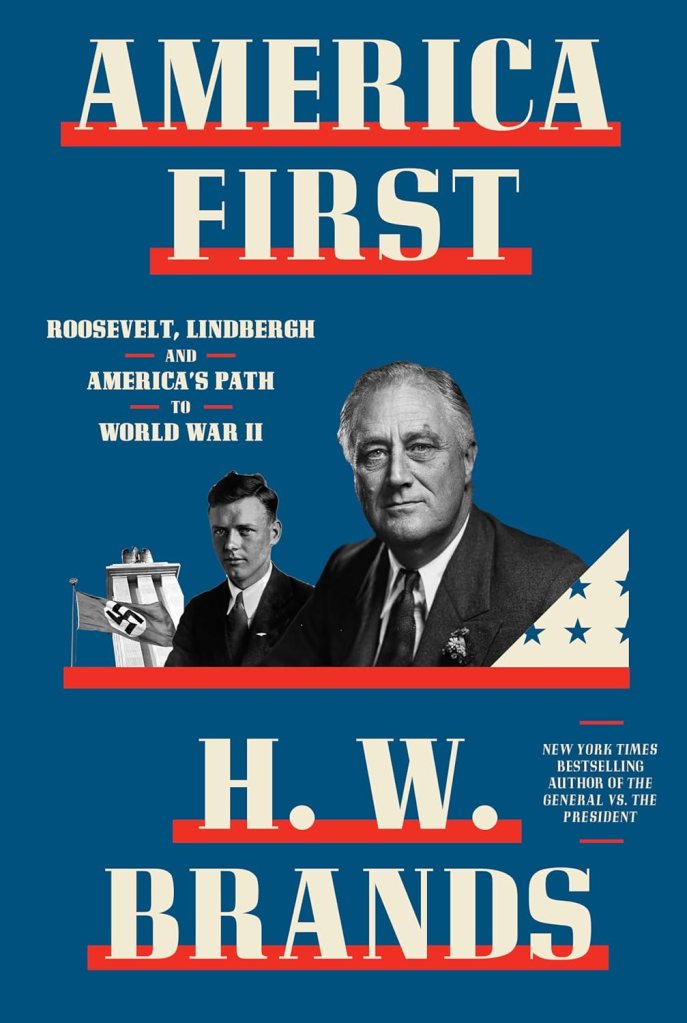
America First: Roosevelt vs. Lindbergh in the Shadow of War by H.W. Brands (Review)


My rating: 4 of 5 stars


On September 1, 1939, fighting broke out in Europe. After the invasion of Poland by Germany, both France and England declared war against the Nazis. Many, if not most Americans, were resistant to participating in a European war. Indeed, there was resistance to even supplying military supplies and other goods to Britain while they basically fought Germany on their own. There was also significant support for the Germany and Hitler’s regime at this time.

Franklin D. Roosevelt managed a fine line. He wished to be re-elected for a third term, but he also understood that Hitler’s goals were not only the conquest of Europe, but world conquest. Charles Lindbergh was an American hero for his exploits about flying across the Atlantic on his own. He and his wife Anne endured the kidnapping and murder of his son in 1932 and this endeared him more to the American public.

Lindbergh opposed US involvement in any war overseas. Lindbergh felt that America was invincible as it was protected by oceans and not vulnerable to air attacks. Lindbergh saw no reason for America to sacrifice its sons in European wars and spoke out strongly against any intervention.

How FDR positioned the United States to prepare for World War II is an interesting story of great judgment and leadership. FDR coordinated closely with Winston Churchill to ensure that Britain had the necessary weapons and materials to survive German assaults. Roosevelt had to skillfully maneuver his aid to Churchill under the watchful eye and some time opposition of a reluctant Congress.

Charles Lindbergh was accused of being an agent and dupe of the German government. There seems to be a little evidence of that. Lindbergh firmly believed that United States could stand on its own and ably defend itself against any foreign attack or invasion. Circumstances and events proved that Lindburgh was incorrect in his analysis but he did volunteer to help the military in any capacity once United States entered the war.

Today there are isolationist policies still being supported. There are many Americans and people in Congress, who do not feel that we should be supporting Ukraine in its battle against Russia and Putin. Are they guilty of being short sighted too? There are some interesting historical similarities there.

This book was well researched and an excellent read. It quotes from Lindbergh’s diaries and provides a good measure of the man and his ambitions. I think that Lindbergh was largely circumspect and responsible in his criticism over American foreign policy. FDR happened to be right in his judgement about Hitler and America’s role in stopping tyranny.


Takeover: Hitler’s Final Rise to Power by Timothy W. Ryback (Review)

My rating: 4 of 5 stars

310 pages

What struck and scared me as I read this book was how similar the political situations in Germany in the early 1930s were to the United States currently. Each country was and is going through a burgerkrieg (civil war) where there exists intense, political differences that often resulted in violence. Hindenburg stayed in office as he feared Hitler gaining political power. Hindenburg was accused of dementia and suffering from the ravages of old age. Today, Joe Biden fears a Trump presidency and the end of democracy in the United States. Biden too, is accused of suffering from dementia and being too old to serve another four year term.

In both the cases of Hitler and Trump, there were events that could have and should have ended their political pursuits. Hitler persevered through many defeats, political, personal and strategic.

I was not familiar with the appropriate knowledge of German history from 1918 till 1933 when Hitler seized power. Ryback provides the necessary background, history, and important men during this period. This book may provide a greater service in understanding what is happening in the United States today by looking back at what happened in Germany in the 1930s.

Shown below are my notes from this book..

“It has been said that the Weimar Republic died twice. It was murdered, and it committed suicide. There is little mystery to the murder. Hitler vowed to destroy democracy through the democratic process and he did.”

Trump and Hitler similarities
Neither were drinkers
Both felons
Both thin skinned
Both very poor liars (If you tell a lie long enough and keep repeating it…Goebbels)
Both suffered election defeats that they refused to accept
Both overestimated crowd sizes at various rallies and events
Both were counted out after electoral and political defeats and came back
Both sought to annul election results and lost
Both seeking to establish dictatorships embraced by the populace
Both opposed by older men (Hindenburg and Biden) who feared their rise to power
Both promising “revenge” on their political opponents when they gain power
Both used immigration issues (Hitler-Polish, Trump-Mexicans and South Americans) to stir up enthusiasm from their political base

Oswald Spengler knew both men. (referring to Hitler and Strasser). The author of the two volume landmark treatise Decline of the West was considered one of the leading conservative thinkers of today. Spengler found Hitler to be “clueless, indecisive, in a word, dumb. “

Adolf Hitler gave thousands of young Germans a chance from escape from reality Time wrote in December 1931. Hitlerites had uniforms, brass bands, roaring mass meetings, plenty of free beer. (Trump MAGA rallies 2020-2024)

The next day, Vorwarts (German newspaper) splashed the news in a banner headline, “Hitler wants to rule!” The editors were frantic at the thought. “The appointment of Hitler is out of the question because he lacks even the most basic qualifications”, they wrote. “You cannot trust a government to the leader of a party in recent days has been responsible for perpetuating countless horrific acts of violence without discrediting the authority of the state before the eyes of the entire world, not to mention the majority of its own people. “There was also the fact that Hitler served prison time for treason against the very state he was now seeking to rule.”


View all my reviews

An Unfinished Love Story: A Personal History of the 1960s by Doris Kearns Goodwin (Review)

My rating: 5 of 5 stars

Memoir…history…love story… Prior to reading this book, I was vaguely aware of the name, Richard Goodwin, and his involvement in politics and in the Kennedy and Johnson administrations. I was not aware of his specific roles. as it turns out, he was a man of certain influence working for both John F, Kennedy and Lyndon Johnson. Turns out he was a great speechwriter, wordsmith and political strategist. He was described as a “generalist”, a man who could fill a lot of roles and responsibilities.

Growing up in the 60s, I, of course, was interested in the nostalgic trip during that decade. Goodwin was a huge fan of the Kennedys. This created significant issues when he worked for Lyndon Johnson. Goodwin was involved to a certain degree in the discussions around civil rights, Vietnam, the Great Society etc.

Based on the book, it seems that Goodwin did not receive the credit he should’ve gotten for his effective communication of both JFK’s and LBJ’s’s policies and goals. Goodwin seem to find himself in hot water, often inadvertently, with people he worked for. In 1968 Goodwin worked for Eugene McCarthy, prior to RFK’s entry into the presidential race. Goodwin had quite a balancing act and at the same time, he did not wish to undermine the policies of Lyndon Johnson.

Doris Kearns Goodwin is an excellent writer. I have seen her on new shows on television where she is a thoughtful and effective communicator. This is an excellent book. If a reader has an interest in 1960’s history, politics or wishes to know more about the Kennedy and Johnson administrations, this book is an excellent resource.

Dick Goodwin had an interesting career and he seems motivated to achieve as much good as he could in the various roles he had in government. This is definitely a five star book!

View all my reviews

Review: The Harding Affair: Love and Espionage during the Great War by David Robenalt

The Harding Affair: Love and Espionage during the Great War by James David Robenalt

My rating: 2 of 5 stars

The affair between Warren Harding and Carrie Phillips was actually very boring. Evidently there were lots of love letters and correspondence between the two. And I do mean boring love letters and boring correspondence. I pretty much skimmed over those that were published in the book. The book contains some interesting history about Republican politics in the years of Taft and Theodore Roosevelt. Harding found himself caught in the middle of that political squabble. There is also some interesting history and commentary regarding the United States entering World War I. Just like World War II, there was great antipathy on the part of the American public to be involved in the war. In addition, there was a great deal of sympathy for Germany.

Based on the book, Harding appears to be a capable senator, hard-working and capable of compromise. He was a very good speaker and in demand for his abilities. However the shameless way that he pursued Mrs. Phillips does not present him in a good light. Given that his wife was constantly in bad health, one could understand his need for female companionship. But Mrs. Phillips was a needy and manipulative woman. The book covers allegations that she was a spy for Germany in World War I. Based on the book, it appears the only certain thing that could be alleged was that she was very sympathetic for the German cause and attempted to persuade Harding towards that end.

I slogged through the book more for the historical morsels around the time of World War I than for the less than sordid details of Harding’s affair(s). This book did provoke an interest in reading a book written about the Harding presidential administration.


View all my reviews