Book Review of 1929: Inside the Greatest Crash in Wall Street History – and How It Shattered a Nation by Andrew Ross Sorkin

I’ve been an admirer of Andrew Ross Sorkin’s financial reporting for years, particularly through his work on CNBC, and I previously enjoyed his book Too Big to Fail, a definitive account of the 2008–2009 financial crisis. With that bias admitted upfront, I found 1929 to be an engaging and illuminating read. Though the book is lengthy—about 444 pages—it never feels like a dry history textbook. Instead, it flows with the narrative tension of a novel, making complex financial events accessible and compelling.

A background or interest in finance, economics, or banking certainly enriches the reading experience, but Sorkin’s storytelling makes the material approachable even for those who aren’t steeped in economic jargon.

A Rich, Relevant History

What makes this book especially resonant is how closely the late 1920s echo aspects of our present moment. The U.S. had recently emerged from a pandemic; optimism about growth and technological change was widespread; and the stock market appeared unstoppable. Investors—large and small—took on unprecedented leverage, borrowing heavily to chase rising share prices.

But economic momentum is fragile. Once confidence cracked, the market’s collapse was swift and devastating. The crash wiped out fortunes, triggered a steep economic downturn, and led to widespread unemployment. The government and the Federal Reserve lacked a clear or unified strategy, and their responses were often reactive, hesitant, or contradictory.

Sorkin offers a nuanced view of Herbert Hoover, depicting him not as the caricature of incompetence found in some earlier accounts, but as a leader who recognized the depth of the crisis and attempted—albeit imperfectly—to stem the damage. It’s a more sympathetic portrait than many readers might expect.

Vivid Personalities and Power Players

The book is populated with fascinating figures from finance, government and politics, including:

  • Charles Mitchell, chairman and CEO of National City Bank (a central figure in the era’s excessive speculation)
  • Winston Churchill
  • Franklin Delano Roosevelt
  • Senator Carter Glass
  • Evangeline Adams
  • Herbert Hoover
  • Ferdinand Pecora
  • and many others

Sorkin demonstrates how the interplay of personalities, policies, and economic forces created the conditions for both the boom and the crash. His research is broad, and his interpretations are measured yet insightful.


Reflections on Today’s Economy

Reading about 1929 inevitably led me to think about the state of the economy today. Although history doesn’t repeat itself exactly, the parallels are difficult to ignore.

  • Policy and leadership concerns: I have deep concerns about the current administration’s economic management. Policies such as tariffs continue to ripple through the U.S. and global economies, often harming consumers and industries rather than helping them.
  • Social and economic inequities: Decisions to cut or withhold food aid and other social supports can create long-lasting harm. Tax structures continue to favor the wealthy, while those with the least must rely on charity to meet basic needs.
  • Economic data skepticism: I find it increasingly hard to trust official numbers—whether on inflation, unemployment, or growth—given how politicized and selectively interpreted economic data has become.
  • Uncertain impact of AI: Artificial intelligence is propping up portions of the stock market, but the long-term effects on employment, productivity, and corporate earnings remain unclear. Few leaders or analysts can articulate what the next decade will really look like if the hype fizzles.
  • Declining trust in corporate leadership: Watching CEOs—particularly in tech and finance—publicly defer to political power has shaken my confidence in their judgment. Elon Musk is the most visible example, but he is not alone.
  • The culture of greed: Increasingly, it feels as if greed has become our national creed. Even institutions that purport to offer moral guidance seem more interested in fundraising than fostering compassion or community.
Discordia Ascendant (Chaos Rules)

Reading the news is not necessarily the best way to start your day

“Big, beautiful” tax bill would add $2.4 trillion to US debts, CBO says.

Trump bans 12 countries’ citizens from entering the US.

Emergency Abortions: The Trump administration announced that it had revoked a Biden administration requirement that hospitals provide emergency abortions to women whose health is in peril, including in states where abortion is restricted or banned.

Too many Christians are transforming Christianity into a vertical faith, one that focuses on your personal relationship with God at the expense of the horizontal relationship you have with your neighbors. Selfishness Is Not a Virtue David French NYT 6/5/25

The consumer goods giant Procter & Gamble said on Thursday that it would cut 7,000 jobs globally over the next two years, or 6 percent of its total work force, as it seeks to reorganize amid uncertainty caused by President Trump’s trade war.

A federal judge in Colorado on Wednesday temporarily blocked the Trump administration from deporting the wife and children of the Egyptian man charged with attacking an event in Boulder, Colo., honoring hostages in Gaza….“Punishing individuals for the alleged actions of their relatives is a feature of premodern justice systems or police state dictatorships, not democracies,” (Eric Lee, Attorney for the family)

But with the Trump administration slashing spending on science, Dr. Patapoutian’s federal grant to develop new approaches to treating pain has been frozen. In late February, he posted on Bluesky that such cuts would damage biomedical research and prompt an exodus of talent from the United States. Within hours, he had an email from China, offering to move his lab to “any city, any university I want,” he said, with a guarantee of funding for the next 20 years…Applications from China and Europe for graduate student or postdoctoral positions in the United States have dropped sharply or dried up entirely since President Trump took office. The number of postdocs and graduate students in the United States applying for jobs abroad has spiked.

When the current Congress was convened in January, there were nearly 120 members who were 70 or older — 86 in the House, including nonvoting delegates, and 33 in the Senate. This number, which is unmatched in modern history, included 14 octogenarians in the House, five in the Senate, and 91-year-old Senator Charles E. Grassley, Republican of Iowa.“Big, beautiful” tax bill would add $2.4 trillion to US debts, CBO says.


Playing with “White House” Money

I’ll admit it: I wasn’t the most attentive economics student in college. But recent events have forced me into a crash course in tariffs, trade, the stock market—and most urgently—the U.S. Treasury market.

These aren’t abstract terms anymore. I’ve been following the conversations—some sober, some frantic—coming from economists, traders, financial analysts, and CEOs. What stands out is how few of them support our current approach to tariffs. I hesitate to call it a “policy.” It feels more like something made up on the fly.

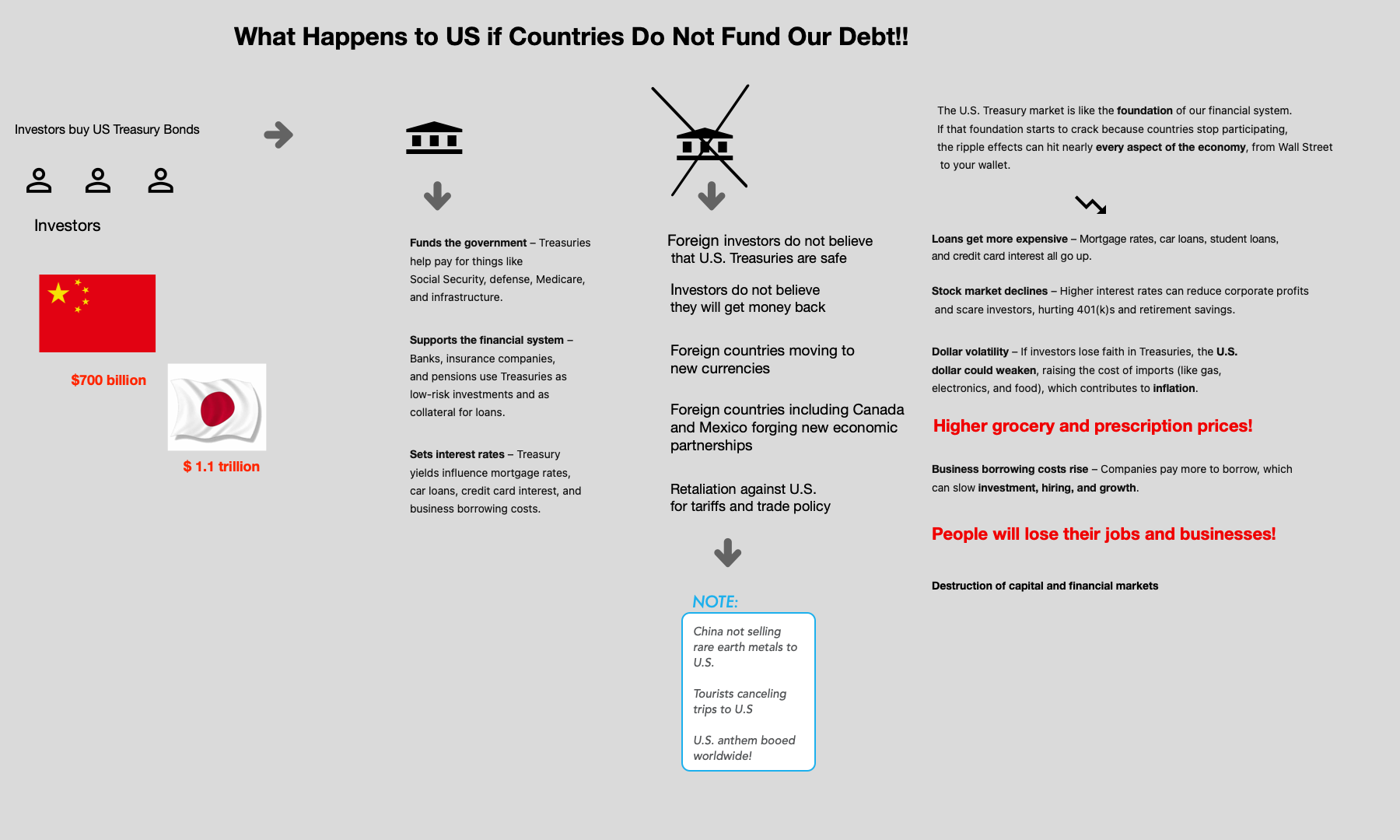
President Trump has been lucky in the past. He was rescued by his father’s money and banks willing to take risks that didn’t always pan out. He wasn’t so lucky in the casino business, and I don’t think he realizes he’s holding a weak hand in the high-stakes game of tariffs. When countries like China and Japan begin offloading U.S. Treasuries, it’s not just a financial maneuver—it’s a warning. They’re saying loud and clear: you’re not playing with our house money.

Let’s be honest: America is losing friends. Longtime allies are distancing themselves. They were stunned when Trump won reelection last November—and outright furious when “Liberation Day” was declared weeks ago. While Congress, the courts, and much of the press seem hesitant to challenge him, our international allies are not. They’re making new economic and diplomatic arrangements—and the U.S. is no longer on the guest list.

This has consequences. If foreign investors stop buying U.S. Treasury bonds—or worse, start selling them—our ability to fund government programs, including Social Security, is at risk. No one will be spared the fallout. It’s hard to believe our leaders don’t grasp how dangerous this path is.

And it may already be too late. Confidence in the U.S. has taken a major hit. There are reports of Canadian tourists canceling trips here—more signs of the growing unease.

If you’re a CEO or business owner, how can you plan with any confidence when the rules of the game keep shifting? The White House seems deaf to the frustration coming from both abroad and increasingly from within our own borders.

Democrats and critics are pinning their hopes on the 2026 midterms. But if this trajectory continues, I worry about what condition the country will be in by then.

And what about the seniors who voted for Trump? How do they feel now that Social Security offices are closing and workers are being laid off? When the Commerce Secretary brushed off concerns about late checks—suggesting a delay of a week or so would be no big deal—I wanted to shout: Wanna bet?

There’s a lot of noise out there. A lot of shouting, marching, hand-wringing. But not a lot of clarity or direction. Sometimes, it feels like we’ve passed the point of no return. Judging by the way our allies are behaving, they seem to think we already have.

Evil Geniuses: the Unmaking of America : A Recent History by Kurt Andersen

This is a very sobering but not surprising story. The “evil geniuses” in this story include Ronald Reagan, Donald Trump, Milton Friedman, Lewis Powell, John H. Sununu, Mitch McConnell, Grover Norquist, Robert Bork and others. The Democrats own a lot of the blame too. Their Congress representatives were lobbied to support various deregulation efforts and tax cut packages. And now many Americans reap what has been sowed and plotted by the economic right.

The rich have gotten richer and the middle and lower classes have struggled the past 40 years. Listed below are some notes from my reading of the book:

In 1980, income above $700,000 (in today’s dollars) was taxed at 70% by the federal government, but today the top rate is 37%. And the richest Americans, who back in the day paid an average of 51% in federal, state and local taxes combined, now pay just 33%.

The richest 0.01% of Americans, the one in 10,000 families worth an average of $500 million, pay in effect federal income tax rate half what it was in the 1970s.

Before 1980, all Americans’ incomes grew at the same basic rate as the overall economy. Since 1980, the only people whose incomes have increased at that rate are people with household incomes in the range today of $180,000 to $450,000. People with incomes higher than that, the top 1%, have gotten increases much bigger than the overall economic growth. Meanwhile 90% of Americans have done worse than the economy overall.

The average monthly Social Security retirement benefit more than tripled from 1950 to 1980, adjusted for inflation, but it has increased by just half in the four decades since.

“The greatest lie is that the 401(k) was capable of replacing the old system of pensions,” says the regretful man who was president of the American Society of Pension actuaries at the time and who had given his strong endorsement to 401(k)s. Today only one in eight private sector employees are in line to get such a pension, and most American workers don’t even have a 401(k) or an IRA or any other retirement account.

Only a quarter of people graduating from four-year public colleges and universities in the early 1990s had student loan debt; by 2010, 2/3 did.

The United States economy since 1980 has grown as much as or more than those of most of our rich country peers, although not all —-Sweden, for instance, has continuously grown faster than America for the last 30 years. But while the average US income and GDP per capita have risen as fast as or faster than incomes in your European economies, in exceptional America the more real life relevant median income – – the amount of money going to the person who earns more than the poor half and less than the rich half has hardly budged for decades.

In every international ranking of healthcare quality, the United States is low, from 28th to 37th place. Until the 1980s too, life expectancies for people in all the rich countries were increasing right in line but now people in the other countries live 3 to 5 years longer on average than Americans. According to the health efficiency index compiled by Bloomberg News which combines longevity and healthcare spending into a single metric for almost every country, the United States is second from the bottom, better only than Bulgaria.