Book Review of 1929: Inside the Greatest Crash in Wall Street History – and How It Shattered a Nation by Andrew Ross Sorkin

I’ve been an admirer of Andrew Ross Sorkin’s financial reporting for years, particularly through his work on CNBC, and I previously enjoyed his book Too Big to Fail, a definitive account of the 2008–2009 financial crisis. With that bias admitted upfront, I found 1929 to be an engaging and illuminating read. Though the book is lengthy—about 444 pages—it never feels like a dry history textbook. Instead, it flows with the narrative tension of a novel, making complex financial events accessible and compelling.

A background or interest in finance, economics, or banking certainly enriches the reading experience, but Sorkin’s storytelling makes the material approachable even for those who aren’t steeped in economic jargon.

A Rich, Relevant History

What makes this book especially resonant is how closely the late 1920s echo aspects of our present moment. The U.S. had recently emerged from a pandemic; optimism about growth and technological change was widespread; and the stock market appeared unstoppable. Investors—large and small—took on unprecedented leverage, borrowing heavily to chase rising share prices.

But economic momentum is fragile. Once confidence cracked, the market’s collapse was swift and devastating. The crash wiped out fortunes, triggered a steep economic downturn, and led to widespread unemployment. The government and the Federal Reserve lacked a clear or unified strategy, and their responses were often reactive, hesitant, or contradictory.

Sorkin offers a nuanced view of Herbert Hoover, depicting him not as the caricature of incompetence found in some earlier accounts, but as a leader who recognized the depth of the crisis and attempted—albeit imperfectly—to stem the damage. It’s a more sympathetic portrait than many readers might expect.

Vivid Personalities and Power Players

The book is populated with fascinating figures from finance, government and politics, including:

  • Charles Mitchell, chairman and CEO of National City Bank (a central figure in the era’s excessive speculation)
  • Winston Churchill
  • Franklin Delano Roosevelt
  • Senator Carter Glass
  • Evangeline Adams
  • Herbert Hoover
  • Ferdinand Pecora
  • and many others

Sorkin demonstrates how the interplay of personalities, policies, and economic forces created the conditions for both the boom and the crash. His research is broad, and his interpretations are measured yet insightful.


Reflections on Today’s Economy

Reading about 1929 inevitably led me to think about the state of the economy today. Although history doesn’t repeat itself exactly, the parallels are difficult to ignore.

  • Policy and leadership concerns: I have deep concerns about the current administration’s economic management. Policies such as tariffs continue to ripple through the U.S. and global economies, often harming consumers and industries rather than helping them.
  • Social and economic inequities: Decisions to cut or withhold food aid and other social supports can create long-lasting harm. Tax structures continue to favor the wealthy, while those with the least must rely on charity to meet basic needs.
  • Economic data skepticism: I find it increasingly hard to trust official numbers—whether on inflation, unemployment, or growth—given how politicized and selectively interpreted economic data has become.
  • Uncertain impact of AI: Artificial intelligence is propping up portions of the stock market, but the long-term effects on employment, productivity, and corporate earnings remain unclear. Few leaders or analysts can articulate what the next decade will really look like if the hype fizzles.
  • Declining trust in corporate leadership: Watching CEOs—particularly in tech and finance—publicly defer to political power has shaken my confidence in their judgment. Elon Musk is the most visible example, but he is not alone.
  • The culture of greed: Increasingly, it feels as if greed has become our national creed. Even institutions that purport to offer moral guidance seem more interested in fundraising than fostering compassion or community.

Discordia Ascendant (Chaos Rules)

Reading the news is not necessarily the best way to start your day

“Big, beautiful” tax bill would add $2.4 trillion to US debts, CBO says.

Trump bans 12 countries’ citizens from entering the US.

Emergency Abortions: The Trump administration announced that it had revoked a Biden administration requirement that hospitals provide emergency abortions to women whose health is in peril, including in states where abortion is restricted or banned.

Too many Christians are transforming Christianity into a vertical faith, one that focuses on your personal relationship with God at the expense of the horizontal relationship you have with your neighbors. Selfishness Is Not a Virtue David French NYT 6/5/25

The consumer goods giant Procter & Gamble said on Thursday that it would cut 7,000 jobs globally over the next two years, or 6 percent of its total work force, as it seeks to reorganize amid uncertainty caused by President Trump’s trade war.

A federal judge in Colorado on Wednesday temporarily blocked the Trump administration from deporting the wife and children of the Egyptian man charged with attacking an event in Boulder, Colo., honoring hostages in Gaza….“Punishing individuals for the alleged actions of their relatives is a feature of premodern justice systems or police state dictatorships, not democracies,” (Eric Lee, Attorney for the family)

But with the Trump administration slashing spending on science, Dr. Patapoutian’s federal grant to develop new approaches to treating pain has been frozen. In late February, he posted on Bluesky that such cuts would damage biomedical research and prompt an exodus of talent from the United States. Within hours, he had an email from China, offering to move his lab to “any city, any university I want,” he said, with a guarantee of funding for the next 20 years…Applications from China and Europe for graduate student or postdoctoral positions in the United States have dropped sharply or dried up entirely since President Trump took office. The number of postdocs and graduate students in the United States applying for jobs abroad has spiked.

When the current Congress was convened in January, there were nearly 120 members who were 70 or older — 86 in the House, including nonvoting delegates, and 33 in the Senate. This number, which is unmatched in modern history, included 14 octogenarians in the House, five in the Senate, and 91-year-old Senator Charles E. Grassley, Republican of Iowa.“Big, beautiful” tax bill would add $2.4 trillion to US debts, CBO says.


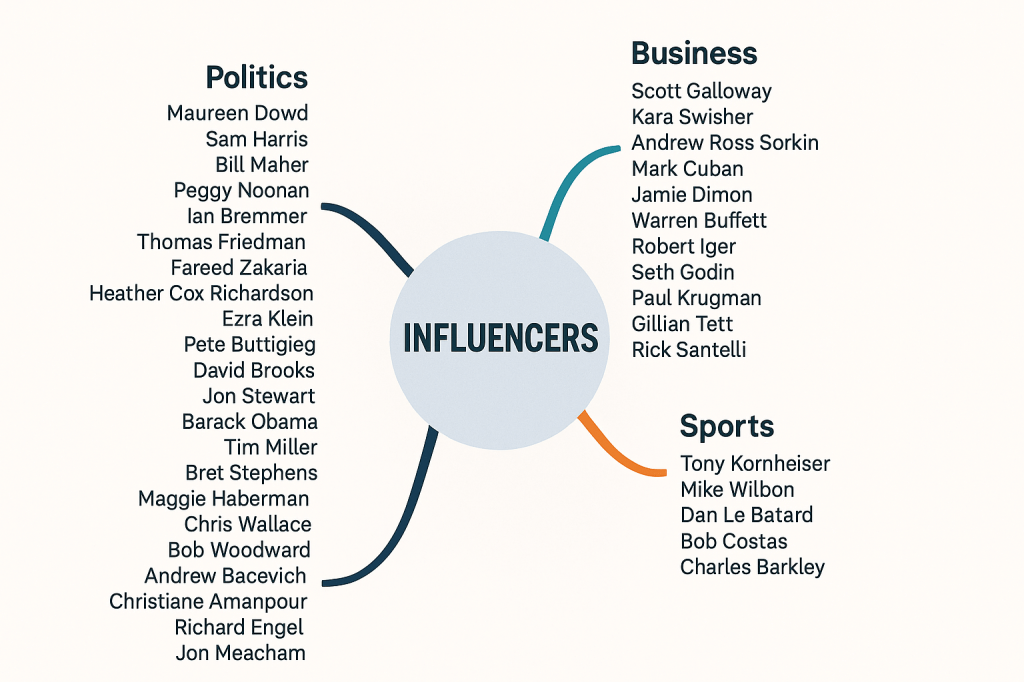
Under the Influence…

Shown below is a short list of journalists, writers and media types, whose opinions I value. I may not agree with all their conclusions or analysis, but I will take the time to consider them.

Late additions to my Political Influencers list: Jon Meacham, Chrystia Freeland, George Will, Jessica Tarlov, Kaitlyn Collins, Garry Trudeau and Jennifer Griffin (sole Fox News journalist).

President Trump is systematically severing America from the globe. This is not simply a shift in foreign policy. It is a divorce so comprehensive that it makes Britain’s exit from the European Union look modest by comparison.

Consider the breadth of this effort. Allies have been treated like adversaries. The United States has withdrawn from international agreements on fundamental issues like health and climate change. A “nation of immigrants” now deports people without due process, bans refugees and is trying to end birthright citizenship. Mr. Trump’s tariffs have upended the system of international trade, throwing up new barriers to doing business with every country on Earth. Foreign assistance has largely been terminated. So has support for democracy abroad. Research cuts have rolled back global scientific research and cooperation. The State Department is downsizing. Exchange programs are on the chopping block. Global research institutions like the U.S. Institute of Peace and the Wilson Center have been effectively shut down. And, of course, the United States is building a wall along its southern border.

100 Days. That’s All It Took to Sever America From the World. Ben Rhodes NYT 4/27/25

In a poll from Washington Post-ABC News-Ipsos, Trump’s standing was the lowest of any president in the first 100 days of his term since 1945, with 39% saying they approve of his job performance while 55% disapprove. As much as I am upset about Trump’s poor performance, as president, I am even more angry that 39% of Americans could possibly approve of his job performance. What kind of grading curve are these people on!? However, I am reminded that even in the ruins of Germany in April 1945 that many Germans still supported Adolf Hitler.

Lucky Loser: How Donald Trump Squandered His Father’s Fortune and Created the Illusion of Success by Russ Buettner and Susanne Craig (Book Review)

This book offers an in-depth look at Donald Trump—the businessman, real estate investor, entrepreneur, and brand. Much of the narrative focuses on his struggles to finance buildings, casinos, golf courses, and other projects. Despite his relentless self-promotion, Trump has repeatedly proven to be a poor businessman, often relying on his father, Fred Trump, to bail him out of financial trouble.

As you read, one question becomes unavoidable: Why would anyone choose to partner with Donald Trump? His track record as a business leader is riddled with failure, and those who have worked with him—contractors, lenders, and employees—frequently find themselves shortchanged. Why lend money to someone who appears to lack financial discipline in both his personal and professional life?

A Trump supporter might dismiss this book as misinformation, but the authors had access to extensive financial records, including Trump’s tax returns. Their research is bolstered by interviews with numerous individuals who have firsthand experience dealing with him.

The fact free bubble Fox News created around Donald Trump as president may have felt familiar. He had spent his entire life in a similar bubble, financed by his father. In this comfortable place, he could hide his failures, pay for them with his father’s money, and later a celebrity’s fortune. There would be no metrics measuring his success, just the impression of self created wealth that he willed into existence.From the moment he left his father’s careful planning practices behind, he protected his bubble by waging war on the fact based world that might pop it.

Trump’s failures in the casino industry in Atlantic City are well-documented. His attempt to buy an NFL franchise led instead to the downfall of the USFL. When journalists and analysts challenged his exaggerated business claims, he responded with lawsuits and intimidation tactics.

Perhaps his greatest success—if it can be called that—was The Apprentice, a reality show that portrayed him as a shrewd businessman with exceptional judgment. This carefully crafted image helped convince much of the public that he was a financial genius, a perception that played a crucial role in his 2016 presidential campaign.

The book is 456 pages long and thoroughly researched, with extensive footnotes to support its claims. In fact, published articles by the authors on Trump’s finances earned them a Pulitzer Prize.

I wish I could say this book might change the minds of his staunchest supporters, but realistically, many of them are unlikely to engage with a work of this length and depth.

Line Calls

When I don’t play pickleball, I write about it…

I Saw the Light
Still playing “lights out”—literally—at St. Matt’s pickleball. No word yet on when the new lights will be installed. Despite the dim conditions, meetups remain popular, with players showing up under less-than-ideal circumstances.

It’s Not You, It’s Me
Like speed dating, partner switching in professional pickleball has become the norm. Even Ben and Colin Johns, dominant champions for years, are splitting up in 2025 to pursue new partnerships. Many pros are following suit, aiming for gold medals and bigger paydays. Pair splitting also happens at the recreational level, but with much less drama.

Offers I Could Refuse
PickleballTV, the online media service, now offers subscriptions: $5.99/month or $59.99/year. While I enjoy watching pickleball online, PickleballTV doesn’t yet match the production quality of Tennis Channel. From a business perspective, it feels premature to charge for a service that’s still refining its offerings.

Meanwhile, MeetUp has introduced MeetUp+ with subscription features that were previously free. Since being acquired by Bending Spoons last year, the platform feels outdated and in need of a refresh—not exactly a premium experience worth the added cost.

What Goes Up, Must Come Down
Pickleball’s growth is impressive, but industry players should tread carefully. If I were a paddle manufacturer, coach, or facility owner, I’d focus on competitive pricing, branding and quality. Just like the stock market, a “correction” could be on the horizon, forcing adjustments in strategy.

Crystal Ball Outlook
An analysis of DUPR scores shows the median player rating at 3.29, meaning half of players score higher and half lower. I predict the median will rise to around 3.50 in the next five years as younger players pick up the sport in schools and colleges.

To Lob or Not to Lob—No Longer the Question
Lobbing in pickleball can be as polarizing as playing with the sun in your eyes or battling high winds. Offensive lobs are often seen as unfair and even risky in social games, where players can injure themselves chasing down balls. I’ve decided to reserve lobs for defensive purposes in casual matches, but in a competitive game, all bets are off!

Takin’ Care of Business
The business side of pickleball risks overshadowing the sport itself. Pro pickleball is a mess, with issues like financial instability, disputes over illegal paddles, ever-changing rules, and player misconduct. Thankfully, the recreational game has largely been insulated from these woes—for now.

Three Best Pickleball Podcasts

  • King of the Court with Tyler Loong and Jimmy Miller
  • PicklePod with Zane Navratil and Thomas Shields
  • Tennis Sucks with Travis Rettenmaier and Graham D’Amico

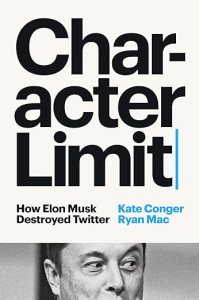
Character Limit: How Elon Musk Destroyed Twitter by Kate Conger and Ryan Mac (Rview


**One of the best-researched and well-written business books I have read, *Character Limit: How Elon Musk Destroyed Twitter* by Kate Conger and Ryan Mac is a compelling exploration of Elon Musk’s controversial purchase of Twitter. The book offers a rich narrative populated by a cast of hundreds of Twitter employees and executives, each bringing a unique perspective. Readers may find heroes and villains among them, all presented in vivid, humanizing detail. With a length far exceeding a tweet at 436 pages, it still keeps the reader engaged from start to finish.

At the heart of the book is Elon Musk, whose reputation as a visionary, eccentric, and often self-centered figure is fully displayed here. Musk is depicted as the center of Twitter’s universe, around which all other stories orbit. His personality and decisions drive the narrative, illustrating his complex and, at times, erratic leadership style.

As a reader, I found myself feeling sympathetic for the executives and employees who had to work with Musk. Many were caught in a difficult position, needing their jobs to support themselves and their families. Musk, however, was a challenging boss, setting impossible deadlines, frequently changing his mind, and often requiring flattery before he would listen to advice. This environment, as described in the book, made for a grueling workplace experience.

The book also draws comparisons between Musk and Donald Trump, noting both men’s tendencies to act impulsively, seeking adulation and approval without considering the full consequences of their decisions. This parallel underscores the irony that Musk, who initially sought to reduce misinformation on Twitter, ended up frequently sharing and amplifying misinformation himself.

After reading this book, I would not want to work with Elon Musk. The book notes that there has been speculation Musk could take on efficiency reforms in the federal government by cutting expenses and staff. However, his approach at Twitter—firing over half the staff without a clear strategy—highlights the dangers of indiscriminately cutting headcount without considering the broader ramifications.


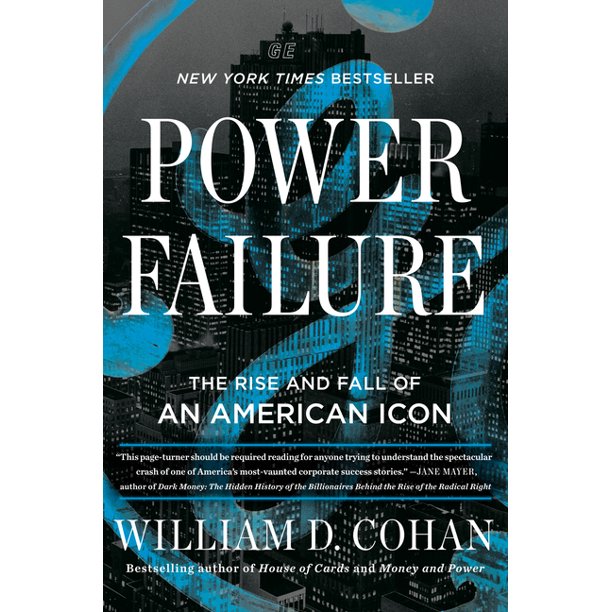
Power Failure: The Rise and Fall of an American Icon (Book Review)

Summary: Written by William D. Cohan, this book chronicles the birth and demise of General Electric. The author focuses specifically on the CEO administrations of Jack Welch and his successor, Jeff Immelt. GE was the premier American business model in the 20th century. With operations worldwide and a diverse line of operations and businesses, GE was a business powerhouse and the CEO title there was competitively sought.

This book read like a novel. Greed, hubris, deception, scandal, paybacks and crime were found at the highest ranks of the company. Did Jack Welch “cook the books” to satisfy his promise of reaching quarterly earning projections? It appears he did utilize assets from GE Capital when there were operation shortfalls. Welch laid off tens if not hundreds of thousands of employees. He closed business lines that had operated successfully for decades. Business operations, employees and products were chess pieces for GE CEOs.

Welch more than Immelt had the respect of GE employees and certainly senior management of the corporation. Welch personally managed the careers of many of the men who moved up in the organization. Welch also listened to objections to his thinking, something that Immelt refused to do.

Both Welch and Immelt made poor business decisions. There were businesses and companies that each man should not have merged with or purchased. Immelt generally did not solicit comments or potential objections from his senior officers before a major business decision. This was a major cause in his downfall and GE’s fortunes.

Welch was a complex figure. His loyalty to men who worked for him did not extend to women he married. He appeared to find solace with his third wife, Susie.

Cohan spent time within the book describing the personalities and lifestyles of not only Welch and Immelt but other men of ambition and power in the GE organization. How GE did or did not develop a succession plan for their next CEO is a topic worthy of study by MBA classes.

Rating: ★★★★★

One of the best business books that I have read.

Book Review: The Man Who Broke Capitalism: How Jack Welch Gutted the Heartland and Crushed the Soul of Corporate America—and How to Undo His Legacy by David Gelles

The Man Who Broke Capitalism: How Jack Welch Gutted the Heartland and Crushed the Soul of Corporate America—and How to Undo His Legacy by David Gelles

My rating: 5 of 5 stars

Best business related book that I have read this year…This book is an indictment of Jack Welch, “welchism” and capitalism in general. Jack Welch is not here to defend himself but the author presents a very compelling narrative supported by numbers that Welch was very overrated as a CEO, role model and strategist.

Welch quelched efforts at innovation, long term planning and corporate responsibility so he can meet or exceed quarterly numbers. Welch’s primary business objectives were to please his stockholders and become very personnaly wealthy.

Very well written book. Interesting stories and business analysis…Good investment of my book purchase…

Notes from the book:

Welch employed three main tools in his crusade: downsizing, dealmaking, and financialization.

Welch developed a new policy, colloquially known as “rank and yank.” Each year, managers rated their employees. Those who were in the bottom 10 percent were let go.

GE stock fell 80 percent in the years after Welch retired, becoming the worst performer in the Dow Jones Industrial Average.

Welchism has at its heart the conviction that companies must prioritize profits for shareholders above all else, that executives are entitled to enormous wealth and minimal accountability, and that everyday employees deserve nothing more than their last paycheck.

From runaway climate change to steep inequality, to hollowed-out communities abandoned by companies seeking cheap labor elsewhere, it can at times seem like corporations do as much harm as they do good.

The chief executive of a major American company now makes in one year what it would take a typical worker in that company 320 years to earn.


Recommended Reading

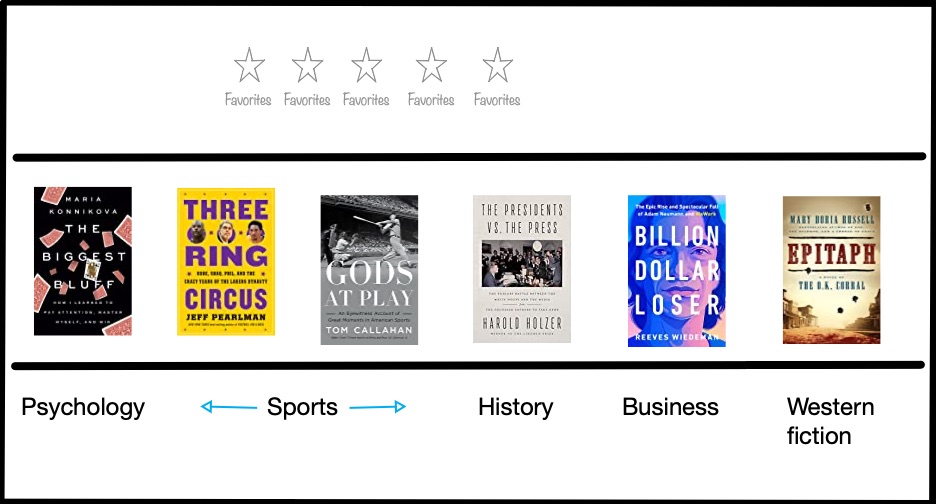
The Biggest Bluff: How I Learned to Pay Attention, Master Myself and Win by Maria Konnikova (With help, a plan and a lot of preparation, a woman writer learns to play professional poker and beats the pros. Excellent psychological insights on mastering poker and life.True story!)

Three Ring Circus: Kobe, Shaq, Phil and the Crazy Years of the Lakers Dynasty by Jeff Pearlman (I really enjoy Pearlman’s sports books and this one is really good with a lot of interesting inside stories. You don’t have to be a Lakers fan to enjoy this book about a dysfunctional group of players and egos who manage to win world titles.)

Gods at Play: An Eyewitness Account of Great Moments in American Sports by Tom Callahan (Reporter’s memoir of covering great athletes like Muhammed Ali, Pete Rose, Oscar Robertson, Roberto Clemente, Arthur Ashe and others. His story about Bob Cousy and how Cousy took care of his sick wife was very moving.)

The Presidents vs. the Press: The Endless Battle Between the White House and the Media by Harold Holzer ( a very long book with interesting anecdotes of Presidents vs. the Press going back to Washington; chapter on Trump is very interesting):

Billion Dollar Loser: The Epic Rise and Spectacular Fall of Adam Neuman and WeWork by Reeves Wiedeman (business book that reads like a novel)

Epitaph by Maria Doris Russell (Historical novel about Wyatt Earp, Doc Holliday and Tombstone. Great read!)

2020: Winners and Losers

2020 has and continues to be a tumultous year politically, economically, financially and culturally. Here is a list of some winners and losers so far…

WinnersLosers

Karma

Jeff Bezos, Amazon CEO

Wall Street

Netflix

Zoom

Fake News

NBA, NHL

Peloton

Mitch McConnell

Health Care and Essential Workers Covid Response

Dr. Jill Biden

Conspiracy theories

Philadelphia Union

Rudy Giuliani, Jerry Fallwell Jr.

Amazon warehouse workers

Main Street

AMC, Regal movie theaters

Commercial Real Estate

Science

NFL, MLB, NCAA

Planet Fitness, gyms

Donald Trump

U.S. Congress and Executive Branch Covid Response

Melania Trump

Reality

Philadelphia Eagles
2020 Winners and Losers