American Philosophy: Book Review and Notes

This book was a very pleasant surprise. In college, I took a philosophy course that covered Pragmatism and I read books by William James, Charles Sanders Pierce, John Dewey, Josiah Royce etc. Kaag had a strong interest in the American philosophy of the late 19th century and did an excellent job of explaining it so that the general reader could understand it. In addition, he described the personalities and lives of the various philosophers – – many of them had more interesting lives outside of their academic pursuits. Kaag’s research takes place in the abandoned library of William Ernest Hocking. To be honest, reading about someone’s research in a library could be very tedious and boring. But I found it very interesting – –Kaag’s dedication and pursuit of information and material. 

I highlight portions of books I own if I find them informative or interesting. Shown below are some of my notes below:

Pragmatism holds the truth is to be judged on the basis of its practical consequences, on its ability to negotiate an enrich human experience.

“Riches take wings; fame is a breath; love is a cheat; youth and health and pleasure vanish.” William James

Thoreau… had a hunch that frenetic busyness should not be the business of human life, that chatter makes one feel horribly alone, that well-paid jobs are different from “callings.” And that long relationships are not necessarily synonymous with meaningful ones. (Thoreau never married.)

Walking gives one many things, according to Thoreau, but one of its greatest gifts is time.

Socrates stands before his neighbors and says the unthinkable – – that there is something worse than death: living an ugly, wicked, boring life.

The lesson that William James gleaned from evolutionarily theory was of an existential variety – – human life was a natural process that began in the wailing of babies and ended in the pangs of death. In between was the seemingly futile struggle for survival.

In the 17th century the Frenchman (Pascal) argued that in the absence of proof, it is safer to believe in God ( since you lose relatively little if you were wrong) about his existence ( then to adopt atheism) and face eternal damnation on the Day of Judgment.

Equanimity

“True equanimity arises when we embrace the flow of life without being swept away by its currents.” – Ram Dass

In memory of two high school classmates who recently died…

As we grow older, we descend like a starship pulling from the gravity of our youthful endeavors, and settle into the “orbit of mortality.”

The sounds of ocean waves lapping along the shore, like hymns from a church organ evoke peace and soulful contemplation.

There is no better sedative than sitting on the couch, cool drink in hand and dozing off to one of my wife’s Hallmark movies.

How I look forward to summer! By July 1, how I look forward to autumn!

My True Confession: I never flirted with a woman I desired. AI version: Desire unspoken, a confession true: I never flirted, yet yearned for you.

Three mindsets of a life long athlete: in youth, WIN; in good health, COMPETE; in old age, PARTICIPATE.

I was surprised to hear of the current writers’ strike in movies and TV. Based on what I view on the screen, I thought their work stoppage began in 1990.

Future historians will equate January 6, 2021 as this era’s Fort Sumter, the start of a new civil war.

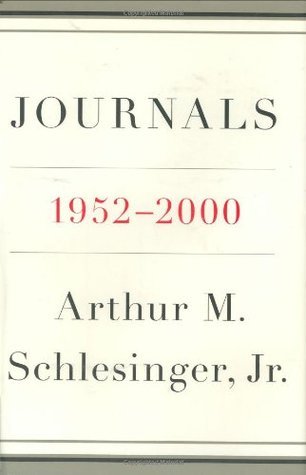
Review: Journals 1952-2000 by Arthur Schlesinger Jr.

In Journals 1952-2000,” Arthur Schlesinger Jr. offers a captivating exploration of American political history spanning the Eisenhower to Clinton administrations. Through his unparalleled connections with U.S. Presidents, foreign leaders, intellectuals, and cultural icons, Schlesinger provides an insider’s perspective on the tumultuous events that shaped the 20th century.

With candor, Schlesinger delves into his personal sentiments, both favorable and critical, towards prominent figures of the era. The admiration for the Kennedy brothers, John and Robert, shines through, while his disillusionment with Lyndon Johnson’s interpersonal approach and bizarre behavior is apparent. Notably, Schlesinger’s palpable disdain for Richard Nixon adds an ironic twist, considering their proximity as neighbors following Nixon’s presidency.

Throughout the book, Schlesinger’s political inclinations come to the fore, as he expresses his reservations about Republican presidents such as Dwight Eisenhower, Ronald Reagan, George W. Bush, and Nixon. His critique extends to a fellow Democrat, Jimmy Carter, revealing Schlesinger’s willingness to evaluate leaders from his own party objectively.

The narrative isn’t limited to policy discussions; Schlesinger enthralls readers with captivating anecdotes, insider gossip, and subtle insinuations involving prominent politicians, particularly those in the nation’s capital. Delicate topics, including the romantic entanglements of President Kennedy, Ted Kennedy, Gary Hart, Bill Clinton, Martin Luther King, and Nelson Rockefeller, are deftly navigated.

A noteworthy revelation is Schlesinger’s subtle hint at the complex relationship between himself, Robert Kennedy, and the enigmatic Marilyn Monroe. His close friendship with Jackie Kennedy also comes to the forefront, offering readers a unique glimpse into her life.

“Journals” serves as a window into Schlesinger’s engagement with pivotal issues of his time, encompassing the Vietnam War, the Cold War, Mideast tensions, diplomatic overtures with Russia and China, and the high-stakes Cuban Missile Crisis. Schlesinger’s multifaceted talents shine as he shares his role in crafting speeches and messages for aspiring Democratic presidential candidates.

Despite its substantial 783-page length, it maintains an engrossing narrative that captivates without causing reader fatigue. The book is both an enjoyable read and an invaluable source of information, making it a compelling recommendation for scholars of presidential history and anyone intrigued by the intricacies of American politics and events from 1952 to 2000.

Three Ingredients for a Successful Pickleball Partnership

As the popularity of pickleball continues to soar and tournaments and informal leagues thrive, the significance of successful partnerships on the court becomes increasingly evident. Whether you’re aiming for victory or simply seeking enjoyment, a well-matched pickleball partnership can make all the difference. In my opinion, here are the three most important criteria for a pickleball partnership.

  1. Shared Mindset

A successful pickleball partnership begins with a shared mindset, where both partners align their expectations regarding the balance between competitiveness and fun. This shared mindset will help create harmony, ensuring both partners are on the same page and working towards a common goal.

Two of my best partners: Julie Close (serving) and Anna Marie. Very skilled players. Great personalities and they put up with me.

2. Communication

Effective communication is the cornerstone of any successful partnership, and pickleball is no exception. On the court, partners must communicate their strategies, tactics, and intentions to synchronize their efforts and maximize their performance. Verbal communication is essential, but non-verbal cues, such as body language and eye contact, also play a significant role in maintaining a strong partnership. Partners should offer encouragement and support to each other, particularly during challenging moments.

3. Synergy

To elevate their game to new heights, partners should strive to achieve synergy—a state where their skills, strengths, and playing styles complement each other. One partner may excel in power shots while the other may possess exceptional finesse and precision. By capitalizing on these strengths, partners can form a dynamic duo that outmaneuvers their opponents and adapts seamlessly to changing game situations.

Conclusion:
Whether you’re aiming for victory in tournaments or seeking joy in friendly matches, embracing these key ingredients will undoubtedly enhance your pickleball experience and help you forge long-lasting partnerships that thrive both on and off the court.

Review: King-A Life by Jonathan Eig

As I immersed myself in this captivating biography, a whirlwind of emotions, memories, and contemplations flooded my mind. Recalling my teenage years, I realized how little I truly comprehended the magnitude of the civil rights struggle, especially in the deeply segregated South during the 1960s. Although I had heard of Martin Luther King Jr. as a young boy, I had no inkling of the profound impact he would have on our nation’s history.

This book, a compelling account of King’s life, stirred within me a deep sense of shame for the violence and hatred inflicted upon Black individuals due to their skin color and the prejudiced perceptions held by many white people. The author’s vivid descriptions of the bombings that claimed innocent lives, the brutal attacks on peaceful demonstrators by police dogs, and the countless murders committed by racists and law enforcement are a haunting reminder of the dark stain on our collective history.

Undeniably, Martin Luther King Jr. was an extraordinarily brave man—perhaps one of the bravest. Despite being subjected to jail, beatings, threats, and mob attacks, he remained steadfast in his commitment to nonviolence. The author adeptly captures King’s experiences, leaving readers in awe of his unwavering equanimity in the face of such brutality.


Moreover, the book delves into King’s personal flaws, including accusations of numerous affairs. The author, Eig, does not shy away from these indiscretions. It is revealed that King was targeted by the FBI through wiretapping and attempts to blackmail him with incriminating information. The book effectively dispels accusations of King being a communist sympathizer, providing compelling evidence to the contrary.

King faced adversaries from all angles: the FBI, racist politicians and officials, the police, fellow Black individuals who disagreed with his nonviolent philosophy, as well as ministers, church leaders, and conservative commentators who opposed his influence. Even Presidents Kennedy and Johnson, while initially ambivalent about King’s politics and impact on the civil rights movement, became entangled in a complex relationship with him. Johnson’s sentiments towards King soured when the latter publicly voiced his opposition to U.S. involvement in the Vietnam War.

Meticulously researched and skillfully written, this biography stands as the pinnacle of my reading experiences this year. It effortlessly transports readers into the turbulent era of the civil rights movement, providing a profound understanding of the indomitable spirit of Martin Luther King Jr. and the transformative power of his vision.

In conclusion, this book is an absolute must-read, capable of evoking an array of emotions and leaving a lasting impact. I wholeheartedly give it five stars, and then some.

The Truth, The Truth, You can’t Handle the Truth

And, nobody died in the Holocaust either. That’s the truth. It should happen. Six million Jews should die right now cause they cause all the problems in the world. But, it never happened.”
Roseanne Barr

“COVID-19 attacks certain races disproportionately,” COVID-19 is targeted to attack Caucasians and black people. The people who are most immune are Ashkenazi Jews and Chinese.”“We don’t know whether it was deliberately targeted or not but there are papers out there that show the racial or ethnic differential and impact.”
RFK Jr.

“That [the war in Ukraine] does nothing to protect our borders, and that’s your hard-earned tax dollars. We’re funding them with equipment, we’re funding them with ammunition…Biden’s war in Ukraine, a proxy war with Russia, has depleted our military. Our military is the weakest it has been in decades and decades.”
Marjorie Taylor Greene

“Millions of illegal aliens have stormed across our borders, it is an invasion, like a military invasion. Our rights and liberties are being torn to shreds. Your country is being turned into a third-world hellhole, run by censors, perverts, criminals and thugs.”
Donald Trump

“Rosa Parks didn’t sit in the back, and neither am I gonna sit in the back.”
George Santos

Years, maybe it was decades ago, politicians, public officials, commentators and celebrities were much more circumspect in their public comments and behavior than their counterparts currently. It seems that chronic stupidity and ill behavior go unpunished. Instead, it gains you more poll points from your party’s voting base, gets you invitations to speak on talk shows and can be a stepping stone to having your own talk show or podcast.

In today’s media, stupid is overwhelming smart. Politicians, political commentators and many news organizations lie with impunity. Very few liars and incompetent people are punished or lose their jobs. Maybe the last time something like that happened occurred with Sarah Palin in 2008.

Today we have Marjorie Taylor Greene, Lisa Boebert, Matt Gaetz, Tommy Tuberville, Tucker Carlson, Jim Jordan, George Santos and countless others who are free to lie, slander and exaggerate. The public does not punish them. In many cases, a good portion of the public supports “a narrative” that gives weight to their slanted political, religious, cultural and prejudicial views.

I’m not sure the exact date when public discourse died but I’d say life support was pulled around 2016. That’s about the same time that the political IQ of this country fell into mid two digits. It’s still plunging…

Few for the Pew

In their new book “The Great Dechurching: Who’s Leaving, Why Are They Going and What Will It Take to Bring Them Back?” Jim Davis and Michael Graham with Ryan Burge argue that the most dramatic change may be in regular attendance at houses of worship. “We are currently in the middle of the largest and fastest religious shift in the history of our country,” they postulate, because “about 15 percent of American adults living today (around 40 million people) have effectively stopped going to church, and most of this dechurching has happened in the past 25 years.” The Largest and Fastest Religious Shift in America Is Well Underway NY Times Jessica Grose

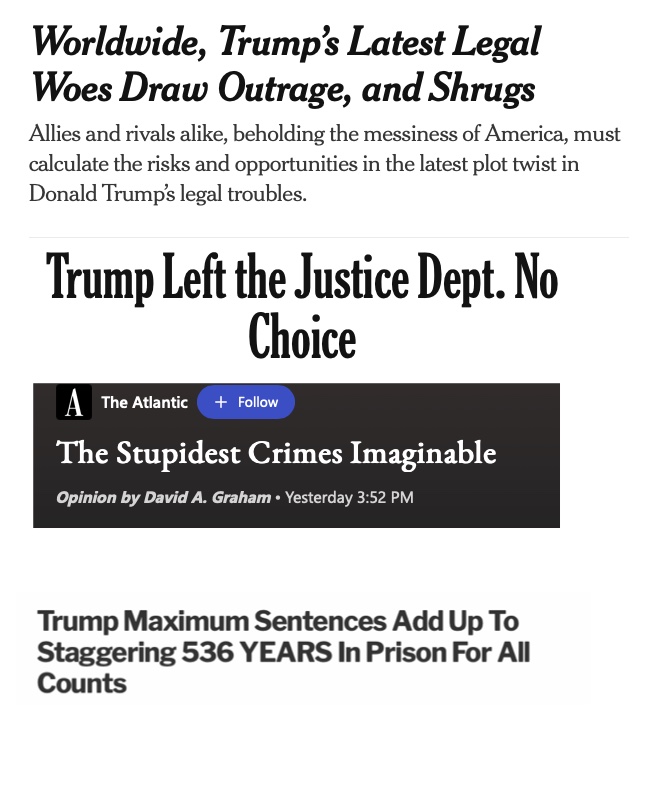
Six Quick Observations about Trump Indictment

In the United States judicial system, it is customary to presume innocence when someone is charged with a crime. However Donald Trump is an exception to this presumption of innocence. He does a bad job of hiding his transgressions, personal, business, political and legal. He has a big ego and a bigger mouth. The weight and breadth of the evidence against him in the documents matter are overwhelming. My God, 37 counts!!!

Are there any stupider people than those who defend Donald Trump? They ignore his traitorous behavior, financial malfeasance, greed, allegations of him committing sexual assault and rape, and general ineptitude. As a leader, he is Barney Fife. I have no respect for the opinions and judgement of those who support Trump just based on this criteria.

If I had could question Donald Trump I’d ask: Do you think that you are a good role model for your son Barron? Would you want Barron to grow up and act like you? Would your wife Melania want Barron to grow up like you?

Laurence Tribe, the Constitutional scholar, said he was profoundly disappointed that the American people elected a man who was so bad at protecting national security and the American public. Tribe uses the word “sad.” I am furious that voters elected and support Donald Trump, a con artist and a “small man.”

My previous thinking was to offer Trump a pardon if he pleaded guilty to several counts and promised to withdraw from politics and public life. I’ve changed my mind. There would be no greater example of justice in our system that Trump going to jail for a long time. No pardon! Trump’s conviction and incarceration would serve as a great deterrent that no man is above the law.

I intend to avoid any Trump news. I don’t want to hear from him. I certainly don’t want to hear from anyone defending him.

The One Name I Wish I Was Called

A polymath.

I cannot think of a more flattering description or title as I have always admired men and women of varied skills, talents, interests and achievements. Leonardo da Vinci, Thomas Jefferson and Benjamin Franklin are three of the most notable polymaths in history. I think that the term “polymath” is ascribed too easily. A polymath is to the world what a Hall of Famer is to baseball. The criteria is very strict and not everyone gets to enter the portal of notoriety.

On my eighth grade graduation, I received this medal for “General Excellence.” Even at the age of 14, I was very interested in current events, literature, politics, history, philosophy, psychology and religion. One of my grade school classmates reminded recently that he remembered me reading a mammoth volume of the Warren commission report on the assassination of President Kennedy when we were in eighth grade.

I have read different criteria to qualify as a polymath. Here is mine…

  1. Education, reading, research and learning on various intellectual topics including politics, history, science, business, literature, religion, philosophy, psychology, sociology, technology,and sports.

2. Communication of ideas, thoughts, imagination and discoveries through writing, public speaking, painting, acting and music.

3. Extensive travels across the world with a wide variety of experiences and adventures.

4. Varied or significant roles and responsibilities in business, science, education, finance or public service.

5. The ability to speak in more than one language.

6. The ability to understand technology for productive and worthwhile goals.

7. The ability to appreciate the arts including music, the theater, cultural events, plays, movies etc

8. A mind with novel ideas, insights, and opinions driven by consilience – – the capacity to merge and synthesize one’s experiences, talents, interests and intelligence.