Bittersweet Review (Goodreads)

Bittersweet: How Sorrow and Longing Make Us Whole by Susan Cain

My rating: 3 of 5 stars

I chose this book because I had read and enjoyed Quiet, a book about introverts, written by the author. With that being said, I skimmed through much of the book. However I did pick up some personal insights, many of which are not surprising to me. For example, based on her Bittersweet quiz, I have a bittersweet state of mind. Or let’s just say, that I can be a very sensitive and empathetic man. As the author points out, when you experience something like a personal tragedy early in your life as I did, you tend to accept sorrow and longing.

The author also suggests that whatever paying you cannot get rid of, make it your creative offering. I do this primarily through my writing.

I can’t say this book will provide you solace or relieve your pain if you are in sorrow or mental distress. But it may explain how you feel or could feel…

Shown below are my notes from the book:

This book is about the melancholic direction, which I call the “bittersweet”: a tendency to states of longing, pregnancy and sorrow; and acute awareness of passing time; and they curiously piercing joy at the beauty of the world. The bitter sweet is also about the recognition that light and dark, birth and death—-bitter and sweet are forever paired.

Most of all, bitter sweetness shows us how to respond to pain: by acknowledging it, and attempting to turn it into art, the way musicians do, or healing, or innervation, or anything else that nourishes the soul. If we don’t transform our sorrows and longings, we can end up inflicting them on others via abuse, domination, neglect but if we realize that all humans know – – or world now – – loss and suffering, we can turn toward each other.This idea of transforming pain into creativity, transcendence and love is the heart of this book.

It’s long been known that the vagus nerve is connected to digestion, sex, and breathing – – to the mechanics of being alive. But in several replicated studies, Keltner discovered another of its purposes: when we witness suffering, our vagus nerves make us care. If you see a photo of a man wincing in pain, or a child weeping for her dying grandmother, your vagus nerve will fire.

Then, the reminder that we have no missing half. “Here’s a little bit of darkness,” he warns. We need to accept that there is no partner who would understand the whole of us, who will share all our of our tastes in large and small areas. Ultimately, it is always a percentage of compatibility we will only ever achieve.

Even in the healthiest relationships, belonging often returns. In these unions, you can raise children, if you want you can share inside jokes, favorite vacation spots, mutual admiration, and a bed; you can search the streets of a brand new city for a heating pad when you’re traveling and your partners back goes out. In the best relationships, you can still, every so often, go to the moon and back. But most likely your relationship will be an asymptote of the thing you long for. As LVL says, “those who search for intimacy with others are reacting to this longing. They think another human will fulfill them. But how many of us have actually ever been totally fulfilled by another person? Maybe for a while, but not forever. We want something more fulfilling more intimate.

Whatever pain you can’t get rid of, make it your creative offering.


Angelou (Maya) story suggests, many people respond to loss by healing in others the wounds they themselves have suffered. Angelou did this through writing, but the process takes many forms. Indeed, the “wounded healer,” a term coined by the psychologist Carl Jung in 1951, is one of humanities oldest archetypes.

What are you longing for?

To find out how bitter sweet you are…¨

Do you tear up easily at touching TV commercials?

Are you especially moved by old photographs? ¨

Do you react intensely to music, art or nature?

Do you feel elevated by sad music? ¨

Do you tend to see the happiness and sadness in things, all at once?

Does the word poignant especially resonate with you? When you have conversations with close friends, are you drawn to talking about their past or current troubles?


View all my reviews

The Psychology of Money: Timeless Lessons on Wealth, Greed and Happiness by Morgan Housel

Takeaways and notes from the book:

Voltaire’s observation: “history never repeats itself; man always does.“ The lowest income households in the United States on average spend $412 a year on lotto tickets, four times the amount of those in the highest income groups. 40% of Americans cannot come up with $400 in an emergency. Which is to say: Those buying $400 in lottery tickets are by and large the same people who say they can’t come up with $400 in an emergency.

Years ago I asked economist Robert Schiller, who won the Nobel prize in economics what do you want to know about investing that we can’t know? “The exact role of luck and successful outcomes,“ he answered.

The difficulty in identifying what is luck, what is skill, and what is risk is one of the biggest problems we face when trying to learn about the best way to manage money.

What Gupta and Madoff did is something different. They already had everything: unimaginable wealth, prestige, power, freedom. And they threw it all away because they wanted more. They had no sense of enough.

Reputation is invaluable. Freedom and independence are invaluable. Family and friends are invaluable. Being loved by those who you want to love you is invaluable. Happiness is invaluable.

Good investing is not necessarily about making good decisions. It’s about consistently not screwing up.

At the Berkshire Hathaway shareholder meeting in 2013 Warren Buffett said he’s owned 400 to 500 stocks during his life and made most of his money on 10 of them. Charlie Munger followed up: “If you remove just a few of Berkshire‘s top investments, its long-term track record is pretty average.“

The highest form of wealth is the ability to wake up every morning and say, “I can do whatever I want today.“

Controlling your time is the highest dividend money pays.

No one is impressed with your possessions as much as you are.

Savings in the bank that earn 0% interest might actually generate an extraordinary return if they give you the flexibility to take a job with a lower salary but more purpose, or wait for investment opportunities that come when those without flexibility turn desperate.

Having more control over your time and options is becoming one of the most valuable currencies in the world.

The most important driver of anything tied to money is the stories people tell themselves and the preferences they have for goods and services. Those things don’t tend to sit still. They change with culture and generation. They’re always changing and always will.

History can be a misleading guide to the future of the economy and stock market because it doesn’t account for structural changes that are relevant to today’s world.

The most important part of every plan is planning on your plan not going according to plan.

German tanks at Stalingrad – – field mice had nested inside the vehicles and eaten away installations covering the electrical systems. (No one had planned for this risk, hence German tanks were inoperative.)

The more you want something to be true, the more likely you are to believe a story that overestimates the odds of it being true.

Manage your money in a way that helps you sleep at night. Use money to gain control over your time.

Effectively all of our net worth is a house, a checking account and some Vanguard index funds. One of my deeply held investing beliefs is that there is little correlation between investment effort and investment results. The reason is because the world is driven by tales – – a few variables account for the majority of returns. (Author describing his financial management.)

Book Review: The Fire is Upon Us: James Baldwin, William F. Buckley Jr. and the Debate over Race in America

What a fascinating and enlightening book! I had seen the Baldwin/Buckley debate at Cambridge on YouTube so I was at least familiar with that event. However, I was not familiar with the backstories regarding the two men and how they influenced the civil rights movement. Buccola’s book provides an excellent historical context around the debate. I am somewhat ashamed to admit that I was not familiar with Mr. Baldwin’s contributions regarding the civil rights movement. Baldwin was certainly a very persuasive and excellent spokesman for civil rights.

I was familiar with Mr. Buckley, particularly through his TV show Firing Line which I watched in my much younger years. Though I did not always agree (or understand) Mr. Buckley’s point of view, I was always impressed by his articulateness, vocabulary and presentation. However after reading this book, I am not so impressed by Mr. Buckley. I had no idea about his views regarding civil rights and blacks as human beings. I know it was a different time and many people shared Mr. Buckley’s opinion that the civil rights movement was proceeding too quickly. But I ascribed more intelligence, judgment and reasoning to Mr. Buckley that he deserved. This book opened my eyes to this part of history that I missed.

According to the author, Mr Baldwin’s opinion of William F. Buckley was much harsher…

“Buckley, Baldwin believed, knew better and had the ability to exert a considerable amount of influence in the world. Indeed, Buckley’s work as a guardian of white supremacy was, from Baldwin’s perspective, more sinister than that of the most hardened racists in American politics. Time and again, Buckley’s ends were the same as the racist demagogues he was always sure to condemn; his primary objection to these men was the means they chose to use on behalf of ‘the cause of white people.’ For these reasons, Baldwin concluded, some of the blood shed as a result of the American racial nightmare was on Buckley’s hands.”

The author points out this warning for American politics today…

“The price of victory, though, has been incredibly high. The American Right seems to be in much the same place today as where it found itself over half a century ago. To achieve overwhelming power, conservatives have had to rely on the political energy provided by racial resentment and status anxiety. Much like Buckley, many conservative elites find reliance on such energy unseemly, but they cling to it because they know it gives life to their agenda. For the American Right, the price of power has been a deal with the devil of white supremacy. This was true in Buckley’s time, and it is true in our own.”

The book is about 400 pages. If you only have limited time, read the transcript of the debate at Cambridge found in the Appendix of the book.

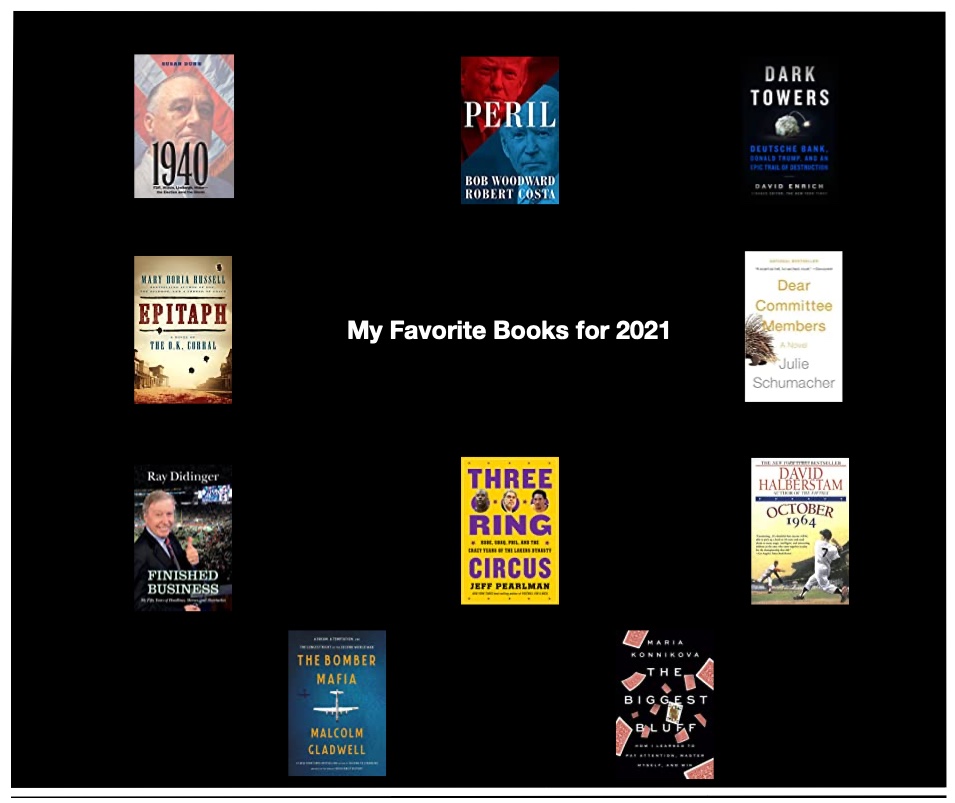
My Favorite Books for 2021

I am a voracious reader. This year I have read 64 books so far and I will probably read another 2-3 books by year end. I tend to be picky as to what I read and I am somewhat reluctant to recommend books  to others given my “eclectic” tastes. Over 80% of what I read is non-fiction though I did recommend two fiction books that I thoroughly enjoyed.

Here are my Top 10 books of 2021 and two extra recommendations..

I have read many of the Trump presidency books. I find that the one written by Bob Woodward and Robert Costa is the best. Peril also covers the candidacy and early administration of Joe Biden and the comparison between the Trump and Biden administration is compelling. I Alone Can Fix It: Donald J. Trump’s Catastrophic Final Year by Carol Leonnig and Philip Rucker is also excellent and the title is self explanatory as to the story within the book. Most of the book details Trump’s failure with managing the Covid pandemic.

1940: FDR, Wilkie, Lindbergh, Hitler—the Election Amid the Storm by Susan Dunn documents the leadership, judgment and foresight of Franklin Delano Roosevelt in the year before we entered World War II. Many Americans wished to remain isolationist and did not want to support Great Britain even as its cities were attacked by German bombers. Wendell Wilkie was the unsuccessful Republican candidate for President in 1940. Wilkie ran an unconventional campaign but unlike many Republicans today accepted the results of the election and supported FDR’s policies about the impending war.

Corruption, bad judgment, mismanagement, suicides, deviant behavior, treachery and Donald Trump, all this and more in Dark Towers: Deutsche Bank, Donald Trump, and an Epic Trail of Destruction. This is a business book that reads like a novel, a huge international bank plagued by scandals.

If you are an Eagles fan, you will thoroughly enjoy Ray Didinger’s Finished Business. Lots of great stories about players, owners and coaches. If you are a basketball fan, Three Ring Circus by Jeff Pearlman about the Los Angeles Lakers team from 1996-2004 is very entertaining and provides some great insights into the rocky relationship between Kobe Bryant and Shaquille O’Neal. Amazing how a very dysfunctional team was so successful. For baseball fans, October 1964 by David Halberstam is a bit of a dated book but an excellent read. It covered the 1964 seasons of the New York Yankees (with Mickey Mantle, Roger Maris and Yoga Berra) and the St Louis Cardinals (Bob Gibson, Tim McCarver, Stan Musial). Interesting personal portraits of many of the players were provided. Phillies fans, take note, the Phillies collapse towards the National League pennant is documented!

Dear Committee Members by Julie Schumacher about a crotchety, sarcastic Creative Writing teacher Jason Fitger was very funny. I would keep my wife awake with my laughter as I read the book in bed. Maybe the Fitger character reminded me of someone else who did not suffer fools gladly in his corporate life? I enjoyed the adventurous tales of Wyatt Earp and Doc Holliday in Epitaph by Mary Doria Russell. Interesting stories of the Wild West beyond the fight at the OK Corral.

The Bomber Mafia: A Dream, a Temptation, and the Longest Night of the Second World War by Malcolm Gladwell was an uncomfortable story. It detailed the thinking and strategies about how to close the wars against the Germans and the Japanese. There were two lines of thought. One was to bomb military and manufacturing targets primarily. Second, bomb population centers and destroy the morale of citizens. The decision on whether to drop the atomic bombs on Hiroshima and Nagasaki also created moral dilemmas.

The Biggest Bluff: How I Learned to Pay Attention, Master Myself, and Win by Maria Konnikova is primarily a story about a woman learning to play poker and also compete (and win) in big money tournaments. The bigger picture contains the lessons that she learns about psychology, luck, focus, risk and control that are useful as to how we conduct our lives, careers, finances and relationships.

Two extra recommendations:

Mediocre: The Dangerous Legacy of White Male America by Ijeoma Oluo (Title is self explanatory. I did not agree with some of her analysis but this book was very well presented and written.)

Zero Fail: The Rise and Fall of the Secret Service by Carol Leonnig. Eye opening expose about the management and performance of the Secret Service. Interesting anecdotes about some of our Presidents and their interactions with the Secret Service.

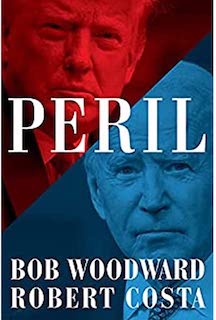
Review: Peril by Bob Woodward and Robert Costa

Authors Bob Woodward and Robert Costa closed this book with the following warning based on a conversation with Donald Trump.

“Real power is – – I don’t even want to use the word – – fear,” Trump told us.

“I bring the rage out. I do bring rage out. I always have. I don’t know if that’s an asset or a liability, but whatever it is, I do.”

Could Trump work his will again? Were there any limits to what he and his supporters might do to put him back in power?

Peril remains.

I have read a number of the retrospectives of the Trump presidency particularly as it relates to his last year and last days in office. There is nothing in this book that presents Trump in a positive light. There are plenty of examples of him being a bully, arrogant, insensitive and just plain stupid. Despite entreaties from many in his cabinet, among advisers and even from his daughter Ivanka, Trump continued to believe that he was cheated in the 2020 presidential election. There is very little doubt that he caused the insurrection on January 6, 2021.

Most of the highlights of this book have been reported through various media. Here is my list of observations and analysis from this book:

Mike Pence was a coward. Yes he finally did the right thing by validating the election. But it appears to the reader that he was looking for a way to accommodate Donald Trump’s wishes to overturn the election results. Pence even sought the advice of that well-known constitutional scholar, Dan Quayle, as to what to do. Quayle thankfully told Pence that he had no role in overturning the election. Even after a Trump mob wanted to hang him, Pence returned to the White House and tried to mend a relationship with a man who mocked him and treated him very poorly during their four year administration.

General Mark Milley was a voice of reason during a very precarious period in our nation’s history. He understood the danger that Donald Trump represented and was very concerned that Trump would create either a war or some type of foreign policy crisis so he could stay in office. In particular Milley assured the Chinese that there would be no military actions against them. There were a few countries that were very concerned that Trump would initiate a military attack against them.

The benefit of this book was to see the campaign of Joe Biden and his first few months as President. The contrast in decency between Biden and Trump is very evident throughout the many anecdotes in this book. Unfortunately the Democratic party does not shine. Too much infighting. Lack of party discipline and unity. Too much influence by West Virginia senator Joe Manchin. One gets the sense that Biden is a placeholder and does not possess the necessary influence to put forward a transformative domestic agenda and get it passed in Congress.

Interestingly enough, there is not a lot of coverage about Vice President Kamala Harris. Biden had spoken with South Carolina congressman Jim Clyburn prior to the South Carolina primary and Biden indicated he was favorable to Kamala being on the national ticket. There is little indication how much influence Harris possesses in decision making or policy.

If you are going to read just one book about the end of the Trump presidency in 2021, this book is the best to read. Just don’t be surprised if Woodward has to write another sequel in 2024 about the re-election of Trump.

Book Review: Landslide: The Final Days of the Trump Presidency by Michael Wolff

There are so many tragedies described within this book. First, Donald Trump’s obsession with perceived fraud in the 2020 presidential election. It absolutely consumed him. Despite entreaties from some responsible Republicans, Trump continued to pursue crackpot theories and schemes that the election was stolen. His “legal team” filed hundreds of suits but no court, including the Supreme Court would listen to their case. Second, the complete fall of Mayor Rudy Giuliani. Once the hero of 9/11, he was described in this book as a drunk and a flatulent, senile old man, spinning wild conspiracy theories and urging Trump to just announce that he won the election. The third major tragedy was that approximately 74 million people voted for Donald Trump. And a significant majority of them also believed that Trump was the legitimate winner of the election.

The book describes the bizarre behaviors of Mike Lindell, Peter Navarro, Mike Flynn and Sidney Powell along with other Trump enablers to encourage Trump to protest the election.

Wolff also recounts the events of January 6, 2021 when at the urging of Donald Trump, his supporters invaded The Capitol. What will future generations think of us that such a horrific event could happen?

There are a number of unflattering portraits and descriptions of people within the Trump White House. Very few heroes exist as no one was able to curb the actions and plans of Donald Trump.

If you are not a supporter of President Trump, nothing in this book will surprise you. What may surprise you is how much worse things really were during his administration. Wolff also includes a chapter on his interview with Trump after the election. Unsurprisingly Trump is not apologetic or remorseful in what he put this nation through, especially in the last year of his Presidency.

Book Review: I Alone Can Fix It: Donald J. Trump’s Catastrophic Final Year by Carol Leonnig and Philip Rucker

Anyone interested in reading this book should first understand that this is not a pro – Trump book. There are very few instances where Donald Trump is shown in a positive light or where he is shown competent in his job. This is not because of the prejudice of the authors but based on the actual reporting and eyewitness accounts during the last year of the Trump presidency. If you keep up with the news or have not been in a coma the past four years, there is not a lot in this book that will surprise you. If I gathered anything new it was that things were a lot worse than even I imagined.

This book primarily focuses on three major events/issues in Trump’s last year: handling (or mishandling) the coronavirus, the 2020 presidential election and post-election claims of fraud by Trump resulting in the January 6, 2021 invasion of The Capitol by his supporters.

What I was looking for were examples of competence and courage by people within the Trump administration. There were a few including General Mark Milley, who was very concerned about a possible coup and how Trump viewed the military as a weapon that he could use. Despite incredible abuse and intimidation by the White House, Dr. Anthony Fauci continued to tell the truth about COVID-19. On occasion, even Attorney General Bill Barr showed some back bone when pressed by Trump to initiate some bogus investigations against Trump enemies.

Secretary of Defense Mark Esper was fired by Trump primarily due to his opposition to Trump’s plan to use the military against demonstrations from the George Floyd killing. Trump wanted to employ the Insurrection Act of 1807 as a means of curbing demonstrations.

Regrettably Trump had a lot of enablers.  Rudy Giuliani, Mike Flynn, and Mark Meadows, Trump’s chief of staff was a faithful soldier to until the end of his Presidency. Mike Pence does not read well in this book. He blindly supported Trump throughout the four years. And though Pence did the right thing in certifying the electoral vote, it seems that he was looking for a way to blocking it. Pence comes off as a toady.

The authors appeared to make every attempt to keep this story as authentic and factual as possible. They also conducted a several hour interview with Trump after he left office.

A very revealing book though there are about 74 million people in the U.S. who might disagree.

A Self Interview about Books and Reading: NY Times Style

What books are on your night stand? Doom: The Politics of Catastrophe by Niall Ferguson, Thinking in Bets by Annie Duke, William James in the Maelstrom of American Modernism by Robert D. Richardson Jr., I Alone Can Fix It: Donald Trump’s Catastrophic Last Year by Carol Leonnig and Philip Rucker.

What’s the last great book you read? The Quiet Americans: Four CIA Spies at the Dawn of the Cold War—-A Tragedy in Three Acts (non-fiction); The End of October by Lawrence Wright (fiction)

Are there any classic novels that you recently read for the first time? Babbitt by Sinclair Lewis.

Describe your ideal reading experience (when, where, what, how). Reading from my recliner in my living room or outside on the porch are my favorite reading places. I read all day and from a variety of locations. I also read in bed before I fall asleep. I read in the tub while taking a bath.

What’s your favorite book no one else has heard of? Stoner by John Williams

Which writers working today do you admire most? John Feinstein (sports), Seth Godin (business and marketing), Anthony Horowitz (mysteries), Robert Harris (historical fiction), Kurt Andersen (history) and Maria Konnikova (psychology).

Do you count any books as guilty pleasures? Stone Barrington series by Stuart Woods, James Bond novels by Ian Fleming, John Gardner, Kingsley Amis, Anthony Horowitz and Spenser detective series by Robert Parker.

KODAK Digital Still Camera

How do you organize your books? I get my books from three sources: my local library, Kindle and Barnes & Noble and in that order, if I can. I wish I had a study which could house thousands of books but I don’t. Normally as soon as I get a book, I read it. Books that I have purchased and that might be of interest to others, I pass on to friends.

What kind of reader were you as a child? Which childhood books stick with you most? I was an avid reader. I was a huge fan of The Hardy Boys series, Tom Swift, Chip Hilton. Rick Brant and Bronc Burnett. I’d rush through my school work just so I could read those books.

How have your reading tastes changed over time? I prefer shorter books (less than 250 pages). I’m starting to read more fiction and I avoid books that offer advice or self-help.

What books are you ashamed not to have read yet? None. I have read what I was always interested in. I have never had the desire to read The Bible or War and Peace. I also don’t follow what is a “best seller.”

What do you plan to read next? Today’s New York Times.

Beach Read Recommendations: Summer 2021

With the start of the summer season, in addition to reaching for the sun tan lotion, many are looking for a good beach read. I have listed a few of my favorite novels that I recommend.

Picture by Karolina Grabowski (Pexels)

Dear Committee Members (Julie Schumaker) I found this book very funny about an acerbic professor in a small midwestern college. The recommendations he writes for students applying for jobs and post graduate school are hilarious.

Epitaph :The OK Corral (Mary Doria Russell) Historical fiction centering on the interesting lives and legends of Wyatt Earp and Doc Holliday.

The End of October (Lawrence Wright) This novel was written prior to the Covid 19 pandemic. Amazing how much the author got right about what actually happened.

Talk to Me (John Kenney) How one man’s public fall from grace leads him back to his family, and back to the man he used to be.

Fleishmann Is In Trouble (Taffy Brodesser Akner) Adventures of a man recently separated with two kids and a missing wife trying to figure out the rest of his life.

Babbitt (Sinclair Lewis) A classic. Written in 1920, this satirical novel about a man’s midlife crisis easily applies to today.

Forever and a Day (Anthony Horowitz) James Bond novel about his early spy adventures.

The Last Days of Night (Graham Moore) Historical fiction. Young lawyer thrown into one of the biggest legal battles in business, the patent around the light bulb.

Conclave (Robert Harris) Scandal, violence, sex, deception…and this is a novel about a papal election.

Our Souls at Night (Kent Haruf) Sentimental story about two elderly and lonely people dealing withe past and trying to work out their futures. Not my type of story generally but very compelling.

Disclosure (Michael Crichton) I literally did not put this book down until I finished it. A married male executive charges sexual harassment against his female boss, who also used to be his girlfriend. However he is being set up as a scapegoat in a corporate power play. Lots of corporate hijinks, politics and deception. Michael Douglas and Demi Moore starred in the movie version.

Lifespan: Why We Age and Why We Don’t Have To by David A. Sinclair (Review and Notes)

If you are over 50 years old, this book is an excellent resource related to your health, general fitness and quality of life.

I have included some excerpts for the book as my notes and reference:

I believe that aging is a disease. I believe it is treatable. I believe we can treat it within our lifetimes. And in doing so, I believe, everything we know about human health will be fundamentally changed.

There are some simple tests to determine how biologically old you probably are. The number of push-ups you can do is a good indicator. If you are over 45 and can do more than 20, you are doing well. The other test of age is the sitting rising test. Sit on the floor, barefooted, with the legs crossed. Lean forward quickly and see if you can get up in one move. A young person can. A middle-age person typically needs to push off with one of their hands. An elderly person often needs to get onto one knee.

There’s also a difference between extending life and prolonging vitality. We’re capable of both, but simply keeping people alive – – decades after their lives have been defined by pain, disease, frailty, and immobility – – is no virtue.

Multiple “hallmarks” of aging:
Genomic instability caused by DNA damage
Attrition of the protective chromosomal endocaps, the telomeres
Alterations to the epigenome that controls which genes are turned on and off
Loss of healthy protein maintenance, known as proteostatis
Deregulated nutrient sensing caused by metallic changes
Mitochondrial dysfunction
Accumulation of senescent zombielike cells that inflame healthy cells
Exhaustion of stem cells
Altered intercellular communication and the production of inflammatory molecules

Youth—broken DNA genome instability— disruption of DNA packaging and gene regulation (the epigenome)— loss of cell identity —cellular senescence— disease— death

The older we get, the less it takes for an injury or illness to drive us to our deaths. We are pushing closer and closer to the precipice until it takes nothing more than a gentle went to send us over. This is the very definition of frailty.

When we stay healthy and vibrant, as long as we feel young physically and mentally, our age doesn’t matter. That’s true whether you are 32, 52, or 92. Most middle-aged and older adults in the United States report feeling 10 to 20 years younger than their age, because they feel healthy. And feeling younger than your age predicts lower mortality and better cognitive abilities later in life.

After 25 years of researching aging and having read thousands of scientific papers, if there is one piece of advice I can offer, one sure fire way to stay healthy longer, one thing you can do to maximize your lifespan right now, it’s this: eat less often.

The important thing is not just what we eat but the way we eat. Many of the centenarians have spent their lives eschewing a morning meal. They generally eat their first small meal of the day around noon, then share a larger meal with their families at twilight. In this way, they typically spend 16 hours or more of each day without eating.

According to one study funded by the Centers for Disease Control and Prevention and published in 2017, individuals who exercise more – – the equivalent of at least a half hour of jogging five days a week – –have telomeres that appear to be nearly a decade younger than those who live a more sedentary life.

One recent study found that those who ran 4-5 miles a week – – for most people, that’s an amount of exercise that can be done in less than 15 minutes per day – – reduce the chance of death from a heart attack by 45% and all cause mortality by 30%.

It’s high intensity interval training (HIIT) the sort that significantly raises your heart and respiration rates— that engages the greatest number of health promoting genes and more of them in older exercisers.

A study of more than 41,000 metformin users between the ages of 68 and 81 concluded that metformin reduced the likelihood of dementia, cardiovascular disease, cancer, frailty, and depression, and not by a small amount.

People taking metformin were living notably healthier lives – – independent, it seemed, of its affects on diabetes.

The beauty of metformin is that it impacts many diseases. Through the power of AMPK activation, it makes more NAD and turns on sirtuins and other defenses against aging as a whole -– engaging the survival circuit upstream of these conditions, ostensibly slowing the loss of epi-genetic information and keeping metabolism in check, so all organs stay younger and healthier.

Like most people, I don’t want unlimited years, just ones filled with less sickness and more love. And for most of those I know who are engaged in this work, the fight against aging is not about ending death; it’s about prolonging healthy life and giving more people the chance to meet death on far better terms – – indeed, on their own terms. Quickly and painlessly. When they are ready.

Either by refusing the treatments and therapies at all for a prolong healthy life or accepting those interventions and then deciding to leave whenever the time is right, no one who has returned what they have been given should have to stay on this planet if he or she does not wish to do so. And we need to begin the process of developing the cultural, ethical, and legal principles that will allow that to happen.