Notes on Democracy by H.L. Mencken Still Relevant Today

H.L. Mencken’s Notes on Democracy was written about 100 years ago, yet the reader will be struck by how sharply his observations on 1920s politics and culture mirror the political landscape of today.

Mencken’s caustic style and biting sarcasm run throughout the book. He held little confidence in the judgment and wisdom of his fellow citizens, particularly regarding politics and voting, as evidenced by this remark:

“Democracy is a pathetic belief in the collective wisdom of individual ignorance. No one in this world, so far as I know—and I have researched the records for years, and employed agents to help me—has ever lost money by underestimating the intelligence of the great masses of the plain people. Nor has anyone ever lost public office thereby.”

Mencken’s disdain was not reserved solely for the electorate. He was equally unforgiving when it came to the judgment and competence of elected leaders, describing their primary motivation with brutal clarity:

“It is his business to get and hold his job at all costs. If he can hold it by lying, he will hold it by lying; if lying peters out, he will try to hold it by embracing new truths.

One quote in particular struck me—written a century ago, yet hauntingly apt in describing the Trump administration’s approach to governance:

“No man would want to be President of the United States in strict accordance with the Constitution. There is no sense of power in merely executing laws; it comes from evading or augmenting them.”

The relevance of Mencken’s skepticism and critique of American democracy is both startling and disheartening. His writing is a reminder that the flaws he saw in the democratic process and its leaders are not new—they are simply dressed in the colors of each era. We could certainly use more writers and journalists like Mencken today: fearless in their observations, unyielding in their criticism, and unafraid to expose the flaws in both our political culture and the electorate that sustains it.

Murder the Truth by David Enrich: Brief Review and Recommendation

There is little doubt that investigative reporting, journalism, and legacy media are under full-scale assault. When politicians or public figures are confronted with articles or reporting that challenge their narratives, they are quick to sneer, “fake news.” In Murder the Truth: Fear, the First Amendment, and a Secret Campaign to Protect the Powerful, David Enrich details the escalating legal and political efforts to undermine press freedoms in the United States. These efforts, he explains, are largely initiated and financed through right-wing groups and MAGA followers.

One glaring example of this shift is the recent resignation of Bill Owens, executive producer of 60 Minutes. Owens cited that “over the past months, it has become clear that I would not be allowed to run the show as I have always run it, to make independent decisions based on what was right for 60 Minutes, right for the audience.” This resignation is symptomatic of a larger fear permeating newsrooms. Newspapers like The Washington Post and The Los Angeles Times have even become hesitant to make political endorsements. Fear of lawsuits, loss of subscriptions, and dwindling advertising revenue have left many media organizations wary of publishing anything that might stir controversy. As a result, crucial stories and investigations—those that expose government corruption, public official malfeasance, and corporate irresponsibility—often remain buried, locked away in the dead files of an editor’s desk drawer.

More than 2500 newspapers in the United States have stopped publishing in the past two decades, a rate of about two per week. Most counties in the United States are no longer home to any daily papers, and many surviving outlets have been gutted by layoffs and other cost-cutting. 70 million Americans live in what researchers have dubbed “news deserts.”

As staffing at local newspapers, declines, mayoral races, become less competitive, and voter turnout wins. Misinformation spreads. Politicians and other public figures are rarely held to account for lies and misdeeds. Today, state, legislators, city Council members, and small town mayors – – not to mention companies that pollute or mistreat workers or sell dangerous products – –are operating with a degree of invisibility and impunity that they have not enjoyed in a century

This book contains interesting stories and analysis of several free speech battles including:

Sarah Palin vs. The New York Times
Donald Trump’s Lawsuits Against Media Entities
Dominion Voting Systems vs. Fox News
Hulk Hogan vs. Gawker
Melania Trump vs Daily Mail

Enrich’s book may come too late to reverse this tide, but it serves as critical research for future historians who will undoubtedly question how a nation that once prided itself on free speech allowed censorship and political pressure to erode First Amendment guarantees.

An excellent read. Highly recommended for anyone who values a free and independent press.

Times Out

The Sunday New York Times remains one of life’s pleasures. I do miss reading the enormous print edition of the paper with the magazine but at least the online edition still suffices. Shown below are a book I’d like to read and useful analysis and advice from various columnists.

Flesh

by David Szalay

Szalay’s new novel traces the life of a young man in Hungary who eventually makes his way to England, following him from troubled youth to immigrant success to tragic fall. Each chapter provides glimpses of the major stages of adulthood — first love, marriage, parenthood — interwoven with intervals of aimlessness, reinvention and grief. With cool detachment, Szalay offers observations on both the complicated self and the unpredictable world surrounding it.

***

Our current antiglobal moment could last for a long time. Illiberalism is alive and strong. Comparisons that once seemed incendiary or irresponsible now seem obvious. As in the 1930s, minority groups are being scapegoated as symbols and causes of globalization’s ills. For Jews then, read migrants or trans people now. Mr. Trump’s imminent betrayal of Ukraine suggests that we are moving rapidly through the 1930s and have already arrived in 1938. That’s when Western leaders in Munich decided to allow Hitler to dismember one of Europe’s few remaining democracies, Czechoslovakia. It was not worth risking lives over “a quarrel in a faraway country, between people of whom we know nothing,” reasoned the dangerously reasonable Neville Chamberlain. Less than one year later, Hitler browbeat the president of what remained of Czechoslovakia into accepting a complete occupation of his country.

Russia’s invasion of Ukraine was a déjà vu moment for historians of World War II. Will Greenland and Canada become the next Czechoslovakia and Poland?

Globalization Is Collapsing. Brace Yourselves.
By Tara Zahra
Dr. Zahra is a professor of history at the University of Chicago and has written extensively about globalization’s first collapse.

***

A 20 minute agility workout to improve balance

***

Instead of following the standard guidance to keep withdrawals to 4 percent of the balance in your retirement account, then adjust annually for inflation, you might forgo the inflation raise when stock prices are falling, Dr. Pfau said. Or you can install so-called guardrails, limiting withdrawals to, say, 3 percent in bad years for stocks but taking out, perhaps, 5 percent when the market is surging.

How to Protect Your Retirement Savings Now as Markets Plunge by Diane Harris

***

My problem is with Trump’s magical thinking that you just put up walls of protection around an industry (or our whole economy) and — presto! — in short order, U.S. factories will blossom and make those products in America at the same cost with no burden for U.S. consumers.

For starters, that view completely misses the fact that virtually every complex product today — from cars to iPhones to mRNA vaccines — is manufactured by giant, complex, global manufacturing ecosystems. That is why those products get steadily better and cheaper. Sure, if you are protecting the steel industry, a commodity, our tariffs might quickly help. But if you are protecting the auto industry and you think just putting up a tariff wall will do it, you don’t know anything about how cars are made. It would take years for American car companies to replace the global supply chains they depend on and make everything in America. Even Tesla has to import some parts.

I Just Saw the Future. It Was Not in America. Thomas L. Friedman

How America Works… and Why it Doesn’t: A Brief Guide to the US Political System by William Cooper (Book Review)

I wish I could have our friends outside the United States read this book so they can understand what is going on inside it. The book is useful for citizens inside the United States but daily events related to DOGE, budget cuts, Elon Musk, court orders being ignored and chaos from Washington DC are front and center in our minds 24 hours daily. 

Cooper does a very good of explaining the national crisis affecting the United States and its consequences to the rest of the world. He describes how the government and our political system were intended to work. And he accurately analyzes why they aren’t working. Cooper also tries to be even handed on his criticism of both political parties and their leaders.

This book will be an excellent resource for historians 20 or more years out trying to explain the craziness of our contemporary times and politics. I appreciate that this book was updated to reflect the start of the second Trump Administration.

If I have any reservations about this book, it’s that I feel that Cooper is being a bit more optimistic than I am about this country’s immediate future. Cooper writes “None of these definitions applies to Trump. He doesn’t have absolute power over the whole of government. He’s not even close to that. He remains constitutionally responsible to the people in significant and fundamental ways…The most serious domestic risk America faces with Trump as president isn’t dictatorship. It’s that the military follows his orders to break the law—to go after American citizens, for example. This scenario, however, is unlikely.”

I have the advantage of seeing how things have unfolded with in the Trump administration since the book has been published and the author may want to temper his faith in the power of our Constitution and the rationality of the Trump presidency.

Below are some notes and highlights that will provide the prospective reader of an introduction to the book and topics…

Obama’s presidency deeply unsettled and angered millions of Americans not ready for a Black president. And Trump’s hostility to minorities (sometimes subtle, sometimes overt, always cunning) drives his popularity among many Republicans, particularly in southern states.

==========

If the President of the United States were ever to punish disfavored speakers like the Harvard faculty, Google’s CEO, or the New York Times’ publisher, the nation would be in peril.

==========

The root cause of America’s twenty-first-century decline is the combination of (1) tribalism, (2) social media, and (3) a malformed political structure.

==========

Journalists are now disproportionately focused on writing stories that will go viral on Facebook and Twitter, a very different goal from writing stories that will educate and inform

==========

Americans focus little on human history, let alone absorb its lessons. And an embarrassing percentage of them don’t understand basic civics.

==========

Just look at the presidency. Donald Trump is grossly unfit to hold America’s highest office…The House of Representatives, moreover, is throbbing with underqualified mediocrities.

==========

The remedies are easy to prescribe. Americans must improve civic education in schools; raise awareness about cognitive biases throughout society; spend more time with people from other political tribes; reduce and regulate the use of social media; rework the political structure to foster more political parties and equal representation; double down on free speech; shun politically motivated prosecutions; feverishly guard election integrity; and support a new Republican champion other than Donald Trump.

==========

While Cooper’s remedies are easier to prescribe, they are impossible to fulfill. God bless the United States…

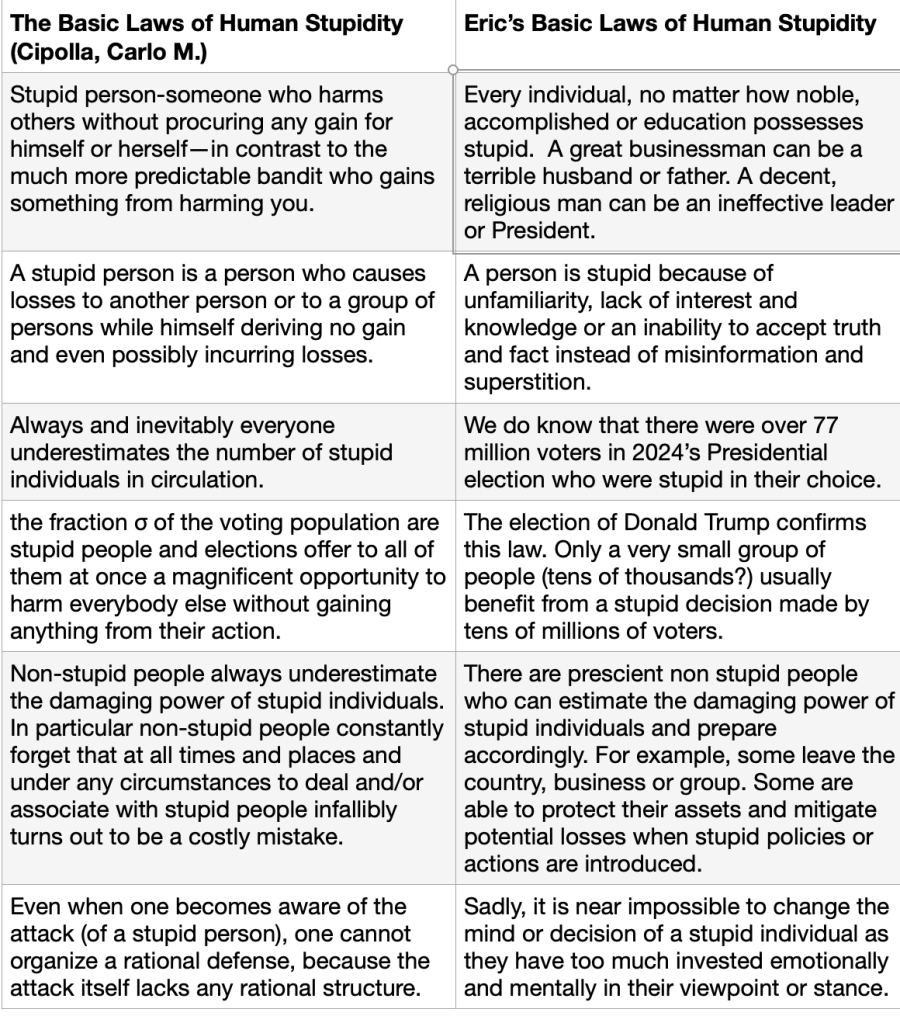
Human Stupidity

Listed below are my notes from reading a small book titled The Basic Laws of Human Stupidity by Carlo M. Cipolla. He wrote his book on Human Stupidity in the 1990s. I believe that stupidity has evolved further in its growth and destructiveness.

Lucky Loser: How Donald Trump Squandered His Father’s Fortune and Created the Illusion of Success by Russ Buettner and Susanne Craig (Book Review)

This book offers an in-depth look at Donald Trump—the businessman, real estate investor, entrepreneur, and brand. Much of the narrative focuses on his struggles to finance buildings, casinos, golf courses, and other projects. Despite his relentless self-promotion, Trump has repeatedly proven to be a poor businessman, often relying on his father, Fred Trump, to bail him out of financial trouble.

As you read, one question becomes unavoidable: Why would anyone choose to partner with Donald Trump? His track record as a business leader is riddled with failure, and those who have worked with him—contractors, lenders, and employees—frequently find themselves shortchanged. Why lend money to someone who appears to lack financial discipline in both his personal and professional life?

A Trump supporter might dismiss this book as misinformation, but the authors had access to extensive financial records, including Trump’s tax returns. Their research is bolstered by interviews with numerous individuals who have firsthand experience dealing with him.

The fact free bubble Fox News created around Donald Trump as president may have felt familiar. He had spent his entire life in a similar bubble, financed by his father. In this comfortable place, he could hide his failures, pay for them with his father’s money, and later a celebrity’s fortune. There would be no metrics measuring his success, just the impression of self created wealth that he willed into existence.From the moment he left his father’s careful planning practices behind, he protected his bubble by waging war on the fact based world that might pop it.

Trump’s failures in the casino industry in Atlantic City are well-documented. His attempt to buy an NFL franchise led instead to the downfall of the USFL. When journalists and analysts challenged his exaggerated business claims, he responded with lawsuits and intimidation tactics.

Perhaps his greatest success—if it can be called that—was The Apprentice, a reality show that portrayed him as a shrewd businessman with exceptional judgment. This carefully crafted image helped convince much of the public that he was a financial genius, a perception that played a crucial role in his 2016 presidential campaign.

The book is 456 pages long and thoroughly researched, with extensive footnotes to support its claims. In fact, published articles by the authors on Trump’s finances earned them a Pulitzer Prize.

I wish I could say this book might change the minds of his staunchest supporters, but realistically, many of them are unlikely to engage with a work of this length and depth.

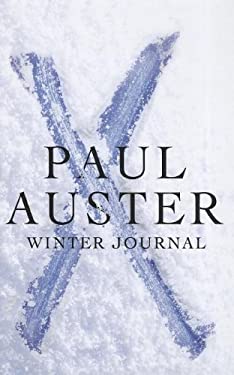
Winter Journal by Paul Auster (Recommendation and Review)

I first read this book in 2012 when I was 60 years old. It had a profound effect on me then. My fears of getting older were starting. Reading this book at 72, I have a new appreciation for Auster’s messaging on aging, death and memories. The tale is sobering, not depressing. Auster had an interesting story to tell about his life’s experiences.

“Winter Journal” is a deeply personal memoir published in 2012, written when Auster was 64 years old. Auster begins by documenting his bodily sensations and physical experiences, starting with a detailed account of his mother’s death and moving through various moments of his life. He explores personal traumas, near-death experiences, and significant physical memories that have shaped his understanding of himself.

The memoir covers several key themes: mortality, aging, memory, and personal history.

List of my favorite excerpts below:

Your bare feet on the cold floor as you climb out of bed and walk to the window. You are 64 years old. Outside, the air is gray, almost white, with no sun visible. You ask yourself: How many mornings are left?

Nevertheless, there are things that you miss from the old days, even if you have no desire to see those days return. The ring of the old telephones, the clacking of typewriters, milk and bottles, baseball without designated hitters, vinyl records, galoshes, stockings, and garter belts, black and white movies, heavyweight champions,… basketball before the three-point shot, contempt for authority.

Your birthday has come and gone. 64 years old now, inching ever closer to senior citizenship, to the days of Medicare and Social Security benefits, to a time when more and more of your friends will have left you. So many of them are gone already – –but just wait for the deluge that is coming.

That is why you will never forget these words, which were the last words spoken to one of your friends by his dying father: “Just remember, Charlie, “he said “never pass up an opportunity to piss.” And so the wisdom of the ages is handed down from one generation to the next.

Joubert: The end of life is bitter. Less than a year after writing those words, at the age of 61, which must’ve seemed considerably older in 1815 then it does today, he jotted down a different and far more challenging formulation about the end of life: One must die, lovable (if one can.)


A Certain Idea of America: Selected Writings by Peggy Noonan (Book Review)

Peggy Noonan is one of the very few Republicans with whom I feel I could sit down and have a civil conversation about politics, history, and current events. My belief is affirmed after reading her book, A Certain Idea of America: Selected Writings, a collection of recent commentaries on politics, personalities, culture, and contemporary issues. Her writing is measured, thoughtful, and often insightful.

For instance, in a column written in 2019, Noonan offered advice to Joe Biden, attempting to dissuade him from running for president in 2020. Her words, in hindsight, appear not only as good counsel but also as prophetic given Biden’s mixed success as president:

“Your very strength – that you enjoy talking to both sides, that deep in your heart you see no one as deplorable – will be your weakness. You aren’t enough of a warrior. You’re sweet, you’re weak, you’re half daffy. You’re meh.”

Noonan stands as an outlier within the Republican Party. Her style of writing seeks to inform, inspire, and not inflame. She is no supporter of Trump. Even her criticism of Trump’s antics and leadership is measured—acerbic yet never descending into vitriol.

One passage in particular may encapsulate her sharp perspective on America’s present and future trajectory:

“In time, we’ll see you lose something when you go post-heroic. Colorful characters will make things more divided, not less. They’ll entertain, but not ennoble. And the world will think less of us – America has become a clownish, unserious country with clownish, unserious leaders – which will have an impact on our ability to influence events.”

This observation feels prescient and poignant, capturing a sense of national disquiet. Unfortunately, not enough Americans shared this view during the last election. Perhaps Noonan could have lent her rhetorical skills to Kamala Harris and the Democrats to sharpen their messaging.

While I don’t agree with all her views—for instance, I’m not as enamored with Billy Graham or Ronald Reagan as she is—I respect her opinions. Her prose is engaging, and the short commentaries, originally published in The Wall Street Journal, make for an easy yet thought-provoking read.

Reagan: His Life and Legend by Max Boot (Book Review)


Max Boot’s biography, Reagan: His Life and Legend, offers a well-written and balanced examination of Ronald Reagan as President, Governor of California, husband, and father. While the book sheds light on Reagan’s admirable traits, it doesn’t shy away from his flaws, making it a nuanced portrayal that might not have pleased Reagan or his wife, Nancy, if they were alive to read it.

Reagan’s admirers—particularly those who regard him as one of the greatest U.S. Presidents—may find aspects of this book unsettling. While Boot acknowledges Reagan’s good qualities, he also highlights numerous shortcomings, presenting a more complex figure than the idealized version often celebrated.

The biography reinforced my belief that Reagan, though a decent man, was neither a particularly intelligent individual nor an exceptional leader. He lacked intellectual curiosity, with Reader’s Digest reportedly being his preferred reading material. Reagan, at heart, was an actor, and much of his success stemmed from his ability to follow direction—something he desperately needed throughout his political life.

One quality I genuinely admired in Reagan was his courage following the 1981 assassination attempt by John Hinckley. His ability to maintain a sense of humor even as he faced death was truly inspiring.

Reagan’s presidency benefited immensely from the presence of highly skilled advisors. For instance, Jim Baker, widely regarded as the best Chief of Staff in presidential history, played a pivotal role in keeping the administration on track. To Reagan’s credit, he recognized his limitations and leaned heavily on his team for guidance. Similarly, he often sought advice from Nancy, who was both his greatest supporter and, at times, a source of controversy in his life.

The book, at 731 pages, is lengthy but flows efficiently, offering a comprehensive look at Reagan’s life. Boot’s writing is engaging, making the biography an easy and compelling read despite its depth.

While there are faint parallels between Reagan and Donald Trump, I would caution against drawing too many comparisons. Reagan’s legacy, while flawed, is distinct in character and style from Trump’s presidency.

However, the book is not without its omissions. Boot largely sidesteps critical moments and controversies that shaped Reagan’s legacy. There’s no mention of the bombings of the U.S. Embassy, the Embassy annex, or the Marine barracks in Beirut—or the paralyzing indecision that followed. Likewise, the humiliating hostage crisis in Lebanon, the Iran-Contra affair, and the diversion of funds to the Contras are conspicuously absent.

Equally glaring is the lack of discussion on domestic issues, including scandals involving savings and loan regulators, the Department of Housing and Urban Development, and other government agencies. Boot also neglects to address Reagan’s rollback of civil rights laws, his failed nomination of Robert Bork to the Supreme Court, or the infamous visit to Bitburg Cemetery. The administration’s tax cuts, social welfare reductions, and their role in growing income inequality and the hollowing out of the middle class are similarly omitted.

On foreign policy, Boot overlooks Reagan’s apathy toward the AIDS pandemic, his opposition to sanctions on South Africa, and the dangerous escalation of tensions with the Soviet Union during the early 1980s fueled by his military buildup and incendiary rhetoric.

While Boot succeeds in painting a vivid picture of Reagan’s life and personality, these omissions leave the portrait incomplete. For readers seeking a full accounting of Reagan’s presidency, these gaps may feel significant. Nonetheless, the book offers a fascinating exploration of Reagan’s life, warts and all.


My Favorite Books of 2024

In 2024, I’ve read 60 books, and these are my top 12—representing the best 20%. Before diving into a book, I perform due diligence, as I want to make the most of my reading time. I gravitate toward nonfiction and typically source my books from the library or Kindle, rarely purchasing hardcovers or paperbacks anymore.

My reading tastes are eclectic. This year, I found myself delving into several books about German history between World War I and World War II, when Hitler rose to power. Perhaps this was influenced, consciously or not, by the recent presidential election results.

The books on this list stood out as informative, thought-provoking, or entertaining. While I may sometimes favor books that align with my existing beliefs, I actively seek perspectives that challenge me and shake up the cobwebs in my thinking.