Lucky Loser: How Donald Trump Squandered His Father’s Fortune and Created the Illusion of Success by Russ Buettner and Susanne Craig (Book Review)

This book offers an in-depth look at Donald Trump—the businessman, real estate investor, entrepreneur, and brand. Much of the narrative focuses on his struggles to finance buildings, casinos, golf courses, and other projects. Despite his relentless self-promotion, Trump has repeatedly proven to be a poor businessman, often relying on his father, Fred Trump, to bail him out of financial trouble.

As you read, one question becomes unavoidable: Why would anyone choose to partner with Donald Trump? His track record as a business leader is riddled with failure, and those who have worked with him—contractors, lenders, and employees—frequently find themselves shortchanged. Why lend money to someone who appears to lack financial discipline in both his personal and professional life?

A Trump supporter might dismiss this book as misinformation, but the authors had access to extensive financial records, including Trump’s tax returns. Their research is bolstered by interviews with numerous individuals who have firsthand experience dealing with him.

The fact free bubble Fox News created around Donald Trump as president may have felt familiar. He had spent his entire life in a similar bubble, financed by his father. In this comfortable place, he could hide his failures, pay for them with his father’s money, and later a celebrity’s fortune. There would be no metrics measuring his success, just the impression of self created wealth that he willed into existence.From the moment he left his father’s careful planning practices behind, he protected his bubble by waging war on the fact based world that might pop it.

Trump’s failures in the casino industry in Atlantic City are well-documented. His attempt to buy an NFL franchise led instead to the downfall of the USFL. When journalists and analysts challenged his exaggerated business claims, he responded with lawsuits and intimidation tactics.

Perhaps his greatest success—if it can be called that—was The Apprentice, a reality show that portrayed him as a shrewd businessman with exceptional judgment. This carefully crafted image helped convince much of the public that he was a financial genius, a perception that played a crucial role in his 2016 presidential campaign.

The book is 456 pages long and thoroughly researched, with extensive footnotes to support its claims. In fact, published articles by the authors on Trump’s finances earned them a Pulitzer Prize.

I wish I could say this book might change the minds of his staunchest supporters, but realistically, many of them are unlikely to engage with a work of this length and depth.

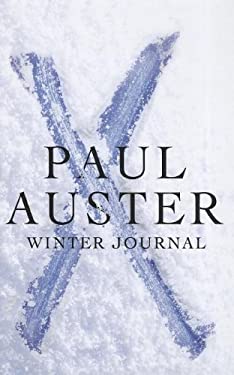
Winter Journal by Paul Auster (Recommendation and Review)

I first read this book in 2012 when I was 60 years old. It had a profound effect on me then. My fears of getting older were starting. Reading this book at 72, I have a new appreciation for Auster’s messaging on aging, death and memories. The tale is sobering, not depressing. Auster had an interesting story to tell about his life’s experiences.

“Winter Journal” is a deeply personal memoir published in 2012, written when Auster was 64 years old. Auster begins by documenting his bodily sensations and physical experiences, starting with a detailed account of his mother’s death and moving through various moments of his life. He explores personal traumas, near-death experiences, and significant physical memories that have shaped his understanding of himself.

The memoir covers several key themes: mortality, aging, memory, and personal history.

List of my favorite excerpts below:

Your bare feet on the cold floor as you climb out of bed and walk to the window. You are 64 years old. Outside, the air is gray, almost white, with no sun visible. You ask yourself: How many mornings are left?

Nevertheless, there are things that you miss from the old days, even if you have no desire to see those days return. The ring of the old telephones, the clacking of typewriters, milk and bottles, baseball without designated hitters, vinyl records, galoshes, stockings, and garter belts, black and white movies, heavyweight champions,… basketball before the three-point shot, contempt for authority.

Your birthday has come and gone. 64 years old now, inching ever closer to senior citizenship, to the days of Medicare and Social Security benefits, to a time when more and more of your friends will have left you. So many of them are gone already – –but just wait for the deluge that is coming.

That is why you will never forget these words, which were the last words spoken to one of your friends by his dying father: “Just remember, Charlie, “he said “never pass up an opportunity to piss.” And so the wisdom of the ages is handed down from one generation to the next.

Joubert: The end of life is bitter. Less than a year after writing those words, at the age of 61, which must’ve seemed considerably older in 1815 then it does today, he jotted down a different and far more challenging formulation about the end of life: One must die, lovable (if one can.)


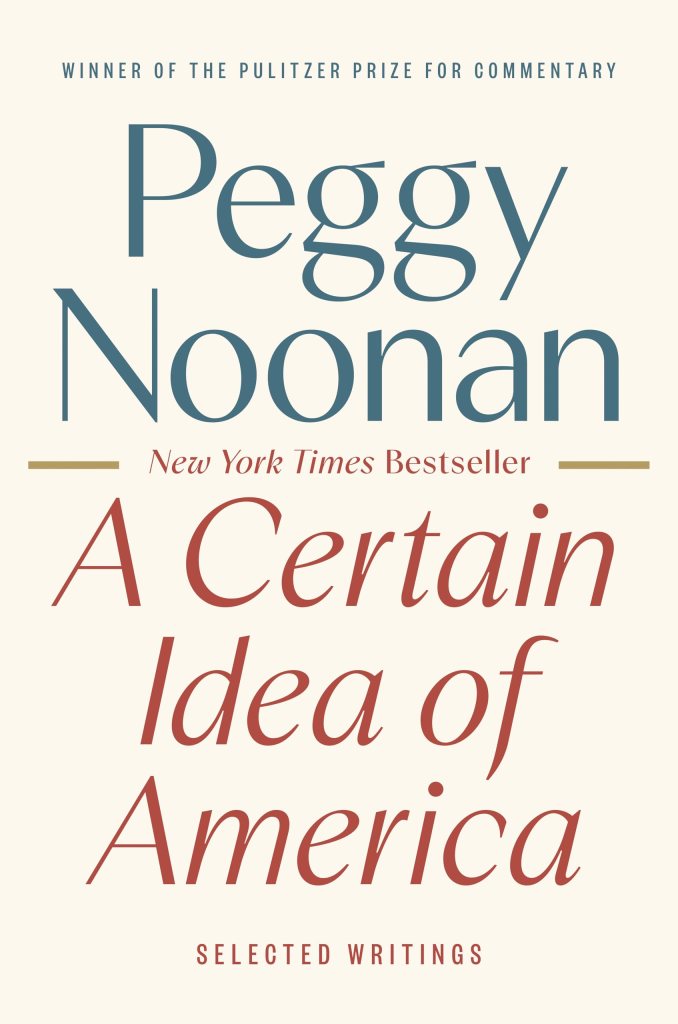
A Certain Idea of America: Selected Writings by Peggy Noonan (Book Review)

Peggy Noonan is one of the very few Republicans with whom I feel I could sit down and have a civil conversation about politics, history, and current events. My belief is affirmed after reading her book, A Certain Idea of America: Selected Writings, a collection of recent commentaries on politics, personalities, culture, and contemporary issues. Her writing is measured, thoughtful, and often insightful.

For instance, in a column written in 2019, Noonan offered advice to Joe Biden, attempting to dissuade him from running for president in 2020. Her words, in hindsight, appear not only as good counsel but also as prophetic given Biden’s mixed success as president:

“Your very strength – that you enjoy talking to both sides, that deep in your heart you see no one as deplorable – will be your weakness. You aren’t enough of a warrior. You’re sweet, you’re weak, you’re half daffy. You’re meh.”

Noonan stands as an outlier within the Republican Party. Her style of writing seeks to inform, inspire, and not inflame. She is no supporter of Trump. Even her criticism of Trump’s antics and leadership is measured—acerbic yet never descending into vitriol.

One passage in particular may encapsulate her sharp perspective on America’s present and future trajectory:

“In time, we’ll see you lose something when you go post-heroic. Colorful characters will make things more divided, not less. They’ll entertain, but not ennoble. And the world will think less of us – America has become a clownish, unserious country with clownish, unserious leaders – which will have an impact on our ability to influence events.”

This observation feels prescient and poignant, capturing a sense of national disquiet. Unfortunately, not enough Americans shared this view during the last election. Perhaps Noonan could have lent her rhetorical skills to Kamala Harris and the Democrats to sharpen their messaging.

While I don’t agree with all her views—for instance, I’m not as enamored with Billy Graham or Ronald Reagan as she is—I respect her opinions. Her prose is engaging, and the short commentaries, originally published in The Wall Street Journal, make for an easy yet thought-provoking read.

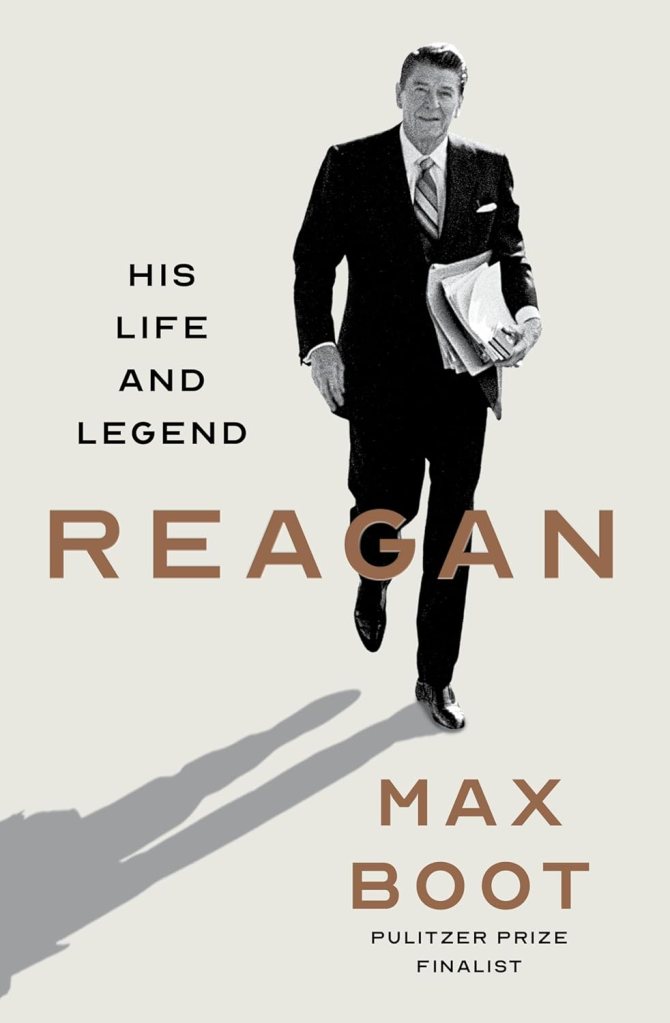
Reagan: His Life and Legend by Max Boot (Book Review)


Max Boot’s biography, Reagan: His Life and Legend, offers a well-written and balanced examination of Ronald Reagan as President, Governor of California, husband, and father. While the book sheds light on Reagan’s admirable traits, it doesn’t shy away from his flaws, making it a nuanced portrayal that might not have pleased Reagan or his wife, Nancy, if they were alive to read it.

Reagan’s admirers—particularly those who regard him as one of the greatest U.S. Presidents—may find aspects of this book unsettling. While Boot acknowledges Reagan’s good qualities, he also highlights numerous shortcomings, presenting a more complex figure than the idealized version often celebrated.

The biography reinforced my belief that Reagan, though a decent man, was neither a particularly intelligent individual nor an exceptional leader. He lacked intellectual curiosity, with Reader’s Digest reportedly being his preferred reading material. Reagan, at heart, was an actor, and much of his success stemmed from his ability to follow direction—something he desperately needed throughout his political life.

One quality I genuinely admired in Reagan was his courage following the 1981 assassination attempt by John Hinckley. His ability to maintain a sense of humor even as he faced death was truly inspiring.

Reagan’s presidency benefited immensely from the presence of highly skilled advisors. For instance, Jim Baker, widely regarded as the best Chief of Staff in presidential history, played a pivotal role in keeping the administration on track. To Reagan’s credit, he recognized his limitations and leaned heavily on his team for guidance. Similarly, he often sought advice from Nancy, who was both his greatest supporter and, at times, a source of controversy in his life.

The book, at 731 pages, is lengthy but flows efficiently, offering a comprehensive look at Reagan’s life. Boot’s writing is engaging, making the biography an easy and compelling read despite its depth.

While there are faint parallels between Reagan and Donald Trump, I would caution against drawing too many comparisons. Reagan’s legacy, while flawed, is distinct in character and style from Trump’s presidency.

However, the book is not without its omissions. Boot largely sidesteps critical moments and controversies that shaped Reagan’s legacy. There’s no mention of the bombings of the U.S. Embassy, the Embassy annex, or the Marine barracks in Beirut—or the paralyzing indecision that followed. Likewise, the humiliating hostage crisis in Lebanon, the Iran-Contra affair, and the diversion of funds to the Contras are conspicuously absent.

Equally glaring is the lack of discussion on domestic issues, including scandals involving savings and loan regulators, the Department of Housing and Urban Development, and other government agencies. Boot also neglects to address Reagan’s rollback of civil rights laws, his failed nomination of Robert Bork to the Supreme Court, or the infamous visit to Bitburg Cemetery. The administration’s tax cuts, social welfare reductions, and their role in growing income inequality and the hollowing out of the middle class are similarly omitted.

On foreign policy, Boot overlooks Reagan’s apathy toward the AIDS pandemic, his opposition to sanctions on South Africa, and the dangerous escalation of tensions with the Soviet Union during the early 1980s fueled by his military buildup and incendiary rhetoric.

While Boot succeeds in painting a vivid picture of Reagan’s life and personality, these omissions leave the portrait incomplete. For readers seeking a full accounting of Reagan’s presidency, these gaps may feel significant. Nonetheless, the book offers a fascinating exploration of Reagan’s life, warts and all.


My Favorite Books of 2024

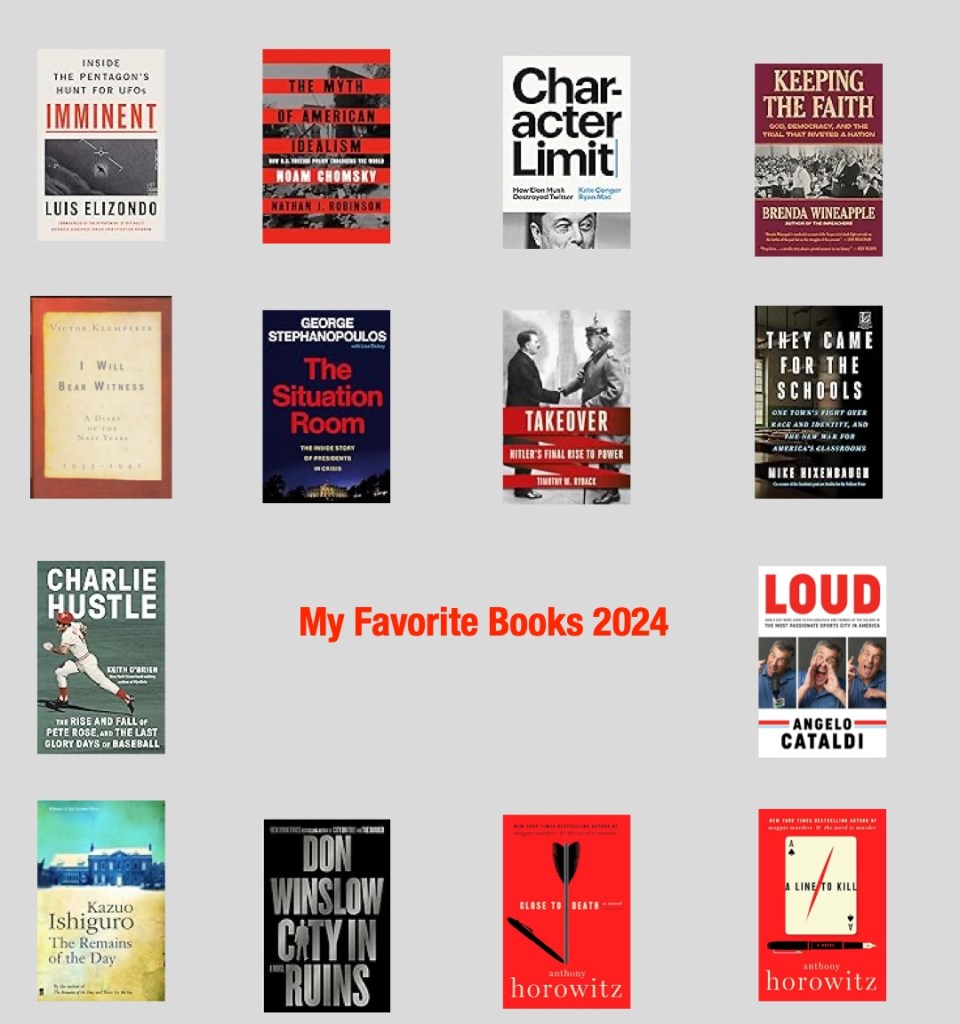
In 2024, I’ve read 60 books, and these are my top 12—representing the best 20%. Before diving into a book, I perform due diligence, as I want to make the most of my reading time. I gravitate toward nonfiction and typically source my books from the library or Kindle, rarely purchasing hardcovers or paperbacks anymore.

My reading tastes are eclectic. This year, I found myself delving into several books about German history between World War I and World War II, when Hitler rose to power. Perhaps this was influenced, consciously or not, by the recent presidential election results.

The books on this list stood out as informative, thought-provoking, or entertaining. While I may sometimes favor books that align with my existing beliefs, I actively seek perspectives that challenge me and shake up the cobwebs in my thinking.

Book Review: Imminent: Inside the Pentagon’s Hunt for UFOs by Luis Elizondo

Luis Elizondo, the former director of the Pentagon’s Advanced Aerospace Threat Identification Program (AATIP), offers a provocative look into the United States government’s investigation of unidentified anomalous phenomena (UAPs) in Imminent: Inside the Pentagon’s Hunt for UFOs. For readers accustomed to the term “UFOs,” the rebranding to UAPs signals a shift—an attempt to expand the narrative beyond flying objects to include all unexplained phenomena.

Elizondo’s book delves into two compelling narratives. The first is his recounting of extraordinary encounters with UAPs—incidents that suggest extraterrestrial involvement. The second is an exposé of governmental resistance to transparency, raising questions about secrecy, incompetence, and ideological opposition within the military and intelligence community. Both threads are bound to captivate anyone with even a passing curiosity about the possibility of extraterrestrial life.

The revelations are staggering: reports of extraterrestrial craft allegedly recovered and reverse-engineered; claims of alien “bodies” found at crash sites; and the disconcerting assertion that UAPs have interfered with U.S. nuclear missile systems. Elizondo even speculates on the potential motives of these visitors—our planet’s water as fuel, or concern over humanity’s penchant for self-destruction via nuclear warfare. Such theories are supported by numerous sightings near military bases and naval fleets.

The book doesn’t shy away from darker implications. While some suggest UAPs could be benign observers, others, including Elizondo, entertain the notion that their intentions may not be friendly. Reports of abductions and injuries suffered by those who’ve come into direct contact with UAPs lend credence to a more ominous view. Alarmingly, Elizondo recounts how a faction within the U.S. government dismissed UAP research altogether, citing their belief that these phenomena were “demonic.”

Yet, for all its intrigue, Imminent stops short of providing definitive proof. The anecdotes are enthralling, but they remain just that—anecdotes. While Elizondo’s credentials and credibility, evident in his congressional testimony and media appearances, lend weight to his claims, the lack of conclusive evidence may frustrate skeptics. In fact, prominent skeptic Michael Shermer has questioned Elizondo’s background and methods, though his critiques might suffer from a superficial engagement with the book’s content.

What truly stands out is Elizondo’s call for an evolution in our understanding of physics and time. He suggests that UAP technology—capable of unimaginable speed and maneuverability—might reveal the limitations of our current scientific paradigms. This conjecture is tantalizing, leaving readers to ponder whether humanity is on the brink of its most profound discovery.

While Elizondo’s accounts fuel fascination and trepidation, they also underscore a broader question: Could humanity cope with the existential shock of proving extraterrestrial life? As the author posits, the mere acknowledgment that we lack the means to defend against such advanced technology could induce global panic.

Despite the lack of a smoking gun, Imminent is undeniably engrossing. It invites readers to consider the implications of UAPs and the reasons behind governmental obfuscation. If clearer evidence—those alleged high-definition images and videos—exists, one wonders when, if ever, the public will see them. Until then, Imminent serves as a tantalizing, if inconclusive, prelude to what might be the greatest story ever told.

For anyone intrigued by the intersection of science, philosophy, and national security, Elizondo’s account is a must-read, even if it leaves more questions than answers. The next chapter of this unfolding story will undoubtedly be one to watch.

The Myth of American Idealism: How U.S. Foreign Policy Endangers the World by Noam Chomsky and Nathan J. Robinson (Review)

The received wisdom insists that the United States is the tireless champion of democracy and human rights—a paragon of “Wilsonian idealism” and “American exceptionalism.” Noam Chomsky’s and Nathan J. Robinson’s The Myth of American Idealism: How U.S. Foreign Policy Endangers the World eviscerates this comforting narrative. The authors argue that U.S. foreign policy aligns not with noble ideals but with the strategic and economic interests of domestic elites. The result? A history marred by moral indifference, lawlessness, and a ruthless adherence to what Adam Smith once called “the vile maxim of the masters of mankind: All for ourselves and nothing for other people.”

This is not a book for the faint of heart or those who prefer their history wrapped in the star-spangled illusions of Hollywood. It is a damning indictment of U.S. actions abroad, examining case studies from Vietnam to Iraq, Chile to Palestine. The authors spare no sacred cow, exposing the contradictions between America’s lofty rhetoric and its sordid realpolitik.

I approached this book with some skepticism. Chomsky’s political ideology leans further left than my own, and I was wary of polemics. Yet his analysis aligns uncomfortably well with historical evidence. Take, for instance, his examination of U.S. support for Israel. The one-sided nature of American backing—military aid, UN vetoes, and tacit approval of Israeli excesses—has devastated Palestinians while fueling anti-American animus across the Middle East. Chomsky is clear-eyed about the complexities: there are cruel men on both sides of the Israeli-Palestinian divide. But the suffering of millions of innocent Palestinians, bombed, maimed, and displaced, is a humanitarian tragedy in which the United States is deeply complicit.

Equally scathing is his treatment of the Vietnam War—a blunder of monumental proportions. The authors chronicle how leaders lied to the public, sent thousands of soldiers to die needlessly, and plunged the nation into chaos. As someone who lived through that era, I can attest to the war’s divisive impact. For younger readers, this history is essential reading, a sobering reminder of how disastrously foreign policy can go astray when guided by hubris and deceit.

The prose is not exactly uplifting, but it is brutally clarifying. Are we, as Americans, driven by democracy and justice—or by greed and oil? The book challenges readers to reckon with a less flattering version of our heritage, one that calls for reflection rather than whitewashing.

No matter where you fall on the political spectrum, The Myth of American Idealism will provoke thought, discomfort, and perhaps a much-needed reckoning. If you prefer fairy tales about America’s benevolence, look elsewhere. For those willing to confront uncomfortable truths, this book is indispensable.

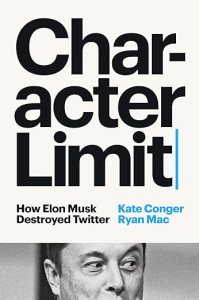
Character Limit: How Elon Musk Destroyed Twitter by Kate Conger and Ryan Mac (Rview


**One of the best-researched and well-written business books I have read, *Character Limit: How Elon Musk Destroyed Twitter* by Kate Conger and Ryan Mac is a compelling exploration of Elon Musk’s controversial purchase of Twitter. The book offers a rich narrative populated by a cast of hundreds of Twitter employees and executives, each bringing a unique perspective. Readers may find heroes and villains among them, all presented in vivid, humanizing detail. With a length far exceeding a tweet at 436 pages, it still keeps the reader engaged from start to finish.

At the heart of the book is Elon Musk, whose reputation as a visionary, eccentric, and often self-centered figure is fully displayed here. Musk is depicted as the center of Twitter’s universe, around which all other stories orbit. His personality and decisions drive the narrative, illustrating his complex and, at times, erratic leadership style.

As a reader, I found myself feeling sympathetic for the executives and employees who had to work with Musk. Many were caught in a difficult position, needing their jobs to support themselves and their families. Musk, however, was a challenging boss, setting impossible deadlines, frequently changing his mind, and often requiring flattery before he would listen to advice. This environment, as described in the book, made for a grueling workplace experience.

The book also draws comparisons between Musk and Donald Trump, noting both men’s tendencies to act impulsively, seeking adulation and approval without considering the full consequences of their decisions. This parallel underscores the irony that Musk, who initially sought to reduce misinformation on Twitter, ended up frequently sharing and amplifying misinformation himself.

After reading this book, I would not want to work with Elon Musk. The book notes that there has been speculation Musk could take on efficiency reforms in the federal government by cutting expenses and staff. However, his approach at Twitter—firing over half the staff without a clear strategy—highlights the dangers of indiscriminately cutting headcount without considering the broader ramifications.


America First: Roosevelt vs. Lindbergh in the Shadow of War by H.W. Brands (Review)


My rating: 4 of 5 stars


On September 1, 1939, fighting broke out in Europe. After the invasion of Poland by Germany, both France and England declared war against the Nazis. Many, if not most Americans, were resistant to participating in a European war. Indeed, there was resistance to even supplying military supplies and other goods to Britain while they basically fought Germany on their own. There was also significant support for the Germany and Hitler’s regime at this time.

Franklin D. Roosevelt managed a fine line. He wished to be re-elected for a third term, but he also understood that Hitler’s goals were not only the conquest of Europe, but world conquest. Charles Lindbergh was an American hero for his exploits about flying across the Atlantic on his own. He and his wife Anne endured the kidnapping and murder of his son in 1932 and this endeared him more to the American public.

Lindbergh opposed US involvement in any war overseas. Lindbergh felt that America was invincible as it was protected by oceans and not vulnerable to air attacks. Lindbergh saw no reason for America to sacrifice its sons in European wars and spoke out strongly against any intervention.

How FDR positioned the United States to prepare for World War II is an interesting story of great judgment and leadership. FDR coordinated closely with Winston Churchill to ensure that Britain had the necessary weapons and materials to survive German assaults. Roosevelt had to skillfully maneuver his aid to Churchill under the watchful eye and some time opposition of a reluctant Congress.

Charles Lindbergh was accused of being an agent and dupe of the German government. There seems to be a little evidence of that. Lindbergh firmly believed that United States could stand on its own and ably defend itself against any foreign attack or invasion. Circumstances and events proved that Lindburgh was incorrect in his analysis but he did volunteer to help the military in any capacity once United States entered the war.

Today there are isolationist policies still being supported. There are many Americans and people in Congress, who do not feel that we should be supporting Ukraine in its battle against Russia and Putin. Are they guilty of being short sighted too? There are some interesting historical similarities there.

This book was well researched and an excellent read. It quotes from Lindbergh’s diaries and provides a good measure of the man and his ambitions. I think that Lindbergh was largely circumspect and responsible in his criticism over American foreign policy. FDR happened to be right in his judgement about Hitler and America’s role in stopping tyranny.


Keeping the Faith: God, Democracy, and the Trial That Riveted a Nation by Brenda Wineapple (Book Review)

My rating: 5 of 5 stars

Before reading this book, I was already intrigued by the Scopes trial, having encountered it through reading Inherit the Wind by Lawrence and Lee in my youth and viewing the film adaptation starring Spencer Tracy as Clarence Darrow.

This book captivated me, not just with the story of the Scopes trial itself but also with the rich background it provides on the cultural and political climate in America leading up to the trial. The country was grappling with racism, antisemitism, women’s disenfranchisement, and a stark divide between the North and South. Religious leaders were increasingly uneasy with the rise of science, and efforts to suppress scientific education in schools were prevalent—an issue that resonates even today.

Wineapple profiles three key figures of the era: Clarence Darrow, H.L. Mencken, and William Jennings Bryan. These profiles were the highlight for me. All three were intelligent, influential, articulate, and deeply flawed. Their strong beliefs on issues like racism, antisemitism, and religion shaped their actions.

Bryan, a staunch defender of the Bible, believed its teachings should be taken literally. His speeches and sermons, especially in the South, were widely popular. Despite three failed presidential campaigns, his political ambition never waned.

Darrow and Mencken, both agnostics, were critical of religious hypocrisy. Liberals in their politics, they used their legal and journalistic skills to push their principles. It’s fascinating that Bryan, Darrow, and Mencken ended up at the center of such a pivotal cultural and political moment.

Reading this book made me reflect on how much progress the United States has—or hasn’t—made in areas like racism, antisemitism, and the influence of religion in education, law, and politics. The challenges to science that existed in the 1920s are still relevant today.

I highly recommend this book as an insightful snapshot of American culture and politics in the 1920s and is still happening today.

Saturday Night will always remain burned in my memory as long as I live, as being the day when I heard the most religion preached, and the least practiced.

Will Rogers