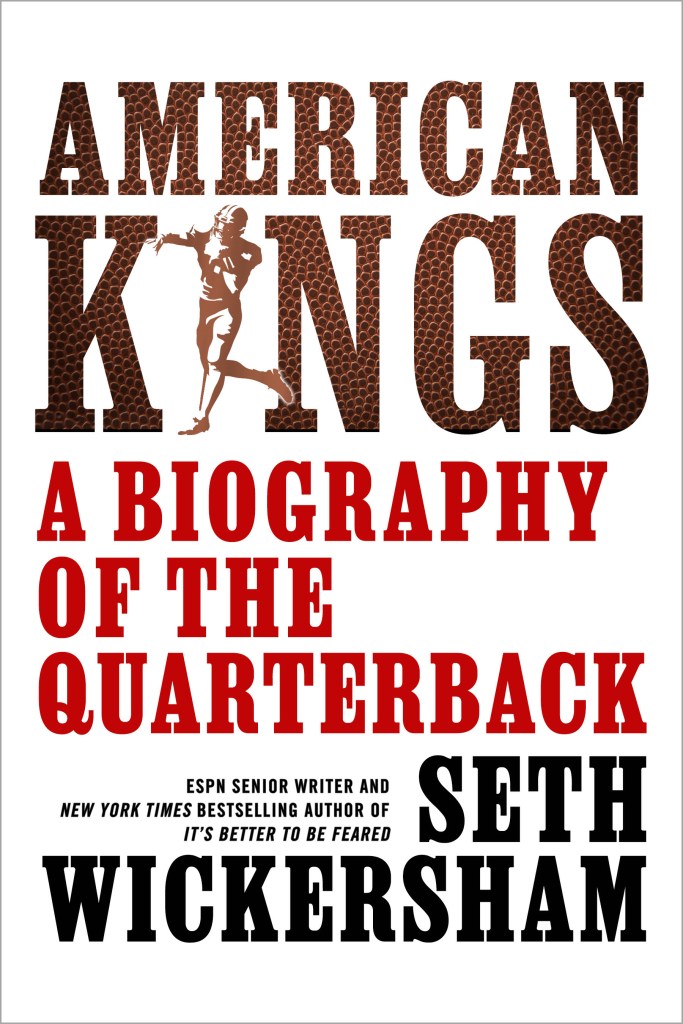
This is one of the finest sports books I’ve read—less a manual on throwing mechanics than a deep dive into the psychology, privilege, pressure, and mythology of the quarterback position. Seth Wickersham strings together interesting personal anecedotes and stories, from Bob Waterfield to Arch Manning, showing how the job evolved from leather-helmet grit to NIL-era celebrity. The through line isn’t arm strength—it’s judgment, image management, leadership, and the peculiar loneliness of being the face of a franchise. The challenge of being a quarterback, is not necessarily just on the field, but off the gridiron and at home.
For those of us who grew up in earlier NFL eras, the portraits of Johnny Unitas, Joe Namath, Y. A. Tittle, Warren Moon, and James Harris are especially resonant—rich with texture and context. Wickersham also delivers sharp, modern profiles of John Elway, Caleb Williams, and even Colin Hurley, who hasn’t yet thrown a college pass but already carries the weight of expectation.
This book pairs nicely, across the decades, with Paper Lion, by George Plimpton which captured the physical reality an author of trying to play the position. American Kings captures the aura.
At nearly 400 pages, it’s substantial but never dull—an absorbing read for any football fan and a revealing study of how America builds (and burdens) its field generals.
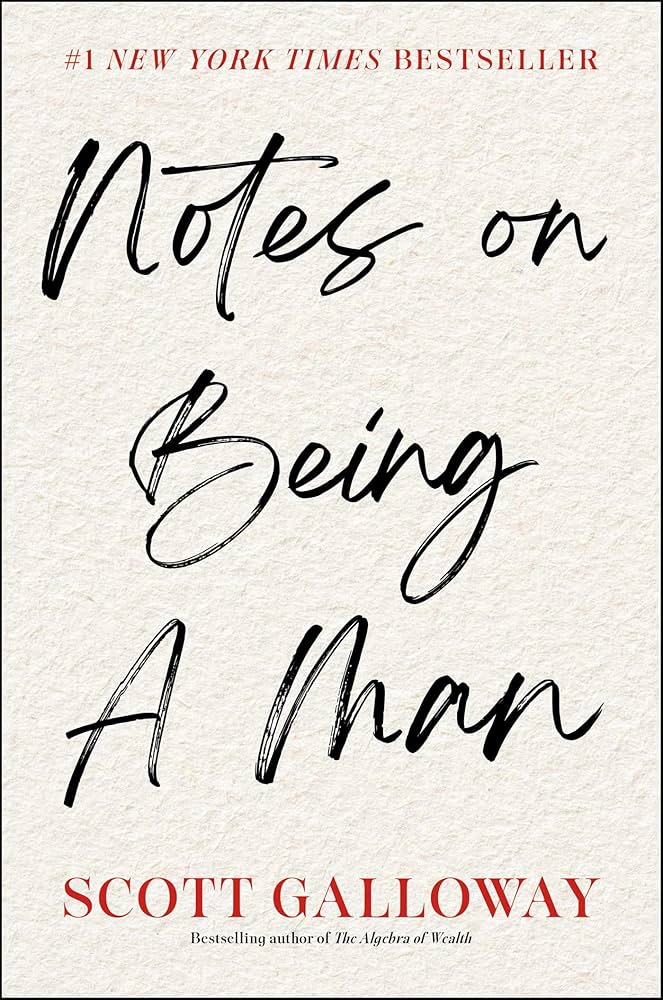
Good book for young men in their 20s and 30s. For this reader in his 70s, it provided some perspective on his life and a bit of a report card on how well he did. Scott Galloway is one of the nation’s top thought leaders. This book is a combination of an autobiography and his notes on how to conduct one’s life as a man. He cites the many issues of masculinity in today’s culture and society and offers his advice on relationships, education, career, family, work and health.
I think Scott has been very lucky. He had a loving and caring mother who filled the parenting roles when his father divorced her. I don’t think many men will identify with his life’s path. Scott worked very hard for his success but there were prices to pay in terms of his first marriage and health. Listed below are some notes of advice from Scott and my commentary regarding its validity and wisdom.
Scott’s Notes
My Notes and Comments
Most boys come apart when a male role model leaves. If there is no father present, the son is more likely to be incarcerated than graduate from college.
I don’t think that I’m the exception. My father died when I was seven. I had a caring mother and family for help. I graduated from college. I dealt successfully with adversity.
Success comes when you put in small, consistent amounts of effort, every day and every week.
Success comes more from luck, connections and opportunity than effort.
College teaches you critical thinking-how to triage.
Depends on the classes, the teacher and the student’s desire to learn. Based on what I see, very few people have marshaled the knack of critical thinking, college or not.
The ratio of time you spend sweating to watching others sweating is forward looking indicator of your success.
Unless you are Donald Trump
Your body will sometimes make decisions for you when your brain won’t. Learn to listen to your body.
Good advice when you’re young, better and more valid advice as you get older!
Don’t be afraid to quit. Failing fast is better than failing over a long period.
As soon as you start a new job, develop a Plan B to escape if the job does not work out. Have an FU fund.
The best romantic partnerships are synced up on three things: passion, values and money.
Money or lack of it ruins many marriages and relationships.
Of the last fifty books I’ve read, forty came from my local library and ten from Kindle. I didn’t buy a single physical book in 2025. When I do purchase a Kindle title, I rarely pay more than $2.99. That number feels less like thrift and more like a verdict on how I now value books: still important, but no longer precious objects.
I wandered into Barnes & Noble twice this past year. Both times I walked out empty-handed. The books that were heavily discounted held no appeal, and the books I might have been interested in weren’t discounted at all. The store felt less like a literary crossroads and more like a museum gift shop—pleasant to browse, but disconnected from my reading life.
When I’m looking for something new to read, I rely on a small, familiar circle: The New York Times Sunday Book Review, Kirkus Reviews, or Goodreads review.
1929: Inside the Greatest Crash in Wall Street History–and How It Shattered a Nation by Andrew Ross Sorkin is the only current New York Times nonfiction bestseller I’ve read. I have no interest in the other titles on the list. The hardcover fiction list holds even less appeal; I haven’t read—and don’t intend to read—any of those books.
What surprises me most is not my indifference to bestseller lists, but how little conversation books generate anymore. I honestly can’t remember the last time someone recommended a book to me, or when I had a real discussion with another person about something we’d both read. Books seem to have slipped quietly out of our shared conversations.
That feels especially strange when I think back to being ten or eleven years old, roaming the Pennsauken Library in search of the next Hardy Boys, Tom Swift, or Chip Hilton book. I wish I had even a quarter of the excitement I felt then—the sense of urgency, discovery, and possibility that came with finding the next volume in a series. Reading was once a small, private adventure that somehow felt enormous.
At seventy-three, reading is harder in ways that have nothing to do with motivation. My mind doesn’t focus for long stretches. My eyes tire quickly. Cataracts and floaters dull the sharpness of the page. And beyond the physical changes, there’s the persistent feeling that many books now trigger: been there, done that. As one gets older, interest naturally drains from subjects that once felt endlessly compelling—politics, sports, business, self-improvement, psychology, religion. Not because they don’t matter, but because their patterns repeat.
There’s also the sense that books—especially those about current events, politics, or celebrities—have lost some of their gravity. So much of their content is given away in advance through interviews, podcasts, op-eds, and promotional appearances that the book itself feels like an afterthought, a bound summary of things already half-known.
And yet, despite all of this, I keep reading. Maybe not with the hunger of a child or the ambition of a younger adult, but with a quieter persistence. The library card still works. The Kindle still lights up. And every now and then, a book manages to cut through the fatigue and familiarity, reminding me why reading mattered in the first place—and why it still does, even now.
This was a surprisingly difficult reading year for me. Not many books truly grabbed me, but the ones that did were memorable for different reasons. If I had to recommend one standout title, it would be The Doorman by Chris Pavone—a fun, tightly written page-turner that’s hard to put down. Pavone captures the cultural and political absurdities of modern America and wraps them in a fast, entertaining plot…with a dash of gratuitous violence for good measure.
I also enjoyed Walter Mosley’s novel Been Wrong So Long It Feels Like Right, the only other work of fiction on my list. Mosley has written a series of detective and mystery novels that I have enjoyed. In this book, he’s able to solve two mysteries simultaneously, including one of a deeply, personal matter.
Notable Nonfiction
1929: Inside the Greatest Crash in History by Andrew Ross Sorkin A detailed, absorbing look at the lead-up to and during the Great Depression. It’s a cautionary tale for what could happen to the economy today. It’s excellent—if a bit long. If you prefer the highlights, Sorkin has several worthwhile YouTube interviews that cover the major themes of the book.
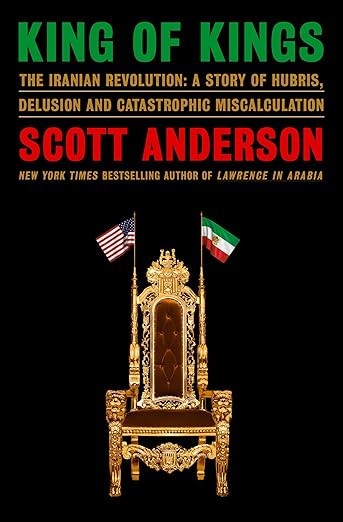
King of Kings by Scott Anderson and The Mission: The CIA in the 21st Century by Tim Weiner These are the kinds of books certain corners of the political world would prefer never be published. Both portray America’s intelligence services, diplomatic corps, and various administrations as shockingly short-sighted and often incompetent—and that’s before Pete Hegseth enters the picture.
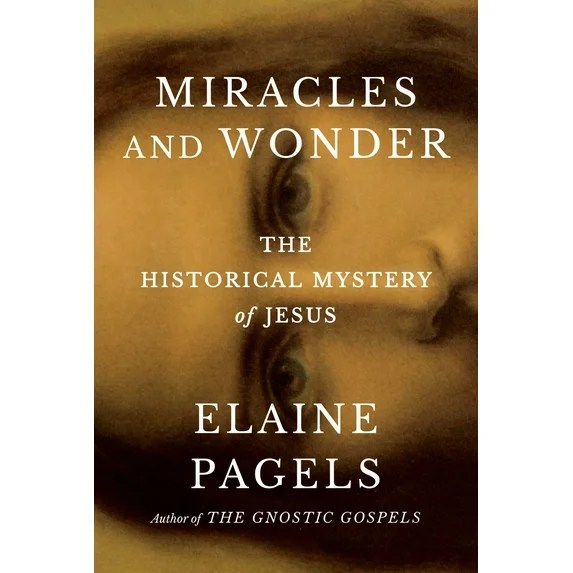
Miracles and Wonder: The Historical Mystery of Jesus by Elaine Pagels I had high hopes for this one. I’m always looking for a thoughtful, persuasive argument that might ease my agnostic skepticism. While Pagels is insightful as always, nothing here challenged my doubts about God, Jesus, or Christianity in any meaningful way. But it is excellent in understanding the times and culture that Christ lived and examining many of the controversial sections of his life.
Murder the Truth: Fear, the First Amendment, and a Secret Campaign to Protect the Powerful by David Enrich A sobering look at how political, economic, and cultural pressures are weakening the First Amendment and undermining journalism. Enrich offers example after example of how free speech and a free press are being chipped away—and it’s hard not to feel discouraged by what now passes for “journalism.”
Lucky Loser: How Donald Trump Squandered His Father’s Fortune and Created the Illusion of Successby Russ Buttenger and Susanne Craig If you’re not a Donald Trump fan, this book will reinforce every doubt you’ve had about his business skills, judgment, and competence. Stories about Trump’s forays into real estate, the USFL, the casino industry, and other businesses. If you are MAGA, it’s fake news.
On Her Game Caitlin Clark, and the revolution in women’s sportsby Christine Brennan Caitlin Clark may have been the best female collegiate basketball player of all time. But she met a lot of resistance from other players and from management when she entered the WNBA. Brennan documents how Clark’s biggest problems were not necessarily on the basketball court but off it.
Winter Journal by Paul Auster Boy could I relate to this book! Excellent written memoir of the author, who is 64, reviewing his regrets, experiences and dreams from youth to “old age.” For those of us who are in the “winter” of our lives, this book will inspire you to be more reflective and accepting of our lives – – successes and failures, both.
I’ve been an admirer of Andrew Ross Sorkin’s financial reporting for years, particularly through his work on CNBC, and I previously enjoyed his book Too Big to Fail, a definitive account of the 2008–2009 financial crisis. With that bias admitted upfront, I found 1929 to be an engaging and illuminating read. Though the book is lengthy—about 444 pages—it never feels like a dry history textbook. Instead, it flows with the narrative tension of a novel, making complex financial events accessible and compelling.
A background or interest in finance, economics, or banking certainly enriches the reading experience, but Sorkin’s storytelling makes the material approachable even for those who aren’t steeped in economic jargon.
A Rich, Relevant History
What makes this book especially resonant is how closely the late 1920s echo aspects of our present moment. The U.S. had recently emerged from a pandemic; optimism about growth and technological change was widespread; and the stock market appeared unstoppable. Investors—large and small—took on unprecedented leverage, borrowing heavily to chase rising share prices.
But economic momentum is fragile. Once confidence cracked, the market’s collapse was swift and devastating. The crash wiped out fortunes, triggered a steep economic downturn, and led to widespread unemployment. The government and the Federal Reserve lacked a clear or unified strategy, and their responses were often reactive, hesitant, or contradictory.
Sorkin offers a nuanced view of Herbert Hoover, depicting him not as the caricature of incompetence found in some earlier accounts, but as a leader who recognized the depth of the crisis and attempted—albeit imperfectly—to stem the damage. It’s a more sympathetic portrait than many readers might expect.
Vivid Personalities and Power Players
The book is populated with fascinating figures from finance, government and politics, including:
Charles Mitchell, chairman and CEO of National City Bank (a central figure in the era’s excessive speculation)
Winston Churchill
Franklin Delano Roosevelt
Senator Carter Glass
Evangeline Adams
Herbert Hoover
Ferdinand Pecora
and many others
Sorkin demonstrates how the interplay of personalities, policies, and economic forces created the conditions for both the boom and the crash. His research is broad, and his interpretations are measured yet insightful.
Reflections on Today’s Economy
Reading about 1929 inevitably led me to think about the state of the economy today. Although history doesn’t repeat itself exactly, the parallels are difficult to ignore.
Policy and leadership concerns: I have deep concerns about the current administration’s economic management. Policies such as tariffs continue to ripple through the U.S. and global economies, often harming consumers and industries rather than helping them.
Social and economic inequities: Decisions to cut or withhold food aid and other social supports can create long-lasting harm. Tax structures continue to favor the wealthy, while those with the least must rely on charity to meet basic needs.
Economic data skepticism: I find it increasingly hard to trust official numbers—whether on inflation, unemployment, or growth—given how politicized and selectively interpreted economic data has become.
Uncertain impact of AI: Artificial intelligence is propping up portions of the stock market, but the long-term effects on employment, productivity, and corporate earnings remain unclear. Few leaders or analysts can articulate what the next decade will really look like if the hype fizzles.
Declining trust in corporate leadership: Watching CEOs—particularly in tech and finance—publicly defer to political power has shaken my confidence in their judgment. Elon Musk is the most visible example, but he is not alone.
The culture of greed: Increasingly, it feels as if greed has become our national creed. Even institutions that purport to offer moral guidance seem more interested in fundraising than fostering compassion or community.
Deemed a modern classic, The Year of Magical Thinking is exquisitely written, deeply poignant—and I hated reading it. I rushed through its pages the way one might rush through the receiving line at a funeral: dutifully, respectfully, but eager to escape the suffocating air of grief.
Didion’s account of the sudden death of her husband and the parallel ordeal of her daughter’s illness feels both raw and composed, intimate yet universal. Her prose opens old wounds you thought had long scarred over. As I read, her words didn’t just tell her story—they resurrected mine.
I found myself silently comparing her losses to my own. Everyone, I suspect, has this book somewhere inside them, but few can articulate sorrow with Didion’s precision and restraint. Like her, I have often wondered whether I could have done more—whether I might have eased my mother’s suffering as dementia slowly erased her, or somehow saved my sister, who died suddenly before reaching forty. The helplessness still stings decades later.
Grief is a solitary ritual. When my father died of a heart attack at thirty-five, I was seven. There were no tears, no tantrums—just the quiet acceptance of a boy who learned too early that life can vanish mid-sentence.
As Didion’s pages turned, I realized I was no longer reading her memoir but reliving my own: the hospital rooms, the whispered prayers, the hollow silences after the machines stopped.
Didion’s The Year of Magical Thinking is a Pandora’s box of 227 pages. Once opened, it releases everything you thought you had buried—grief, guilt, love, regret—and leaves you to reckon with the consequences.
After reading this book, it’s easy to understand why U.S. relations with Iran remain so strained and why so much hostility exists toward America. For nearly a century, presidential administrations have made diplomatic blunders, compounded by intelligence failures that shaped disastrous outcomes.
I recently finished Tim Weiner’s The Mission: The CIA in the 21st Century, which documented the CIA’s missteps in Vietnam, Afghanistan, Iran, Iraq, and elsewhere. Anderson’s account shows the same pattern: Did we get anything right?
The intelligence failures in Iran were staggering. Agencies recorded Ayatollah Khomeini’s speeches but never bothered to translate them—missing clear warnings about his intentions. Meanwhile, the U.S. continued to prop up Shah Mohammad Reza Pahlavi, a weak and indecisive ruler despised by his own people. Ironically, his wife, Farah Pahlavi, displayed far more backbone and foresight. Yet to Washington, Iran’s real value was simply the oil beneath its soil.
Equally unconscionable was the way U.S. embassy staff in Tehran were treated as expendable pawns. The Carter administration fully understood the risks—especially after allowing the Shah into the United States—yet left personnel exposed to the fury of revolutionary crowds.
The lack of coordination between diplomatic and intelligence communities in the 1970s was nothing short of criminal. Mixed signals to the Shah, who desperately needed guidance and resolve, only deepened the chaos. Even today, the lingering question remains: Did Ronald Reagan deliberately delay the hostages’ release until after his inauguration?
Anderson does an excellent job highlighting both the heroes and villains of this tragic story. One memorable account involves teacher Michael Metrinko, who earned the respect of his Iranian students by deliberately standing up to—and physically subduing—the toughest among them.
By weaving personal tales with geopolitical history, Anderson makes the Iranian Revolution come alive in all its complexity. The result is a powerful and unsettling reminder of how deeply poor leadership and intelligence failures can alter history.
As an agnostic, I opened this book hoping it might shift my faith-doubt meter. It didn’t. Perhaps I expected too much.
Elaine Pagels, a distinguished scholar of religion, offers a deeply researched exploration of the history, culture, and legends surrounding Jesus. She examines familiar themes—the virgin birth, Jesus as prophet, miracles, crucifixion, and resurrection—while weaving in theories, conjectures, and historical possibilities. At times, though, her inquiry stops short of resolution, leaving questions dangling.
She does not shy away from provocative possibilities: Was Mary a prostitute? Was Jesus the illegitimate son of a Roman soldier? Was Jesus even buried after crucifixion, or left, like most executed criminals of the era, to scavenging animals?
Pagels acknowledges that the gospels themselves—written decades after Jesus’ death—are a blend of myth, storytelling, and propaganda designed to win followers. Yet she ends with a surprisingly devotional note: “The point is clear as a lightning flash; God can make a way out of no way.” She praises the gospels for offering what humanity craves most—an outburst of hope.
That left me puzzled. How much of Jesus’ life was historical, and how much was invention? If much of it was propaganda, why cling to its hope-filled message? For me, the book opened doors, raised intriguing questions, and stirred thought—but ultimately left me standing where I began.
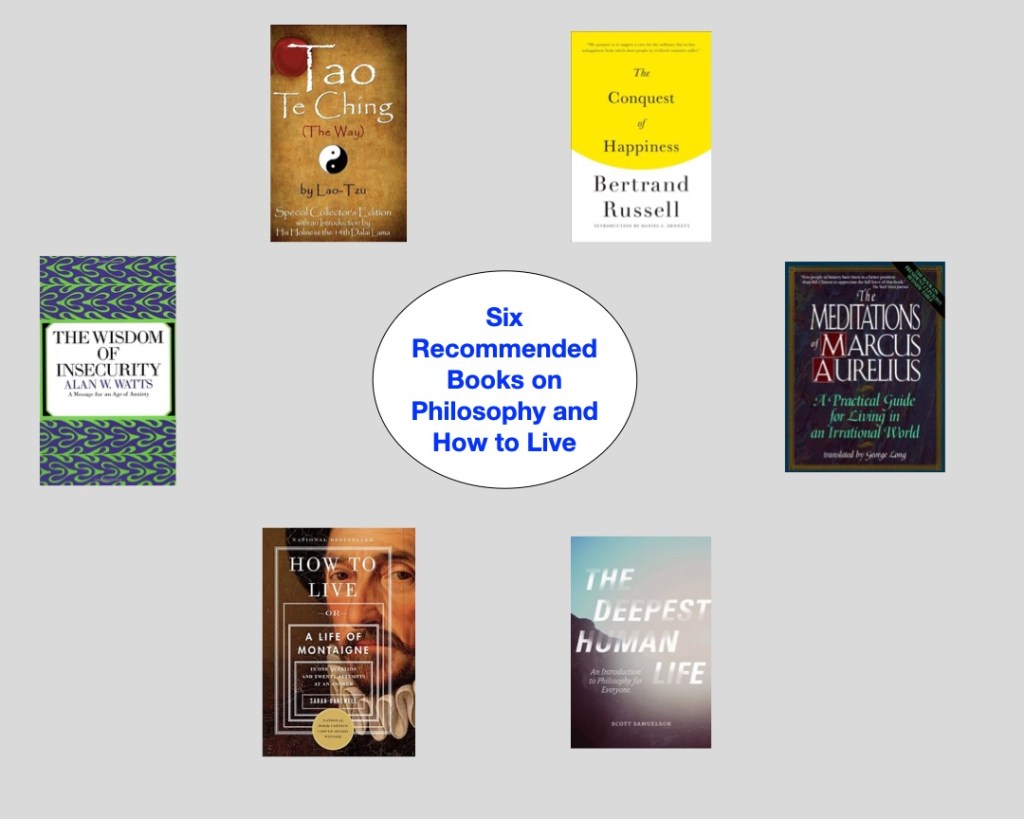
When religion failed to be an adequate guide on how to live and conduct oneself, I became interested in philosophy. I don’t pretend to be particularly wise or that I have conducted myself in life to a high standard, but these books provided some inspiration and guidance based on reason and common sense.
Because life is sweet, we do not want to give it up, and yet the more we become involved in it, the more we are trapped, limited and frustrated. We love it and hate it at the same time. We fall in love with people and possessions, only to be tortured by anxiety for them.
The Wisdom of Insecurity by Alan Watts
Chase after money and security and your heart will never unclench. Care about people’s approval and you will be their prisoner.
Tao Te Ching Translated by Stephen Mitchell
The wise man thinks about his troubles, only when there is some purpose in doing so; at other times, he thinks about other things, or, if it is night, about nothing at all.
The Conquest of Happiness by Bertrand Russell.
The best way of avenging one self is not to become like the wrong doer.
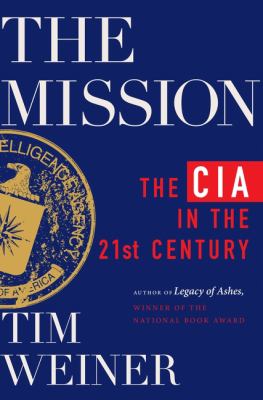
Tim Weiner’s The Mission is a sobering account of the CIA’s role in America’s foreign policy missteps and disasters in the 21st century. Drawing from extensive research, Weiner chronicles the agency’s involvement in 9/11, the failed search for weapons of mass destruction, the wars in Afghanistan and Iraq, the hunt for Osama bin Laden, CIA-led torture programs, intelligence scandals, and the rise of authoritarian threats from Russia and China.
This is a meticulously documented narrative by an author who previously wrote a highly regarded history of the CIA. His deep dive into the post-Cold War era exposes not just institutional failures, but also the personal hubris and political dysfunction that have plagued U.S. intelligence efforts for decades.
My key takeaways:
Lack of Trust and Influence: The CIA has long struggled to earn respect from Presidents and Congress. Time and again, its expertise was dismissed or ignored, and its assessments branded as unreliable.
The Bush Administration’s Failures: The book paints a particularly damning portrait of the Bush era. Following 9/11, President Bush, Dick Cheney, Condi Rice and Donald Rumsfeld failed to provide clear leadership. Their decisions around Afghanistan and Iraq were marked by confusion, overreach, and incompetence.
Torture and Moral Failure: The CIA’s use of torture—sanctioned by the Bush administration—was both brutal and ineffective. Weiner describes techniques that border on the medieval, with little intelligence gained and great moral cost.
Civilian Casualties and Poor Strategy: U.S. policies led to the deaths of countless innocent civilians. Nation-building efforts were hollow and often reduced to buying influence with cash, with no sustainable long-term strategy.
Leadership Void: Successive CIA directors often lacked the competence or temperament needed for the job. David Petraeus, once seen as a reformer, was undone by scandal and the mishandling of classified information.
Enemies Within: Some of the most troubling stories involve not foreign adversaries, but Americans working within the intelligence community– “evil doers.”
Russia and Trump: The book raises urgent concerns about Vladimir Putin’s manipulation of Donald Trump. While some critics view Weiner’s treatment of Trump as partisan, his claims are backed by specific examples of erratic behavior and questionable judgment.
China’s Strategic Gains: The author also warns about China’s aggressive espionage efforts, including theft of data, intellectual property, and personal information—threats that continue to grow.
Final Thought:
Weiner’s central question—What exactly is the CIA’s mission?—remains disturbingly unclear. The agency’s goals seem to shift with political winds rather than strategic foresight. If the U.S. is to effectively combat terrorism and the evolving threats posed by Russia, China, North Korea, and others, we need a vastly improved intelligence apparatus—one built on clear purpose, strong leadership, and accountability.




 Esot-eric