Book Review: King of Kings: The Iranian Revolution: A Story of Hubris, Delusion and Catastrophic Miscalculation by Scott Anderson

After reading this book, it’s easy to understand why U.S. relations with Iran remain so strained and why so much hostility exists toward America. For nearly a century, presidential administrations have made diplomatic blunders, compounded by intelligence failures that shaped disastrous outcomes.

I recently finished Tim Weiner’s The Mission: The CIA in the 21st Century, which documented the CIA’s missteps in Vietnam, Afghanistan, Iran, Iraq, and elsewhere. Anderson’s account shows the same pattern: Did we get anything right?

The intelligence failures in Iran were staggering. Agencies recorded Ayatollah Khomeini’s speeches but never bothered to translate them—missing clear warnings about his intentions. Meanwhile, the U.S. continued to prop up Shah Mohammad Reza Pahlavi, a weak and indecisive ruler despised by his own people. Ironically, his wife, Farah Pahlavi, displayed far more backbone and foresight. Yet to Washington, Iran’s real value was simply the oil beneath its soil.

Equally unconscionable was the way U.S. embassy staff in Tehran were treated as expendable pawns. The Carter administration fully understood the risks—especially after allowing the Shah into the United States—yet left personnel exposed to the fury of revolutionary crowds.

The lack of coordination between diplomatic and intelligence communities in the 1970s was nothing short of criminal. Mixed signals to the Shah, who desperately needed guidance and resolve, only deepened the chaos. Even today, the lingering question remains: Did Ronald Reagan deliberately delay the hostages’ release until after his inauguration?

Anderson does an excellent job highlighting both the heroes and villains of this tragic story. One memorable account involves teacher Michael Metrinko, who earned the respect of his Iranian students by deliberately standing up to—and physically subduing—the toughest among them.

By weaving personal tales with geopolitical history, Anderson makes the Iranian Revolution come alive in all its complexity. The result is a powerful and unsettling reminder of how deeply poor leadership and intelligence failures can alter history.

Book Review: Miracles and Wonder: The Historical Mystery of Jesus by Elaine Pagels

As an agnostic, I opened this book hoping it might shift my faith-doubt meter. It didn’t. Perhaps I expected too much.

Elaine Pagels, a distinguished scholar of religion, offers a deeply researched exploration of the history, culture, and legends surrounding Jesus. She examines familiar themes—the virgin birth, Jesus as prophet, miracles, crucifixion, and resurrection—while weaving in theories, conjectures, and historical possibilities. At times, though, her inquiry stops short of resolution, leaving questions dangling.

She does not shy away from provocative possibilities: Was Mary a prostitute? Was Jesus the illegitimate son of a Roman soldier? Was Jesus even buried after crucifixion, or left, like most executed criminals of the era, to scavenging animals?

Pagels acknowledges that the gospels themselves—written decades after Jesus’ death—are a blend of myth, storytelling, and propaganda designed to win followers. Yet she ends with a surprisingly devotional note: “The point is clear as a lightning flash; God can make a way out of no way.” She praises the gospels for offering what humanity craves most—an outburst of hope.

That left me puzzled. How much of Jesus’ life was historical, and how much was invention? If much of it was propaganda, why cling to its hope-filled message? For me, the book opened doors, raised intriguing questions, and stirred thought—but ultimately left me standing where I began.

To Lob or Not to Lob

There are five dreaded labels in the pickleball world that no one wants to wear: sandbagger, hooker (that’s a cheater on line calls, for the uninitiated), poacher, banger, and—my personal cross to bear—lobber.

Now, I can’t speak for the first four, but I’ve earned a reputation for being that last one. Yes, I lob. Sometimes more than once. Occasionally more than “socially acceptable.”

One of my partners recently suggested that I might want to cut back. Apparently, I’ve been annoying some of my fellow players. The eye rolls and glares haven’t escaped me, and I’ll admit I’ve even apologized a few times for exceeding the unofficial “lob quota.”

But here’s the thing: the lob is not the weak, outdated, sneaky shot it was once considered. Years ago, pros and commentators sneered at it. You almost never saw it on the big stage. Today? Pros lob often, and they lob well. It’s a legitimate strategy—a way to reset a point or outwit opponents who camp at the kitchen line like they’ve paid rent there.

At 73, I don’t have the hand speed or footwork of a 30-year-old tournament player. Just as a pitcher with a fading fastball learns to mix in more curveballs and off-speed junk, I mix in more lobs. For me, it’s both a survival tool and an offensive weapon.

If I lob you, take it as a compliment: it means I think you’re good enough to deserve it.

That said, I try to be mindful. I don’t lob against beginners, players with mobility challenges, or anyone who tells me they just don’t want to chase them down. I do not use the sun as my secret doubles partner, I do my best not to lob into it deliberately. (Though, if I see a wide-open chance for a clean winner? Sorry, I’m taking it. I’m not that saintly.)

At this point in my pickleball journey, I want opponents to bring their best game against me—lobs, drop shots, body-bag drives, all of it. It’s part of what makes pickleball fun and unpredictable. And when the day comes that I can no longer compete, I’ll gladly hang up my paddle and write about pickleball instead of playing it. Or maybe I’ll take up chess—where, mercifully, no one will complain about a well-timed lob

From Sunlight to Shadows

At 73, this Labor Day weekend makes me wonder: How many summers do I have left?

I don’t miss the heat or humidity of summer. I miss the sunlight—the early sunrises, the lingering evenings. A metaphor, perhaps, for life’s stages.

Leisure reading is fading. Only 16% of Americans read regularly for pleasure—down from 28% in 2003. In the UK, just 41% of parents read daily to toddlers, compared with 64% in 2012.

I wandered into a Barnes & Noble last week, my first visit in over a year. Chairs and cozy nooks were gone—B&N is all business now. I left without a book. Even their sale couldn’t entice me; I balk at paying more than $20 for a hardcover.

On my nightstand:

  • King of Kings: The Iranian Revolution—A Story of Hubris, Delusion and Catastrophic Miscalculation by Scott Anderson
  • Miracles and Wonder: The Historical Mystery of Jesus by Elaine Pagels

Haruki Murakami once wrote:

“If you only read the books that everyone else is reading, you can only think what everyone else is thinking.”

Mortality hovers. I don’t fear death, but I do fear dying. Sometimes I feel like a man with his head beneath a guillotine, staring at the blade. I’ve been fortunate with health, but around me I see friends whose luck has run out. The blade will fall on me too.

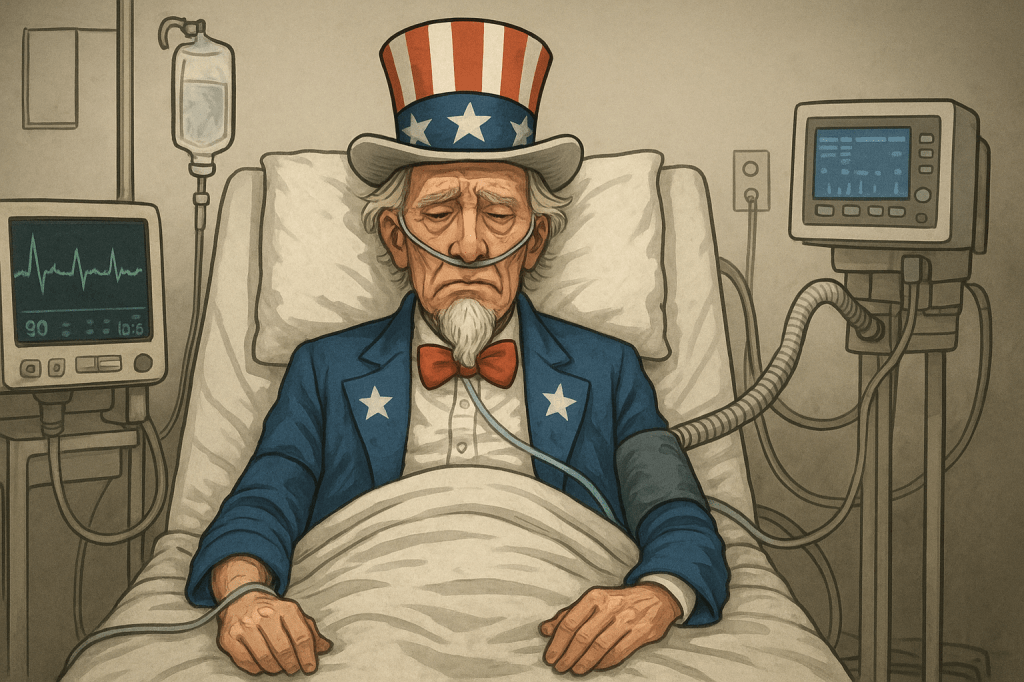
Meanwhile, the U.S. falters. Ineptitude, cowardice, hubris—displayed daily. A recent New York Times photo showed India’s Modi with Putin and Xi, a tableau of shifting power. It captured the failure of American diplomacy and leadership. One man bears much of the blame: Donald Trump. As summer declines, so does America as it retreats further into the darkness.

Best Six Philosophy Books of My Lifetime

When religion failed to be an adequate guide on how to live and conduct oneself, I became interested in philosophy. I don’t pretend to be particularly wise or that I have conducted myself in life to a high standard, but these books provided some inspiration and guidance based on reason and common sense.

Because life is sweet, we do not want to give it up, and yet the more we become involved in it, the more we are trapped, limited and frustrated. We love it and hate it at the same time. We fall in love with people and possessions, only to be tortured by anxiety for them.

The Wisdom of Insecurity by Alan Watts

Chase after money and security and your heart will never unclench. Care about people’s approval and you will be their prisoner.

Tao Te Ching Translated by Stephen Mitchell

The wise man thinks about his troubles, only when there is some purpose in doing so; at other times, he thinks about other things, or, if it is night, about nothing at all.

The Conquest of Happiness by Bertrand Russell.

The best way of avenging one self is not to become like the wrong doer.

Meditations by Marcus Aurelius.

Lessons from the Final Moments

We rarely know when we are sharing the last conversation, the last laugh, or the last look with someone we love. Sometimes death announces itself with months of warning; other times it slips in like a thief, stealing a life in the space between heartbeats. Over the years, I have stood at the bedsides and shared the dinners that turned out to be final moments. These are the stories of my aunt, my sister, my stepfather, my mother—and of a Valentine’s Day in childhood that taught me the lesson I carry still: tomorrow is never promised.

Aunt Irene’s Peace

My Aunt Irene was plagued with poor health, especially heart issues in her fifties. She endured multiple heart attacks—just as nearly all her brothers and sisters did, including my father, who died at 35.

For years, Irene feared death, understandably so given her condition and the string of family losses she had endured. Then, one day at a family function, she pulled me aside with an urgency I’ll never forget.

She told me she no longer feared dying.

During one of her heart attacks, she had what the medical profession would call a near-death experience—but to her, it was entirely real. She said she saw and spoke with loved ones who had already passed, including my father, with whom she had been very close. She described it as a place of pure peace, tranquility, and happiness.

Because of that experience, she was no longer afraid—and she wanted me to understand that I should never fear death either. My father gave my aunt his house when her marriage failed and she needed a home for her and her three children. I think she felt duty bound to pass on something that would guide me as I got older.

She died peacefully a few months after sharing her feelings with me.

My Sister’s Ominous Reading

In January 1995, my sister Sandra died at just 38 years old during brain surgery to remove a growing tumor near her optic nerves. The main fear had been the risk of blindness. I don’t recall any great concern that she might not survive the surgery. A few months before the surgery, she and some of her friends had gone to dinner, followed by a visit to a psychic.

The psychic read cards for each of her friends with ease and everyone marvelled and laughed at their future predictions—until it was Sandra’s turn. The psychic’s demeanor changed. She looked unsettled and while staring at the cards said she could not see Sandra’s future. Sandra’s psychic session ended abruptly. I hold no firm beliefs on psychics or their practice but I found this a cautionary tale. Was it coincidence? Or a warning? The unsettling moment stayed with Sandra’s friends long after she was gone.

One Last Look

Two days before her surgery, my wife and I hosted Sandra, her husband, her daughter, and my mother for dinner. Sandra showed no visible fear and instead focused on how long her recovery would take. However I was deeply worried, but Sandra teased me when my wife mentioned I’d gone to Mass earlier that day. I had not been at Mass in years and had no great belief in prayer.

When dinner was over and Sandra left, she got into her car and stared at me for a long, deliberate moment as she drove away. My wife and mother noticed it too. At the time, our greatest fear was that she might go blind; I thought perhaps she was memorizing my face just in case.

We shared that one last look before she died.

My Stepfather’s Last Words

In his final months, my stepfather’s body was ravaged by cancer. He lost 100 pounds, was confined to bed, drifted in and out of awareness, and could no longer communicate. Hospice care became his world.

On his last day, I had to put an oxygen mask on him because the visiting technician was too shaken by his condition to do it. I secured the mask, and to my shock, my stepfather lifted it, looked me directly in the eyes, and asked, in a clear, steady voice, “What’s next?” I was stunned and offered that the mask would let him breath easier.

He hadn’t spoken coherently in months. He was comatose. Yet, in that moment, he seemed alert to fully understand where he was—and what was coming. He passed away a few hours after his last words.

A Fleeting Return

My mother’s final years were spent in an assisted living facility. Dementia robbed her of clarity, recognition, and the gentle temperament she had always carried. Most days she didn’t know me, my sister, or even her best friend of 50 years.

Visits were often an exercise in quiet heartbreak. But one afternoon, perhaps a month before she died, she surprised me. She knew exactly who I was. She spoke with complete lucidity, telling me she was scared, that she missed her home, and that she hated being a burden. She even apologized for her condition—as if she had caused it.

For a brief, shining moment, she was herself again. I thought of taking her home. But within minutes, the light in her eyes faded, the fog returned, and she was gone from me once more, though her body lived on a few more weeks. I remember that I cursed God for what had been done to my mother and to all the other helpless people that I saw in that assisted living home.

The Valentine’s Day Card

In the winter of 1960, when I was seven, my parents were heading out to a Valentine’s Day party. I had made a card for my mother and gave it to her gladly. I had also made one for my father—but I was angry with him for some reason, and I withheld it.

As they put on their coats, something inside me changed. I handed my father his card. He opened it, smiled, kissed my forehead, and said, “I’ll see you tomorrow.”

But I never saw him again. He died that night of a heart attack at age 35.

I have often thought of that moment. Had I let my anger win, the guilt of my last act toward him being one of rejection would have been unbearable. Instead, I learned—at the age of seven—that tomorrow is never guaranteed, and the chance to make amends may never come again.

In all these moments—some peaceful, some mysterious, some unbearably sad—the same truth emerges:
Life is fragile. Goodbyes can be sudden. And sometimes, in the quiet between breaths, there is a chance to speak the words that matter most.

So say them now—while you still can.

Book Review: The Mission: The CIA in the 21st Century by Tim Weiner

Tim Weiner’s The Mission is a sobering account of the CIA’s role in America’s foreign policy missteps and disasters in the 21st century. Drawing from extensive research, Weiner chronicles the agency’s involvement in 9/11, the failed search for weapons of mass destruction, the wars in Afghanistan and Iraq, the hunt for Osama bin Laden, CIA-led torture programs, intelligence scandals, and the rise of authoritarian threats from Russia and China.

This is a meticulously documented narrative by an author who previously wrote a highly regarded history of the CIA. His deep dive into the post-Cold War era exposes not just institutional failures, but also the personal hubris and political dysfunction that have plagued U.S. intelligence efforts for decades.

My key takeaways:

  • Lack of Trust and Influence: The CIA has long struggled to earn respect from Presidents and Congress. Time and again, its expertise was dismissed or ignored, and its assessments branded as unreliable.
  • The Bush Administration’s Failures: The book paints a particularly damning portrait of the Bush era. Following 9/11, President Bush, Dick Cheney, Condi Rice and Donald Rumsfeld failed to provide clear leadership. Their decisions around Afghanistan and Iraq were marked by confusion, overreach, and incompetence.
  • Torture and Moral Failure: The CIA’s use of torture—sanctioned by the Bush administration—was both brutal and ineffective. Weiner describes techniques that border on the medieval, with little intelligence gained and great moral cost.
  • Civilian Casualties and Poor Strategy: U.S. policies led to the deaths of countless innocent civilians. Nation-building efforts were hollow and often reduced to buying influence with cash, with no sustainable long-term strategy.
  • Leadership Void: Successive CIA directors often lacked the competence or temperament needed for the job. David Petraeus, once seen as a reformer, was undone by scandal and the mishandling of classified information.
  • Enemies Within: Some of the most troubling stories involve not foreign adversaries, but Americans working within the intelligence community– “evil doers.”
  • Russia and Trump: The book raises urgent concerns about Vladimir Putin’s manipulation of Donald Trump. While some critics view Weiner’s treatment of Trump as partisan, his claims are backed by specific examples of erratic behavior and questionable judgment.
  • China’s Strategic Gains: The author also warns about China’s aggressive espionage efforts, including theft of data, intellectual property, and personal information—threats that continue to grow.

Final Thought:

Weiner’s central question—What exactly is the CIA’s mission?—remains disturbingly unclear. The agency’s goals seem to shift with political winds rather than strategic foresight. If the U.S. is to effectively combat terrorism and the evolving threats posed by Russia, China, North Korea, and others, we need a vastly improved intelligence apparatus—one built on clear purpose, strong leadership, and accountability.

Top 50 Movies in My Lifetime (My Opinion)

Movie TitleTop 2 StarsYear
Butch Cassidy and the Sundance KidPaul Newman, Robert Redford1969
Citizen KaneOrson Welles, Joseph Cotten1941
RockySylvester Stallone, Talia Shire1976
All Quiet on the Western FrontLew Ayres, Louis Wolheim1930
DraculaBela Lugosi, Helen Chandler1931
Animal HouseJohn Belushi, Tim Matheson1978
Witness for the ProsecutionTyrone Power, Marlene Dietrich1957
Duck SoupGroucho Marx, Harpo Marx1933
The GodfatherMarlon Brando, Al Pacino1972
Nicholas and AlexandraMichael Jayston, Laurence Olivier1971
GoodfellasRobert De Niro, Ray Liotta1990
The Grand Budapest HotelRalph Fiennes, Tony Revolori2014
John WickKeanu Reeves, Ian McShane2014
You Only Live TwiceSean Connery, Donald Pleasence1967
Airplane!Robert Hays, Julie Hagerty1980
The Last SamuraiTom Cruise2003
CasablancaHumphrey Bogart, Ingrid Bergman1942
Bull DurhamKevin Costner, Susan Sarandon1988
The Good, the Bad and the UglyClint Eastwood, Eli Wallach1966
The Naked GunLeslie Nielsen, Priscilla Presley1988
Death at a Funeral Chris Rock, Martin Lawrence2010
Once Upon a Time in HollywoodLeonardo DiCaprio, Brad Pitt2019
The CandidateRobert Redford, Peter Boyle1972
The Best ManHenry Fonda, Cliff Robertson1964
CasinoRobert De Niro, Sharon Stone1995
Road HousePatrick Swayze, Sam Elliott1989
Margin CallKevin Spacey, Jeremy Irons2011
Raging BullRobert De Niro, Joe Pesci1980
The Good ShepherdMatt Damon, Angelina Jolie2006
DownfallBruno Ganz, Alexandra Maria Lara2004
Glengarry Glen RossAl Pacino, Jack Lemmon1992
Bonnie and ClydeWarren Beatty, Faye Dunaway1967
High NoonGary Cooper, Grace Kelly1952
City HallAl Pacino, John Cusack1996
HeatAl Pacino, Robert De Niro1995
Scarface (1932)Paul Muni, Ann Dvorak1932
Wall StreetMichael Douglas, Charlie Sheen1987
Too Big to FailWilliam Hurt, Billy Crudup2011
Casino RoyaleDaniel Craig, Eva Green2006
Fatal AttractionMichael Douglas, Glenn Close1987
The Dirty DozenLee Marvin, Charles Bronson1967
All the King’s MenBroderick Crawford, John Ireland1949
Advise and ConsentHenry Fonda, Charles Laughton1962
The Last HurrahSpencer Tracy, Jeffrey Hunter1958
The Ides of MarchGeorge Clooney, Ryan Gosling2011
RoninRobert De Niro, Jean Reno1998
Mission: Impossible – FalloutTom Cruise, Henry Cavill2018
The Thomas Crown Affair (1968)Steve McQueen, Faye Dunaway1968
The Thomas Crown Affair (1999)Pierce Brosnan, Rene Russo1999

I collected this list in about an hour’s time. I’m sure there are movies I would add/subtract to my top 50 if given more time and reflection. These are movies that I would view again and again. I know that most of these movies are older and were enjoyed when I was younger. Just about all these movies had compelling storylines that I enjoyed.

Review: On Her Game: Caitlin Clark and the Revolution in Women’s Sports by Christine Brennan

On Her Game is a compelling homage to Caitlin Clark, the dazzling college basketball star whose impact on women’s sports has transcended the court. In just four years at the University of Iowa, Clark became a national phenomenon: a 3.64 GPA marketing major, multiple-time All-American, record-setting scorer, and the face of a sport in transformation. She led her team to the Final Four, sold out arenas, and inspired young fans—both girls and boys—to wear her jersey.

Clark’s influence extended beyond basketball. With millions in endorsement deals, a sharp media presence, and a spotless off-court reputation, she quickly became a symbol of excellence and marketability in women’s sports. Articulate, humble, and team-oriented, she embraced her role as an ambassador of the game with poise.

So why has Clark—and this book—stirred controversy?

Christine Brennan, a veteran journalist with a well-earned reputation for fairness, explores the complex cultural tensions that have surrounded Clark’s rise. She notes that Clark’s identity as a white, attractive, straight woman in a league where many stars are Black and openly gay has led to resentment in some quarters. A handful of critics—players, coaches, and analysts—dismissed her collegiate dominance and questioned whether her game would translate to the pros. Early in her WNBA career, she faced not only physically intense defenses but also moments that bordered on bullying.

Some veteran players treated her with noticeable coldness. I draw parallels to the experience of Pete Maravich, another flamboyant scorer whose transition from college to the pros in 1970 was also met with skepticism and envy—particularly from Black teammates and established NBA stars who resented the media attention he received.

Interestingly, Brennan herself came under fire from some WNBA figures who accused her of pushing an agenda. Yet her reporting includes attempts to speak with those critical of Clark, many of whom declined to go on record. Brennan does not shy away from addressing racial dynamics, including examples of racism aimed at Clark. She also argues that leaving Clark off the 2024 U.S. Olympic team was a mistake—one that speaks more to league politics than performance.

Brennan’s book is sharp, fair, and timely. It raises important questions about race, gender, power, and the uneasy growing pains of a league adjusting to sudden mainstream attention.

As a fan of Caitlin Clark, I found On Her Game to be both informative and affirming. I hope Clark continues to thrive in the WNBA and that the league’s leadership recognizes the opportunity she represents. Stars like Clark don’t come along often—and when they do, they have the power to elevate not just a team or a league, but an entire sport.

I Don’t Get It….?

House Republicans Move to Rename Kennedy Center Opera House After Melania Trump. Why? This woman has as much interest in being first lady as she does in spending any meaningful time with her husband. I can’ t think of any remote contribution that Melania Trump has made to the Arts, the Theater or Entertainment to deserve that type of recognition.

French President Macron Files Lawsuit Against Candace Owens for Repeatedly Claiming His Wife Is a Man. Again why? I would advise any Europeans or people outside the United States to largely ignore the gross insanity of our political culture, comportment and chaos. Why give this woman any platform or notoriety for her ridiculous charges?

The extent of the furor and mockery about the “Coldplay couple” canoodling at a concert and getting caught. The Astronomer CEO immediately retired or was fired, depending on what story you believe. However, we have a president whose conduct was even worse (with even more to come?) and yet there is no outrage about him still holding office.

Regrettably the shame committed by the CEO and HR director is going to be shared with their spouses and even worse, their young children. Maybe we should consider terminating all the parodies and skits that most of us have found funny just out of respect for their kids.

Greg Gutfeld of Fox News? I’ve seen brief snippets of his show and also some of his appearances on The Five. I don’t find him funny or relevant. Gutfeld is not an H.L. Mencken, he’s not even Dennis Miller.