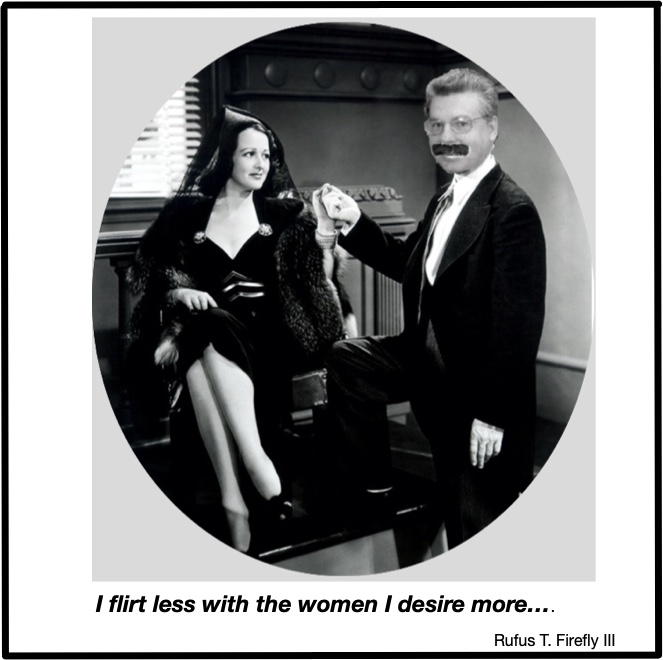
Flirting by Rufus T. Firefly III


Strangely enough, I had a hard time focusing on Stolen Focus. I skimmed through the first five chapters of this 14 chapter book. I confess that I focused on chapter topics that interested me and on information that basically reinforced my current views on attention and concentration. Regrettably over the years, my ability to sit still for 60 or 90 minutes and read a book has greatly diminished. To a very large extent, I blame it on the distraction of social media and the Internet.
Hari’s book basically confirmed what I already know – – it is very hard to be focused and to apply attention for any great period of time. Everyone has certain addictions – – for me, its carbohydrates, salt etc. I am easily distracted. As I write this, I hear a TV in my living room, I am mentally composing a checklist of things that I need to do tomorrow and I am thinking about getting ready for a trip next week.
From this book, I learned why I and everyone else become distracted. What I did not necessarily find out was how to eliminate distractions and improve my concentration.
Shown below are my notes from the book:
Teams took ordinary people and got them to read much faster than they ordinarily would; with training, and with practice, it sort of works. They can run their eyes over the words quickly and retain something of what they are saying. But if you do then test them on what they read, you’ll discover that the faster you make them go, the less they will understand. More speed means less comprehension.
Scientists then studied professional speed readers – – and they discovered that even though they are obviously better at it than the rest of us, the same thing happens. This show there’s just a maximum limit for how quickly humans can absorb information, and trying to bust through that barrier simply busts your brain’s abilities to understand it instead.
The scientists investigating this also discovered that if you make people read quickly, they are much less likely to grapple with complex or challenging material. They start to prefer simplistic statements.
Scientists discovered… When people think they are doing several things at once, they are actually – – “juggling.” They are switching back-and-forth. They don’t notice the switching because their brain sort papers it over, to give a seamless experience of consciousness, but what they’re actually doing is switching and reconfiguring their brain moment to moment, task to task and that comes with a cost.
The more he studied flow states, the more Mihaly noticed something else crucial about them. They are extraordinarily fragile and easily disrupted.
When you are approaching death, I thought, you won’t think about your reinforcements – – the likes and retweets – – you’ll think about your moments of flow.
We all have a choice now between two profound forces – – fragmentation, or flow. Fragmentation makes you smaller, shallower, angrier. Flow makes you bigger, deeper, calmer. Fragmentation shrinks us. Flow expands us.
The proportion of Americans to read books for pleasure is now at its lowest level ever recorded. The American Time Use Survey – – which studies a representative sample of 26,000 Americans found that between 2004 and 2017 the proportion of men reading for pleasure had fallen by 40%, while for women, it was down by 29%.
Gallup found that the proportion of Americans who never read a book in any given year tripled between 1978 and 2014. Some 57% of Americans do not even read a single book in a typical year.
… the collapse in reading books is in someways a symptom of our atrophying attention, and in someways a cause of it. It’s a spiral – – as we begin to move from books to screens, we start to lose some of the capacity for the deeper readings that come from books, and that, and turn makes us less likely to read books.
My rating: 5 of 5 stars
I found this book to be very inspirational. I write a blog. I write commentary on Pickleball and post it to a community of Pickleball players on Facebook. I maintain a journal. I assist a nonprofit with communications and marketing. I would like to live a more creative life.
There is a lot of good advice and observations to think about. This is almost like a step-by-step handbook on how to find, develop, craft and deliver a work of art whether it is a painting, a book, a song or a building design.
Highly recommended for any writer, musician, painter, architect or anyone desiring to improve their creative abilities. Five star book for this reader.
My notes from this book:
Look for what you notice but no one else sees.
Broadening our practice of awareness is a choice we can make at any moment. It is not a search, though it is stoked by curiosity or hunger. A hunger to see beautiful things, hear beautiful sounds, feel deeper sensations. To learn, and to be fascinated and surprised on a continual basis.
Read the finest literature, watch the masterpieces of cinema, get up close to the most influential paintings, visit architectural landmarks. There is no standard list: no one has the same measures of greatness.
There’s a reason we are drawn
to gazing at the ocean.
It is said that the ocean provides
a closer reflection of who
we are than any mirror.
If we focus on what’s going on inside our cells – – sensations, emotions, the patterns of our thoughts – – a wealth of material can be found. Our inner world is every bit as interesting, beautiful, and surprising as nature itself. It is, after all, born of nature.
Sometimes disengaging is the best way to engage.
Re-reading even a well understood paragraph or page can be revelatory. New meanings, deeper understandings, inspirations, and nuances arise and come into focus.
Reading, in addition to listening, eating, and most physical activities, can be experienced like driving: we can participate either on auto pilot or with focused attention. So often we sleep walk through our lives. Consider how different your experience of the world might be if you engage in every activity with the attention you might give to landing a plane.
To create space for inspiration, we might consider practices of quieting the mind: meditation, awareness, silence, contemplation, prayer, and any other ritual that helps us fend off distraction…
Collecting seeds typically doesn’t involve a tremendous amount of effort. It’s more a receiving of a transmission. A noticing. As if catching fish, we walk to the water, bait the hook, cast the line, and patiently wait. We cannot control the fish, only the presence of our line.
Number one seed, number two experimentation, number three craft and number four completion.
It’s generally preferable to accumulate several weeks or months worth of ideas and then choose which of them to focus on, instead of following an urge or obligation to rush to the finish line with what is in front of us today.
We are performing for an audience of one…
Living in discovery is at all times preferable to living through assumptions.
There is no telling where the next great story, painting, recipe, or business idea is going to come from. Just as a surfer cannot control the waves, artists are at the mercy of the creative rhythms of nature. This is why it’s of such great importance to remain aware and present at all times. Watching and waiting.

Sports nostalgia tour of the American Basketball Association whose heydays were in the late 60s and 70s. The league had some great players like Dr. J, Rick Barry, George Gervin, Artis Gilmore, Dan Issel and others. Interesting stories about how they tried to create the league. Poor Pat Boone was one of the early investors and almost went broke. There were some smart owners and many greedy ones. George Mikan was the ABA’s first commissioner and insisted that the league’s headquarters be situated in Minnesota where he lived.
So many characters Marvin Barnes, Johnny Neumann, John Brisker etc. played in the league. The book details many of their antics. I remember Rick Mount, one of the best shooting guards in college at Purdue. Unfortunately his college game did not translate that well into the pros.
The financial status of the teams and the league were always in peril. They did not have a national TV contract like the NBA. Many coaches and players suffered returned checks or did not get paid at all.
I did not realize or remember that ABA teams played NBA teams in exhibition games and competed fairly well. There were some excellent ABA coaches including Hubie Brown, Larry Brown, Stan Albeck and Doug Moe. (Even Wilt Chamberlain was an ABA coach but not a very good or devoted one.)
There are a large number of amusing anecedotes and stories. This is a very entertaining sports book about a very interesting time in professional basketball.
Well, this could be the last time
This could be the last time
Maybe the last time
I don’t know
The Last Time by the Rolling Stones
Once I lived in a time of firsts, first grade, first date, first kiss, first love, first job, first house… Youth created the illusion of an unlimited future and an infinity of repeat experiences, opportunities and time.
Now I exist in a time of lasts, last job, last meeting, last look, last conversation, last vacation, last healthy day, last goodbyes, last breath… Realities of limited time and few opportunities…No guarantees that tomorrow will be the same as today. Or that I may have a tomorrow. Moments may never repeat. Family and friends may leave me. Or I leave them.
Caitlin Clark from Iowa was the best college basketball player that I saw this year. She may be the best women’s basketball player that I have ever seen. I don’t remember another female player with her shooting range and passing ability.
Though LSU won the NCAA Women’s Tournament yesterday, I don’t think they would have beaten South Carolina.
Best Matches from 2023 WrestleMania
To my surprise, I enjoyed yesterday’s ESPN Pickleball Challenge featuring John McEnroe, Andre Agassi, Michael Chang and Andy Roddick. The levels of performance got better as the four legends played. I think the telecast helped improved the pickleball brand. I enjoyed McEnroe’s antics. Great job by the young woman who was the referee!
Phillies are 0-3.Too early to panic…
I’m slightly prejudiced for being a “homer” but Joel Embiid deserves to be the NBA MVP. He rarely has a bad game and most games I watch, he dominates.
Not sure who is the biggest disappointment give their career starts: Ben Simmons or Carson Wentz?
Still prefer “old guys” Michael Wilson and Tony Kornheiser as sports commentators ahead of Colin Cowherd, Steven A. Smith, Jim Rome etc.
Serves:
Practice your serve as much as your other shots.
Develop a variety of serves.
The closer the serve is to a lob the more difficult it is for your opponents to attack to serve.
Consider, keeping a very effective serve for a critical point in the game or time.
A medium high bouncing serve to your opponent’s backhand is always a challenge. Don’t hit serve too high, however, because it will give him/her time to run around the backhand, and hit a more comfortable forehand.
A player who steps onto the court from behind the baseline when his or her partner is serving, is in a seriously negative position, even if assuming a perfect stance.
Prior to serve, communicate with partner who has the middle on return.
Service Returns:
Hitting the return of serve with appropriate pace and deep enough giving you time to join your partner at your kitchen line is offensive in nature, but it puts you and your partner in the best defensive position on the court
For the intermediate to advanced players, the skill of “hitting the ball on the rise“ provides the following benefits:
Two Handed Backhands:
If you don’t already have a two handed backhand, I recommend you use the time perfecting your one-handed backhand. The two handed backhand has much more potential use in singles.
The non-volley zone/kitchen stance
Feet wider than the shoulders. Knees bent and back straight. Center of getting gravity through the back and rear straight to the ground behind you.
Dinks:
The whole idea behind the dink is to “strike” the ball, so it drops into the opponents NVZ area. You do not hit it over the net! You push it over the net.
Players who hit their dinks, usually take a backswing of 2 inches or more, and this places far too much power into the ball when you were only trying to hit the ball 5 to 8 inches. There is no wrist movement in the dink shot. Your wrist is locked as you push the paddle forward.
Avoid hitting your dinks straight at the opponent in front of you. Instead, make him or her move laterally, keeping in mind most people have a weaker backhand dink than a forehand dink.
Avoid hitting the same dink in the same spot repeatedly. Aggressive opponents are trying to stay “in the mental zone“ and look for the right shot to attack. By changing the location of your dinks, especially to the same opponent, you minimize his or her ability to zero in on a attackable return.
Check your spacing and make sure you and your partner are staying linked together on every dink. Your opponents may be exploiting the gap/space between you and your partner because you are not staying “one step, and a reach” between you.
Hitting it back to the opponent that hit it to you is the safest way to hit it. Adding different spins to the ball, make it more difficult to hit the ball “squarely“ and straight.
Volleys:
The faster the ball is traveling towards you, the shorter the back swing. The slower the ball coming towards you the longer/greater the back swing.
Volleying while you are moving, is not productive, or a good idea. The closer you are to the net, the less the backswing.
Pickleball checklist for volley errors
Lobs:
Lobs can be a “rainbow” in your game, but they usually result in a “downpour” of unforced errors. Three things can happen when you lob: (1) the lob can be hit too long, and it goes out; (2) the lob could be hit too short and gets attacked by your opponents; (3) the lob can be the perfect rainbow arc and falls onto the court non-returnable by your opponents.
If your opponents are making your pickle ball life from lobs, miserable back up two or three steps from your no volley zone. They should convince them to try other shots such as hitting the ball at your feet, which is more possible the further you move away from the net, this, however, may be the lesser of two evils.
The best option for returning a good lob is to re-lob the good lob high and deep back over the net forcing one or both of your opponents to retreat to their baseline to reset the point/rally.
Important point: the height of your return lob is far more important than the depth. The higher, the lob, the more difficult it is for opponents to hit especially aggressively.
Strategy:
70% of points are the results of unforced errors. Unforced errors are usually offensively hit balls, not defensively hit balls.
Protecting your backhand – – from the deuce court if you are right, handed, and need to protect your backhand, stand so your left foot is only 3 feet away from the midcourt line. If you’re right handed and need to protect your backhand in the ad Court, stand 3 feet from the left side line/baseline intersection.
Reaching for the ball with arm extended, or reaching in front to hit the ball limits power.
Getting closer to the ball increases power.
If a player is moving, he or she is in the worst defensive position possible.
Give your opponent a chance to lose. By playing good defense you increase your chances of winning.
You win more points by “playing smarter” than hitting harder.
Force your opponents to hit one more shot.
Ball placement trumps power.
On overhead shot, turn your shoulders and body into a sideways – – facing the sideline – – position as quickly as possible.
Pickleball players are discovering an interesting fact: by a large percentage, the first team to attack the ball aggressively loses the points/rally. Don’t force the attack shot. Wait for the attack shot that has a much better chance of being not defensible.
Probably 70 to 80% of Pickleball hitting errors can be directly attributed to poor foot work. Footwork is the key factor in being in the best position to return shots.
Know the assets/liabilities of your opponents.
My Brief Review:
It is a long book (282 pages but very comprehensive). I skimmed through many of the illustrations and sections of little interest. The content is slightly dated but there are plenty of good tips and strategies for players of all levels.


The value of reading, and of writing things down that we read, or hear, cannot be overstated. Two expert guests (who specialize in speech and memory) on the Huberman Lab podcast explained that when we read text or listen to something and then write key aspects/takeaways down by hand- not typing, it engages our motor control centers in ways that deeply embed that information to our memory. Taking notes, however cursory, turns out to be the best way to remember and implement information later.
In full disclosure, I did not follow college basketball like I have years ago. For example, I used to be able to tell you the top 10 or 15 players in NCAA basketball. Today, the only All Americans or top draft picks I know about are the Purdue center, Edey and the Alabama forward, Miller, who just got in trouble. My NCAA picks (below) are basically wild hunches based on only a cursory study or familiarity of the teams. I am picking Purdue to win at all even though I have only seen a few of their games. Two of the games were against Rutgers. Rutgers beat Purdue in the regular season and barely lost to them in the Big 10 tournament.

Speaking of Rutgers, I was one of those people who were a bit disappointed that they did not make the NCAA tournament. However, I can’t feel too bad for Rutgers today. Last night, as the number 1 seed, and playing in their gym, they lost to Hofstra in the first round of the NIT. Rutgers did not exactly bolster their objection into not getting into the field of 64 or 68.
No Big Five team (Villanova, Saint Joe’s, Temple, Penn and La Salle) made it into the NCAA tournament. This was the first time since 1977 that a Philadelphia-based school failed to play in the tournament. Penn actually came the closest to playing in the tournament with their semifinal game in the Ivy League tournament against Princeton, which they lost. Not sure that any team will play in next year’s tournament either…
I have not seen a lot of Big Five teams play. However the two best players in the Big Five for this year are Jordan Dingle for Penn and Erik Reynolds for St Joe’s. I’m not sure that either of those players or NBA caliber or will be drafted. However they impressed me more than Cam Whitmore of Villanova who probably will be picked early this year in the year’s NBA draft.
One of the best ideas that I have read on Twitter of all places is that Dawn Staley should replace Aaron McKee as head coach of Temple’s men’s basketball team. If any woman could succeed in coaching men’s basketball at a major college level, it is Dawn Staley. It would be nice to see her back coaching in Philadelphia!