“We didn’t tell anybody about it because we wanted surprise,” he said. “Who knows better about surprise than Japan, OK? Why didn’t you tell me about Pearl Harbor, OK? Right?”
There was some laughter from the officials and journalists gathered in the room. “You believe in surprise, I think, much more so than us,” he added.
As Mr. Trump spoke, Ms. Takaichi (Japanese Prime Minister) widened her eyes and appeared to take a deep breath. She kept her arms crossed in her lap and did not speak.
My commentary:
Trump should be very careful about “Pearl Harbor references. The United States was in negotiations with Iran when it launched its attack. According to Oman diplomats who were facilitating the meetings, negotiations were going quite well and peace seemed reasonable as Iran had agreed to many of U.S. demands. Then the U.S. began to bomb Iran. In December 1941, the United States and Japan were also in the midst of diplomatic negotations and this provided confidence to the U.S. that no hostile acts from Japan were imminent. On December 7, 1941 Japan attacked Pearl Harbor
2. Any journalist or official who laughed at that remark is an idiot and not worthy of being in a room with the stature of the Japanese Prime Minister and she would be right to consider the laughter as an insult to her personally and Japan.
3. Trump desperately needs not to make any more enemies or to make enemies feel more embittered to the United States. Japan, like most of the world is getting screwed from rising oil prices. And Trump wonders why no one takes him seriously.
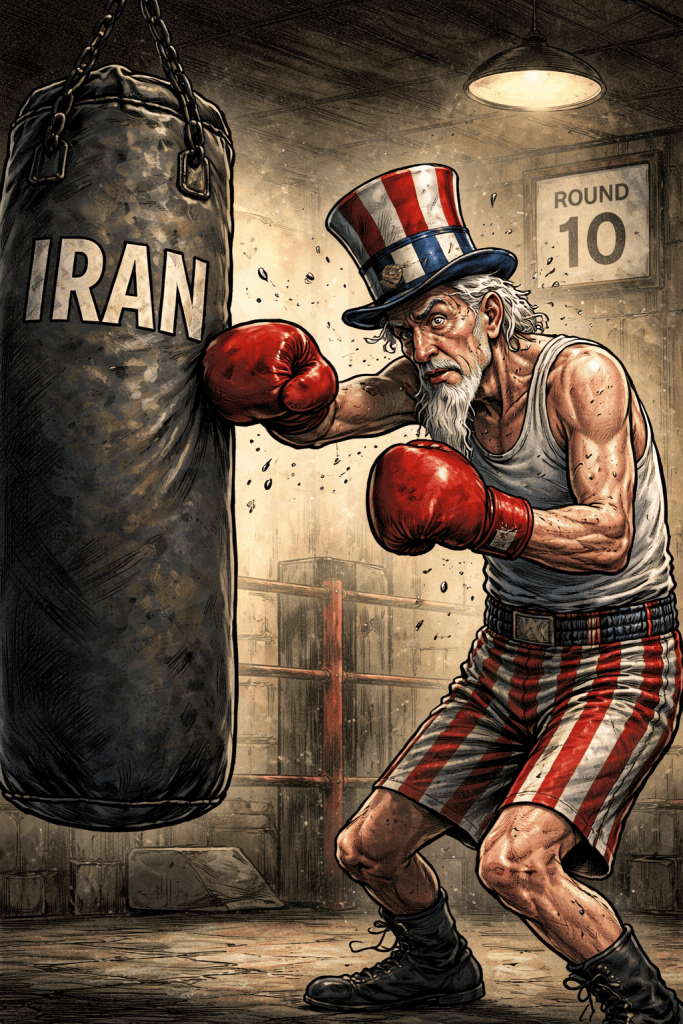
It is a curious coincidence that my current mood mirrors the title of our military operation in Iran: “Epic Fury.” The name suggests thunder, certainty, and righteous purpose. The reality, at least from the cheap seats, looks more like improvisation.
I have lived long enough to watch the United States march confidently into a number of foreign adventures—Vietnam, Afghanistan, Libya, Bosnia, and Iraq. Each was introduced with a sense of urgency and moral clarity. Most ended with a mixture of exhaustion, regret, and unanswered questions. Our present venture in Iran already shows signs of joining that distinguished club, perhaps even eclipsing it.
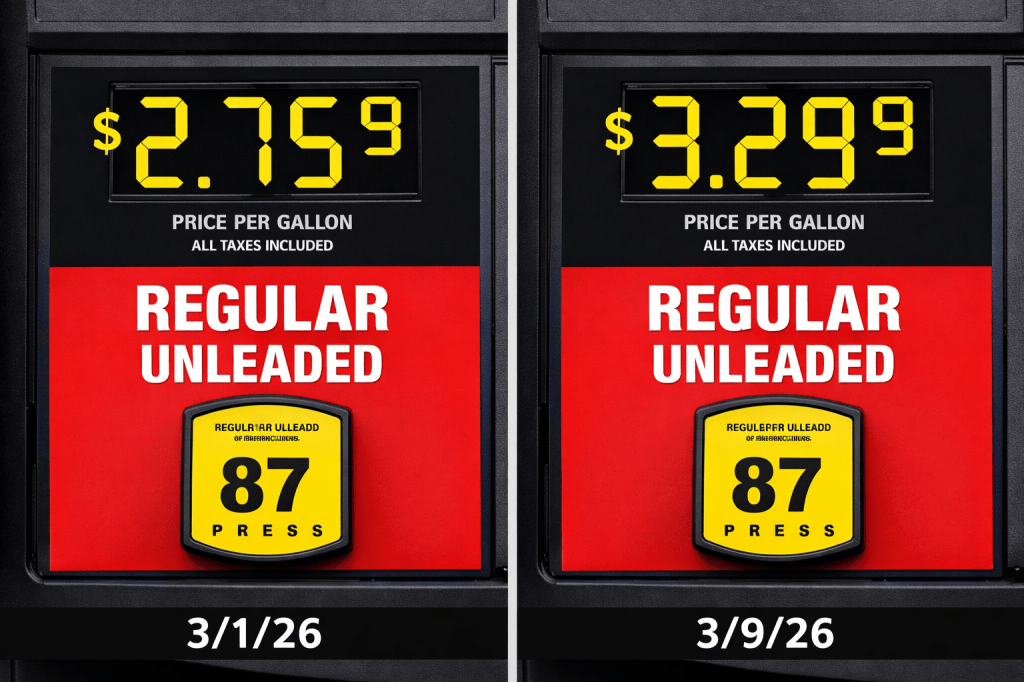
The consequences are beginning to show up in the most ordinary places. Less than two weeks ago, I was able to buy gasoline for $2.75 a gallon. Today the price stands at $3.29, nearly a 20 percent increase in a remarkably short time. If the conflict drags on—and poorly managed wars have a habit of doing just that—it is not difficult to imagine four- or even five-dollar gasoline within a couple of months.
Military operations also have political consequences beyond the battlefield. Whatever chance there might have been for ordinary Iranians to rise up against their government likely vanished with the bombing of a school that reportedly housed more than 160 girls. Matters were made worse when the President of the United States denied American responsibility for the strike, despite widespread evidence suggesting otherwise. In international affairs, credibility is a fragile currency; once spent, it is not easily replenished.
Meanwhile, reports have surfaced of American citizens stranded in the Middle East and struggling to return home. Many of them have publicly criticized the government’s response as slow and ineffective. European nations appear to have moved more quickly to assist their citizens. One might think that when preparing to launch military action in a volatile region, the vulnerability of civilians traveling there would be among the first considerations.
At home, the tone of official commentary has been oddly celebratory. President Donald Trump and Defense Secretary Pete Hegseth have spoken enthusiastically about the progress of the war, as though they were watching a football game and cheering for the home team. The president has even suggested that victory is already at hand. One cannot help recalling the moment when George W. Bush stood beneath a banner reading Mission Accomplished during the early days of the Iraq War—history’s way of reminding us that wars rarely consult our schedules.
Equally striking is the silence from United States Congress, which has shown little appetite for asserting its constitutional role in declaring war. In an odd twist, the make shift government of Iraq seems to have displayed more backbone than the legislative branch of the United States.
Nor does the rhetoric appear to be cooling. The president and Senator Lindsey Graham have already floated the possibility of confronting Cuba next. If this pace continues, the rest of the world may soon revive the old phrase “axis of evil,” this time with the United States awkwardly included in the lineup.
Yet the most unusual feature of this conflict may be the public reaction—or lack of it. There is little enthusiasm for the war. Outside of Fox News, vocal support seems muted. To be sure, few people mourn the death of Ruhollah Khomeini, but his successor—his son, widely described as even more militant—now stands ready to assume power. If the goal was regime change, the results remain unclear and may even prove counterproductive.
At the same time, there are no massive protests in the streets. My suspicion is that the country is suffering from a kind of national exhaustion—call it Trump fatigue. Americans have been through so many political convulsions in recent years that many seem to have retreated into weary silence. That quiet might evaporate quickly if the conflict expands into a ground war requiring a military draft.
History provides its own contrast. During World War II, the United States benefited from the leadership of Franklin D. Roosevelt and a formidable group of experienced military commanders. Today’s leadership—President Trump and Secretary Hegseth—presents a different picture. Comparisons are inevitable, though perhaps best left unstated.
Where all this leads is anyone’s guess. The conflict has already begun to ripple through the global economy and the delicate machinery of international politics. My own sense is that the outcome will prove costly for the United States in both arenas. At the moment, the only nation that appears satisfied is Israel. Elsewhere, goodwill toward America is becoming a scarce commodity.
For a country that prides itself on making friends and leading alliances, that may turn out to be the most serious casualty of all.
If the first casualty of war is truth, the second casualty is trust..
What if you throw a regime-change party and the people you’re “liberating” don’t come?
Iran is an example of intelligence failure, not that attributed to the CIA or military sources but specifically the lack of judgement, expertise and rationality from decision makers in Washington.
Trump supporters and enablers are learning or will soon find out that they will be held with the same regard as those associated with Jeffrey Epstein.
Past “credible war spokeswomen”: Tokyo Rose and Axis Sallie; today: Karoline Leavitt
Opportunity open for regime change in Iran= Khomeini killed; opportunity closed for regime change in Iran= Minab school bombing
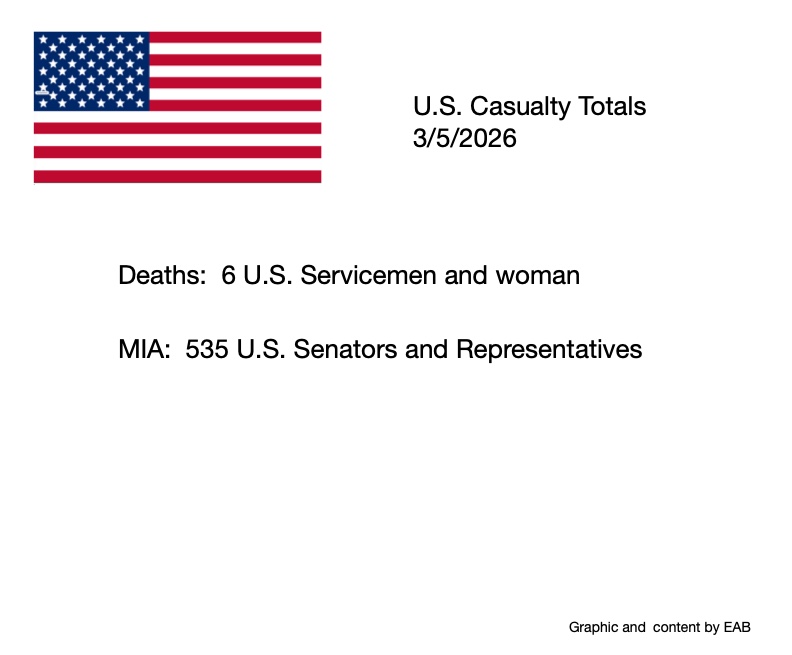
Personal Note: What a mess! Not much rationality and reason getting through at this time. Iran’s drones are more successful penetrating our defense system.
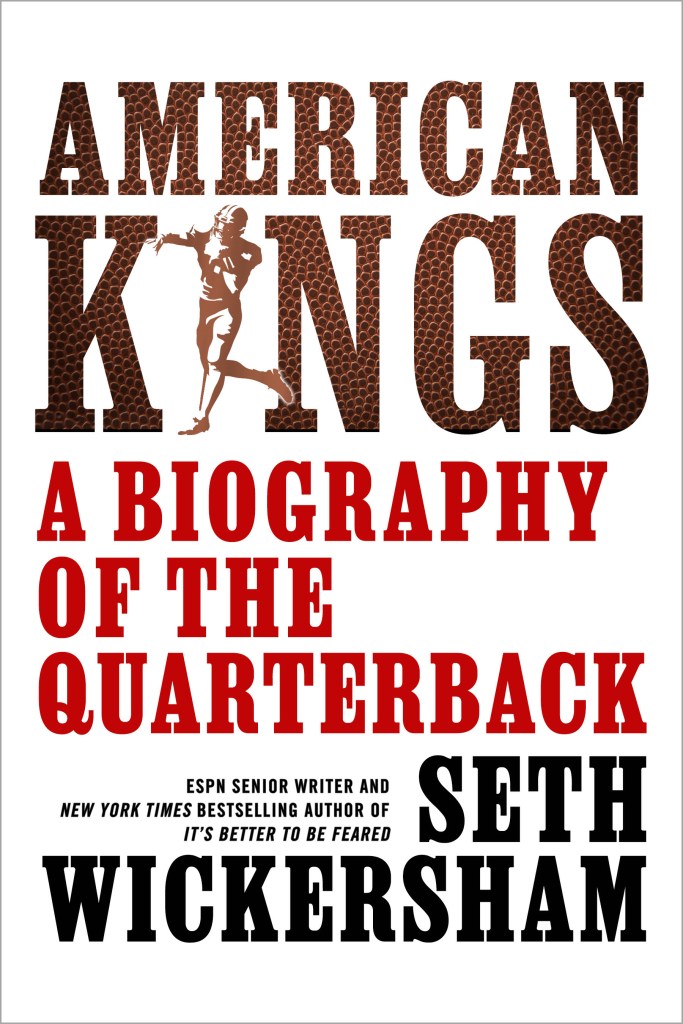
This is one of the finest sports books I’ve read—less a manual on throwing mechanics than a deep dive into the psychology, privilege, pressure, and mythology of the quarterback position. Seth Wickersham strings together interesting personal anecedotes and stories, from Bob Waterfield to Arch Manning, showing how the job evolved from leather-helmet grit to NIL-era celebrity. The through line isn’t arm strength—it’s judgment, image management, leadership, and the peculiar loneliness of being the face of a franchise. The challenge of being a quarterback, is not necessarily just on the field, but off the gridiron and at home.
For those of us who grew up in earlier NFL eras, the portraits of Johnny Unitas, Joe Namath, Y. A. Tittle, Warren Moon, and James Harris are especially resonant—rich with texture and context. Wickersham also delivers sharp, modern profiles of John Elway, Caleb Williams, and even Colin Hurley, who hasn’t yet thrown a college pass but already carries the weight of expectation.
This book pairs nicely, across the decades, with Paper Lion, by George Plimpton which captured the physical reality an author of trying to play the position. American Kings captures the aura.
At nearly 400 pages, it’s substantial but never dull—an absorbing read for any football fan and a revealing study of how America builds (and burdens) its field generals.