Deemed a modern classic, The Year of Magical Thinking is exquisitely written, deeply poignant—and I hated reading it. I rushed through its pages the way one might rush through the receiving line at a funeral: dutifully, respectfully, but eager to escape the suffocating air of grief.
Didion’s account of the sudden death of her husband and the parallel ordeal of her daughter’s illness feels both raw and composed, intimate yet universal. Her prose opens old wounds you thought had long scarred over. As I read, her words didn’t just tell her story—they resurrected mine.
I found myself silently comparing her losses to my own. Everyone, I suspect, has this book somewhere inside them, but few can articulate sorrow with Didion’s precision and restraint. Like her, I have often wondered whether I could have done more—whether I might have eased my mother’s suffering as dementia slowly erased her, or somehow saved my sister, who died suddenly before reaching forty. The helplessness still stings decades later.
Grief is a solitary ritual. When my father died of a heart attack at thirty-five, I was seven. There were no tears, no tantrums—just the quiet acceptance of a boy who learned too early that life can vanish mid-sentence.
As Didion’s pages turned, I realized I was no longer reading her memoir but reliving my own: the hospital rooms, the whispered prayers, the hollow silences after the machines stopped.
Didion’s The Year of Magical Thinking is a Pandora’s box of 227 pages. Once opened, it releases everything you thought you had buried—grief, guilt, love, regret—and leaves you to reckon with the consequences.
With the death of vaudeville and variety shows, you can observe how new technologies change the economic landscape of media and narrow viewers’ tastes. With vaudeville, it was motion pictures, and with variety shows, it was cable TV. With late-night, it’s playing out over the internet and social media.
Gambling doesn’t just sponsor sports games. It shapes them, deciding which matchups are worth watching and how players are covered. Gambling doesn’t just buy ads. It owns sports networks, producing shows that prod fans to bet ever more.
Today, the gambling companies wield far more power over sports than the leagues or team owners ever did. News media outlets have criticized commissioners, players and executives for decades. But I can’t recall a single major sports broadcast program or publication willing to take gambling companies on directly. My friends in sports journalism tell me this is the one topic they can’t speak up about — not without risking their careers.
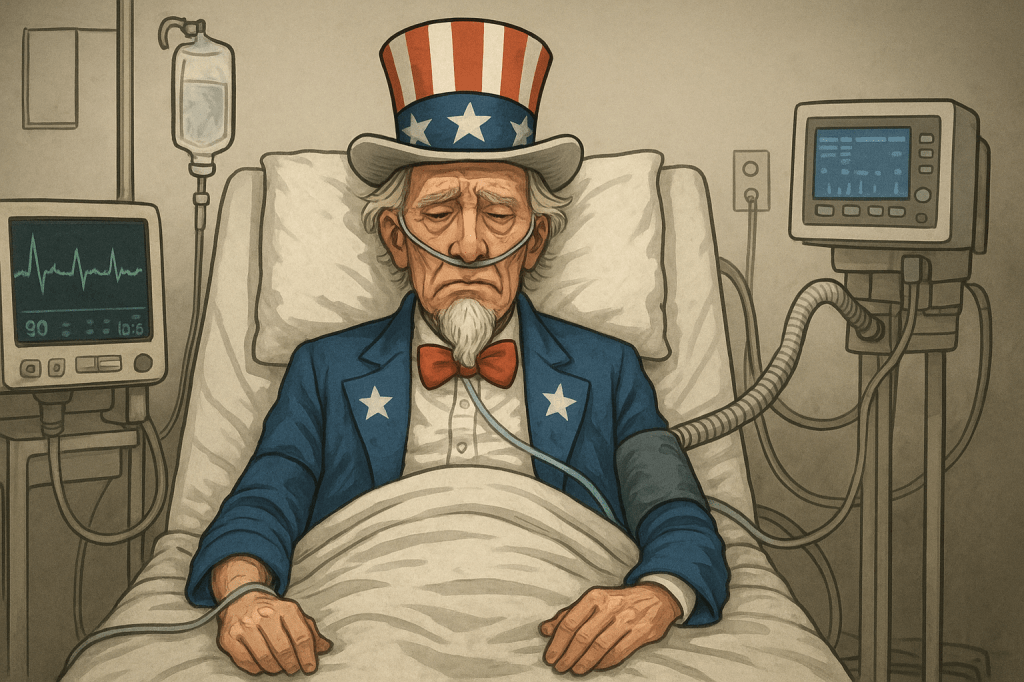
Patient Name: Uncle Sam Age: 249 years Date of Birth: July 4, 1776 Location: United States of America
Chief Complaint:
Progressive systemic decline characterized by political arrhythmia, social inflammation, moral neuropathy, and chronic division.
Medical History:
Patient presents with metastatic ideological cancer, first detected in 2017 following years of untreated inflammation from greed, corruption, and truth decay. A brief remission was noted, but malignancy has since spread to vital organs including the Judicial System, Congress, and National Conscience.
Patient also suffers from acute historical amnesia, with repeated lapses in memory regarding equal rights, freedom of the press, and separation of church and state. Increasing episodes of selective recall noted, often triggered by political self-interest and social media exposure.
In 2020, the patient contracted COVID-19, complicated by political co-infection. Though vaccinated, his recovery was hampered by widespread disinformation and refusal among many cells to follow treatment protocols. Residual scarring remains in the respiratory and trust systems.
Patient also exhibits chronic income disparity, hypertension of hostility, and arteriosclerosis of empathy, limiting blood flow to compassion and understanding.
Psychiatric History:
Patient demonstrates paranoid delusions, convinced that enemies lurk within rather than abroad. Displays mood instability, alternating between manic displays of nationalism and depressive bouts of self-loathing.
Once socially active, the patient is now increasingly isolated from former allies and global partners. Exhibits projection, blaming others for self-inflicted wounds.
Recent assessments reveal addiction to misinformation and dopamine dependency on outrage-based media. Sleep cycle disrupted due to 24-hour news exposure and endless campaigning.
Family History:
Descended from immigrants, now expresses hostility toward relatives of similar lineage. Strained relationship with younger generations due to generational and cultural disconnect.
Current Medications:
Denial (high dosage)
Partisan rhetoric (administered hourly)
Corporate lobbying (self-prescribed)
Occasional dose of hope and activism, though compliance inconsistent
Vital Signs:
Pulse: Erratic (divided between left and right chambers)
Blood Pressure: Elevated due to constant internal conflict
Temperature: Rising globally
Vision: Impaired by polarization
Hearing: Selective—responds mainly to echo chambers
Heart: Enlarged historically, now showing signs of hardening
Prognosis:
Guarded to poor. Survival depends on:
Aggressive treatment of ideological malignancy
Coronary transplant (restore compassion and moral circulation)
Rehabilitation therapy to strengthen backbone and restore balance
Cognitive behavioral therapy to reverse chronic denial and historical amnesia
Detoxification from greed, fear, and misinformation
Long-term infusion of education, empathy, and critical thinking
Summary:
Patient remains in critical but not terminal condition. Though his immune system of democracy is weakened, the antibodies of truth, courage, and civic duty still circulate—albeit faintly. Immediate intervention is required to prevent full organ failure of the Republic.
My expectation for those promoting the teaching of the Ten Commandments in schools is that they’ll soon explain how the penalties for breaking them depend on one’s political party, ideology, or religious affiliation.
***
This may be the sorriest era in which to write a decent book or speech, for the mob no longer reads to think but to feel confirmed—and preferably entertained.
***
Commercially, the most successful political and cultural “thought leaders,” pundits, and analysts are those who are first controversial, second entertaining, and a distant third—if ever—wise, prescient, or correct in their pronouncements.
***
Twenty or thirty years from now, history will mock and expose many of today’s cultural, political, and religious heroes and influencers as the charlatans and fools they always were.
***
Once, citizens braved fire hoses, clubs, and bullets to win the rights we now take for granted—laws signed in ink but sealed in blood. Today, those rights are being revised by comfortable hands and poisoned hearts, undone not by courage but by cowardice.
I find it totally fascinating how sports fans demand perfection in games that don’t matter and patience in affairs that do. A coach can fall quickly out a favor with fickle fans and lose their jobs instantly when their teams underperform often unrealistic expectations, while the chief executive of this country, despite a calamity of losses and fumbles with far greater consequences to the public than games over a much longer period of time, keeps his.
In professional wrestling parlance, a “heel turn” occurs when the heroic figure (the face) does something unexpectedly cruel or out of character, transforming into a villain.
In a recent Ryder Cup tournament—where U.S. golfers compete against their European counterparts—the American crowd became so boisterous, rude, and insulting that several European golfers said they would never return to the United States. Rory McIlroy, one of the world’s top players, said he and his wife endured personal insults and even had drinks poured on them.
Years ago, the U.S. brand was that of the world’s leading democracy. Now, foreigners see chaos in the manhunt and detention of immigrants and the deployment of soldiers in major U.S. cities. We are viewed as selfish and destructive, especially in light of new tariffs. I don’t see a “face turn” for America anytime soon.
Ironically, Marjorie Taylor Greene seems to be attempting her own heel-to-face transformation—saying and doing things that suggest a rebranding effort, however implausible.
The arrogance of Pam Bondi testifying before the Senate oversight committee reminded me of certain high-ranking Nazi officials at the Nuremberg Trials—lying and obfuscating to save themselves.
Can one win the Nobel Peace Prize while presiding over a civil war?
I agree with Jessica Tarlov, the moderate voice on Fox News’ The Five, who expressed surprise that there hasn’t been a stronger national reaction to ICE’s actions and the deployment of soldiers to “blue city” locations. My sense is that the Baby Boom generation—now mostly passive—would have been far more disruptive if these events had occurred 40 or 50 years ago.
What could possibly go wrong sending the military and National Guard into U.S. cities? Remember Kent State?
There’s growing fury over the pending release of the Epstein files. Many believe Donald Trump will be prominently named among those accused of sexual misconduct with underage girls. I confess to some cynicism: if such evidence emerged, the Republican Party and MAGA movement might simply try to lower the age of consent.
Our inability to have children has been my wife’s and my greatest life regret. Yet, given how American culture and politics have deteriorated, that regret feels less sharp. Perhaps it was a blessing.
I spend much of my time reading or listening to financial analysts about the current and future state of the U.S. economy. There’s no consensus. While some investors thrive in the stock market, many Americans are struggling with rising costs for food, health insurance, prescriptions, and other essentials. Trump’s tariffs are beginning to bite. As a senior on a fixed income, I know I’ll have to tighten my belt in 2026.
While I’m not happy, I feel great sympathy for those in their 20s and 30s who are trying to build careers under the shadow of artificial intelligence. They must now question the value of a college degree: Is the time and money worth it? The average first-time homebuyer is now 38 years old.
If someone is a struggling comedian or athlete, I’d understand their choice to perform at Saudi-sponsored events. But most of the entertainers and athletes going there are already wealthy—well-positioned to follow their conscience and decline the money.
I once dismissed talk of “blue-state secession” as fanciful. Now, I’m not so sure.
As Mother Jones editor Clara Jeffery recently wrote:
“So far this year has been marked by a collective action problem. Media conglomerates, law firms, universities, banks, CEOs—too many powerful institutions have failed to meet the moment. That’s why people across the country, desperate for pushback against Trump’s autocracy, have embraced Newsom’s redistricting plan. With Trump provocatively sending troops into blue cities, and using rescission and shutdowns to claw back funds from blue states, it’s time to turn the tables. Soft secession, powered by the ambitions of blue-state governors, could become the proving ground for a new confederacy. Hopefully the threat of CalExit or a new Union will be enough. But that such extreme measures might be necessary to ensure that American democracy shall not perish from the earth is becoming more self-evident with every passing day.”
I usually post reviews about books that I enjoyed or would think that other readers might enjoy and find worthwhile. This is not such a book I would pass on as a recommendation. But it is helpful to understand how the other side thinks or doesn’t think.
I approached David Mamet’s The Disenlightenment: Politics, Horror, and Entertainment with some suspicion, given its endorsements by Mark Levin, Megyn Kelly, and Ben Shapiro. Still, I try to remain open to viewpoints different from my own.
That said, my initial doubts proved correct. Mamet portrays the “American Left since the Obama years as an existential threat to constitutional democracy—accusing it of seizing power, corrupting the media and universities, erasing borders, and waging an ongoing coup through “unwarranted prosecutions” of Donald Trump.” For Mamet, Trump is not just a political leader but a heroic defender of the Constitution whose heirs will, he hopes, preserve the American Experiment.
This framing is far removed from my own understanding of politics, history, and current events. At times, Mamet’s rhetoric veers into caricature: President Biden is described as “an obviously senile crook,” and Vice President Harris as an “incoherent nullity.” Meanwhile, Trump—whom Mamet celebrates as a constitutional protector—is spared any similar scrutiny, though many would argue he is equally vulnerable to charges of diminished capacity.
To be fair, the book has a few redeeming qualities. It is short, the chapters are brisk, and Mamet’s word choice may stretch your vocabulary. But after reading several chapters, I found little in the way of fresh ideas or convincing analysis.
In the end, The Disenlightenment felt more like a polemic than a serious examination of politics, horror, or entertainment.


 Esot-eric