
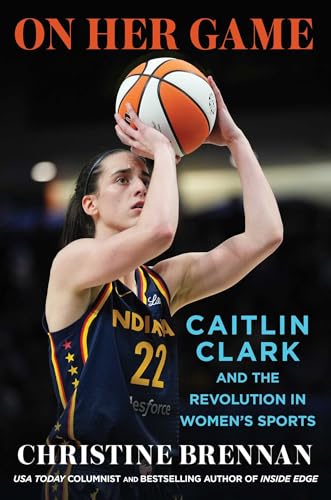
On Her Game is a compelling homage to Caitlin Clark, the dazzling college basketball star whose impact on women’s sports has transcended the court. In just four years at the University of Iowa, Clark became a national phenomenon: a 3.64 GPA marketing major, multiple-time All-American, record-setting scorer, and the face of a sport in transformation. She led her team to the Final Four, sold out arenas, and inspired young fans—both girls and boys—to wear her jersey.
Clark’s influence extended beyond basketball. With millions in endorsement deals, a sharp media presence, and a spotless off-court reputation, she quickly became a symbol of excellence and marketability in women’s sports. Articulate, humble, and team-oriented, she embraced her role as an ambassador of the game with poise.
So why has Clark—and this book—stirred controversy?
Christine Brennan, a veteran journalist with a well-earned reputation for fairness, explores the complex cultural tensions that have surrounded Clark’s rise. She notes that Clark’s identity as a white, attractive, straight woman in a league where many stars are Black and openly gay has led to resentment in some quarters. A handful of critics—players, coaches, and analysts—dismissed her collegiate dominance and questioned whether her game would translate to the pros. Early in her WNBA career, she faced not only physically intense defenses but also moments that bordered on bullying.
Some veteran players treated her with noticeable coldness. I draw parallels to the experience of Pete Maravich, another flamboyant scorer whose transition from college to the pros in 1970 was also met with skepticism and envy—particularly from Black teammates and established NBA stars who resented the media attention he received.
Interestingly, Brennan herself came under fire from some WNBA figures who accused her of pushing an agenda. Yet her reporting includes attempts to speak with those critical of Clark, many of whom declined to go on record. Brennan does not shy away from addressing racial dynamics, including examples of racism aimed at Clark. She also argues that leaving Clark off the 2024 U.S. Olympic team was a mistake—one that speaks more to league politics than performance.
Brennan’s book is sharp, fair, and timely. It raises important questions about race, gender, power, and the uneasy growing pains of a league adjusting to sudden mainstream attention.
As a fan of Caitlin Clark, I found On Her Game to be both informative and affirming. I hope Clark continues to thrive in the WNBA and that the league’s leadership recognizes the opportunity she represents. Stars like Clark don’t come along often—and when they do, they have the power to elevate not just a team or a league, but an entire sport.
 Esot-eric