The Almanack of Naval Ravikant: A Guide to Wealth and Happiness (Jorgenson, Eric) Review and Takeaways

I am a bit old to take advantage of Ravikant’s advice on building a brand, a business and a life. His advice is pretty much opposite of what I heard over 50 years ago when I started my career. At that time, it was important to climb the corporate ladder. You got promoted by working long hours and making your boss look good. When your boss looks good, he or she gets promoted and then hopefully good things trickle down to you. Honestly, I can’t say that that strategy worked too well for me in the corporate world. Often the good things and results that I did accomplish went unnoticed and I did not get the credit that I deserved many times in my corporate career. But things are definitely very different. Young people, either out of high school or college, have to think entrepreneurial. Their goal should be to work for themselves and not for corporations or people who can take advantage of them. Technology is so important, particularly understanding how to use AI.

Listed below are some of Ravikant’s words of wisdom. I actually think that the first one on the list is the most important and true.

Earn with your mind, not your time.

Become the best in the world at what you do. Keep redefining what you do until this is true.

The most important skill for getting rich is becoming a perpetual learner.

When you’re studying something, like a geography or history class, and you realize you are never going to use the information, drop the class. It’s a waste of time. It’s a waste of your brain energy.

Following your genuine intellectual curiosity is a better foundation for a career than following whatever is making money right now. 

There are basically three really big decisions you make in your early life: where you live, who you’re with, and what you do.

Be a maker who makes something interesting people want. Show your craft, practice your craft, and the right people will eventually find you.

It’s actually really important to have empty space. If you don’t have a day or two every week in your calendar where you’re not always in meetings, and you’re not always busy, then you’re not going to be able to think.

Reading science, math, and philosophy one hour per day will likely put you at the upper echelon of human success within seven years.

A rational person can find peace by cultivating indifference to things outside of their control.

Spent money on books. I never viewed that as an expense. That’s an investment to me.

The Almanack of Naval Ravikant: A Guide to Wealth and Happiness (Jorgenson, Eric)
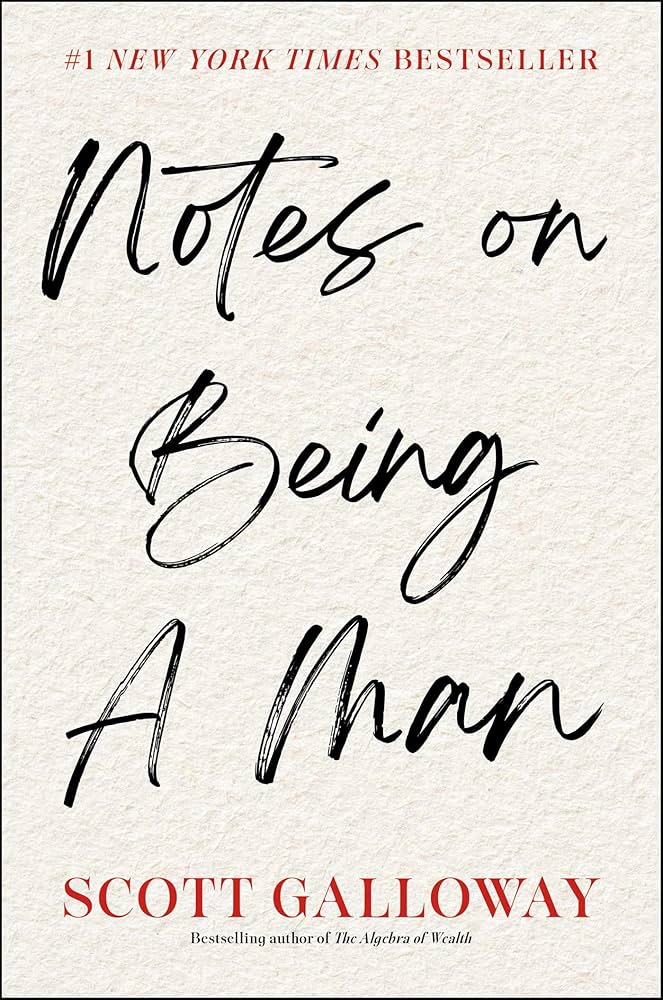
Review and Commentary: Notes on Being a Man by Scott Galloway

Good book for young men in their 20s and 30s. For this reader in his 70s, it provided some perspective on his life and a bit of a report card on how well he did. Scott Galloway is one of the nation’s top thought leaders. This book is a combination of an autobiography and his notes on how to conduct one’s life as a man. He cites the many issues of masculinity in today’s culture and society and offers his advice on relationships, education, career, family, work and health.

I think Scott has been very lucky. He had a loving and caring mother who filled the parenting roles when his father divorced her. I don’t think many men will identify with his life’s path. Scott worked very hard for his success but there were prices to pay in terms of his first marriage and health. Listed below are some notes of advice from Scott and my commentary regarding its validity and wisdom.

Scott’s NotesMy Notes and Comments
Most boys come apart when a male role model leaves. If there is no father present, the son is more likely to be incarcerated than graduate from college. I don’t think that I’m the exception. My father died when I was seven. I had a caring mother and family for help. I graduated from college. I dealt successfully with adversity.
Success comes when you put in small, consistent amounts of effort, every day and every week.Success comes more from luck, connections and opportunity than effort.
College teaches you critical thinking-how to triage.Depends on the classes, the teacher and the student’s desire to learn. Based on what I see, very few people have marshaled the knack of critical thinking, college or not.
The ratio of time you spend sweating to watching others sweating is forward looking indicator of your success.Unless you are Donald Trump
Your body will sometimes make decisions for you when your brain won’t. Learn to listen to your body.
Good advice when you’re young, better and more valid advice as you get older!

Don’t be afraid to quit. Failing fast is better than failing over a long period.As soon as you start a new job, develop a Plan B to escape if the job does not work out. Have an FU fund.
The best romantic partnerships are synced up on three things: passion, values and money.Money or lack of it ruins many marriages and relationships.

Hidden Potential: The Science of Achieving Greater Things by Adam M. Grant (Book Review)

My rating: 4 of 5 stars

Want to reach your potential? Achieve success on your terms? This book offers a variety of strategies to get you there.

There were perspectives on success, learning and improvement that I found interesting and consistent with what I experienced in my life. For example, I wish that I was not so afraid to make mistakes when I was younger. I also wished that I dreamed bigger than I did. I believe its important to have a network of advisors and mentors.

Parts of the book were more interesting to me than others. However it is well written. I particularly enjoyed the stories about Seth Curry and R.A. Dickey and their routes to playing at professional levls in their respective sports. Dickey’s story about how he finally succeeded as a major-league pitcher is particularly inspiring.

Listed below are portions of the book I found worthy of note…

Potential is not a matter of where you start but of how far you travel.

This capacity to absorb, filter and adapt enables sponges to grow and thrive. And it’s a capacity that matters a great deal for humans too.

A key to being a sponge is determining what information to absorb versus what to filter out.

Seek discomfort. Instead of just striving to learn, aim to feel uncomfortable. Pursuing discomfort sets you on faster path to growth. If you want to get it right, it has to first feel wrong.

Seek out new knowledge, skills and perspectives to fuel your growth—-not feed your ego.

Strive for excellence, not perfection. Practice wabi sari, the art of honoring beauty in imperfection. Did you make yourself better today?

Deliberate practice is the structured repetition of a task to improve performance based on clear goals and immediate feedback. Deliberate play = deliberate practice + free play (Seth Curry)

It’s better to disappoint others than to disappoint yourself.

Compete against yourself. The risk of competing against others is that you can win without getting better.

Instead of relying on a single expert or mentor, remember that the best directions come from multiple guides.

Hundreds of experiments show that people improve faster when they alternate between different skills (interleaving).

It turns out that if you are taking a new road, the best experts are often the worst guides. Experts often have an intuitive understanding of a route, but they struggle to articulate all the steps to take.