
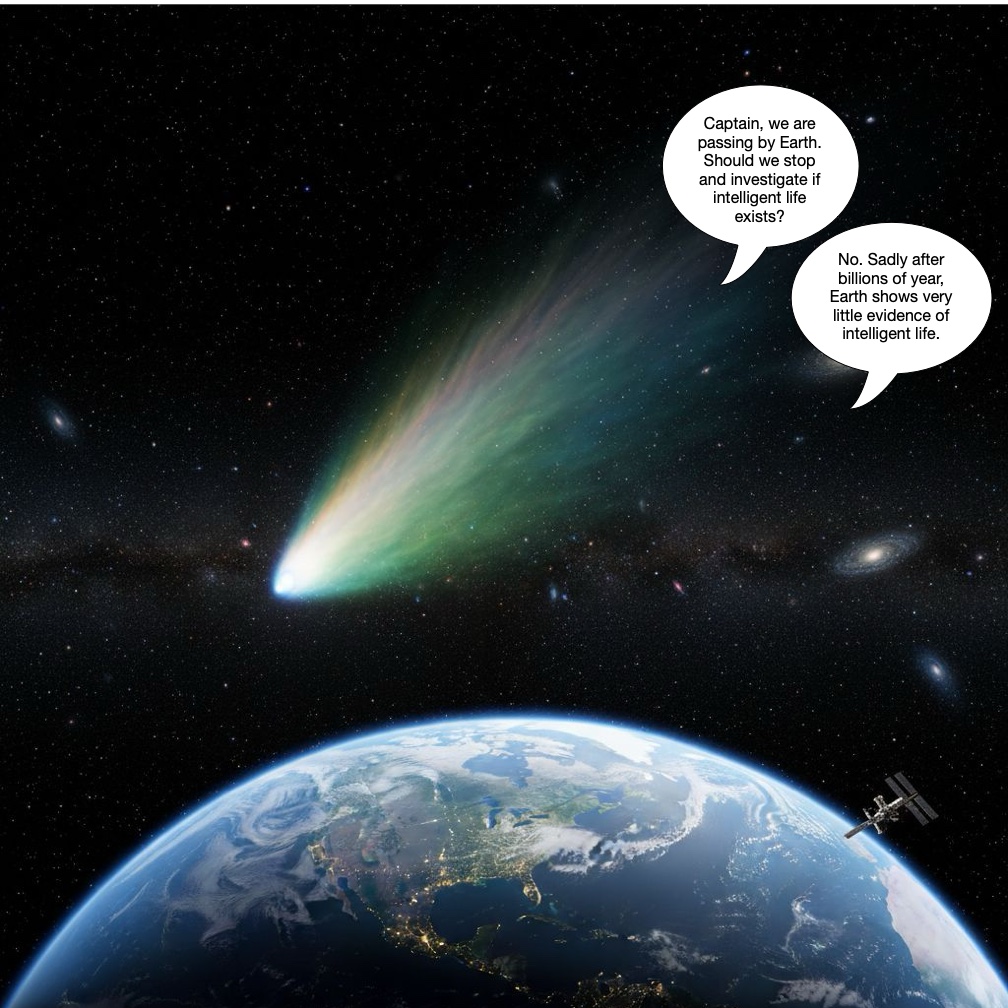
Some scientists and observers opine that 3iAtlas now traveling in our solar system is actually an alien craft. If so, this may be a possible communication on board as it passes Earth.
Some scientists and observers opine that 3iAtlas now traveling in our solar system is actually an alien craft. If so, this may be a possible communication on board as it passes Earth.
Luis Elizondo, the former director of the Pentagon’s Advanced Aerospace Threat Identification Program (AATIP), offers a provocative look into the United States government’s investigation of unidentified anomalous phenomena (UAPs) in Imminent: Inside the Pentagon’s Hunt for UFOs. For readers accustomed to the term “UFOs,” the rebranding to UAPs signals a shift—an attempt to expand the narrative beyond flying objects to include all unexplained phenomena.
Elizondo’s book delves into two compelling narratives. The first is his recounting of extraordinary encounters with UAPs—incidents that suggest extraterrestrial involvement. The second is an exposé of governmental resistance to transparency, raising questions about secrecy, incompetence, and ideological opposition within the military and intelligence community. Both threads are bound to captivate anyone with even a passing curiosity about the possibility of extraterrestrial life.
The revelations are staggering: reports of extraterrestrial craft allegedly recovered and reverse-engineered; claims of alien “bodies” found at crash sites; and the disconcerting assertion that UAPs have interfered with U.S. nuclear missile systems. Elizondo even speculates on the potential motives of these visitors—our planet’s water as fuel, or concern over humanity’s penchant for self-destruction via nuclear warfare. Such theories are supported by numerous sightings near military bases and naval fleets.
The book doesn’t shy away from darker implications. While some suggest UAPs could be benign observers, others, including Elizondo, entertain the notion that their intentions may not be friendly. Reports of abductions and injuries suffered by those who’ve come into direct contact with UAPs lend credence to a more ominous view. Alarmingly, Elizondo recounts how a faction within the U.S. government dismissed UAP research altogether, citing their belief that these phenomena were “demonic.”
Yet, for all its intrigue, Imminent stops short of providing definitive proof. The anecdotes are enthralling, but they remain just that—anecdotes. While Elizondo’s credentials and credibility, evident in his congressional testimony and media appearances, lend weight to his claims, the lack of conclusive evidence may frustrate skeptics. In fact, prominent skeptic Michael Shermer has questioned Elizondo’s background and methods, though his critiques might suffer from a superficial engagement with the book’s content.
What truly stands out is Elizondo’s call for an evolution in our understanding of physics and time. He suggests that UAP technology—capable of unimaginable speed and maneuverability—might reveal the limitations of our current scientific paradigms. This conjecture is tantalizing, leaving readers to ponder whether humanity is on the brink of its most profound discovery.
While Elizondo’s accounts fuel fascination and trepidation, they also underscore a broader question: Could humanity cope with the existential shock of proving extraterrestrial life? As the author posits, the mere acknowledgment that we lack the means to defend against such advanced technology could induce global panic.
Despite the lack of a smoking gun, Imminent is undeniably engrossing. It invites readers to consider the implications of UAPs and the reasons behind governmental obfuscation. If clearer evidence—those alleged high-definition images and videos—exists, one wonders when, if ever, the public will see them. Until then, Imminent serves as a tantalizing, if inconclusive, prelude to what might be the greatest story ever told.
For anyone intrigued by the intersection of science, philosophy, and national security, Elizondo’s account is a must-read, even if it leaves more questions than answers. The next chapter of this unfolding story will undoubtedly be one to watch.
My rating: 5 of 5 stars
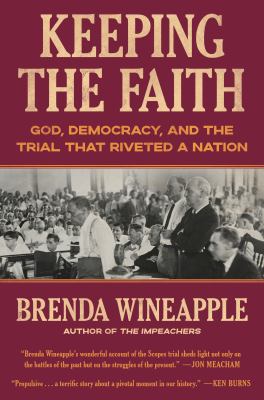
Before reading this book, I was already intrigued by the Scopes trial, having encountered it through reading Inherit the Wind by Lawrence and Lee in my youth and viewing the film adaptation starring Spencer Tracy as Clarence Darrow.
This book captivated me, not just with the story of the Scopes trial itself but also with the rich background it provides on the cultural and political climate in America leading up to the trial. The country was grappling with racism, antisemitism, women’s disenfranchisement, and a stark divide between the North and South. Religious leaders were increasingly uneasy with the rise of science, and efforts to suppress scientific education in schools were prevalent—an issue that resonates even today.
Wineapple profiles three key figures of the era: Clarence Darrow, H.L. Mencken, and William Jennings Bryan. These profiles were the highlight for me. All three were intelligent, influential, articulate, and deeply flawed. Their strong beliefs on issues like racism, antisemitism, and religion shaped their actions.
Bryan, a staunch defender of the Bible, believed its teachings should be taken literally. His speeches and sermons, especially in the South, were widely popular. Despite three failed presidential campaigns, his political ambition never waned.
Darrow and Mencken, both agnostics, were critical of religious hypocrisy. Liberals in their politics, they used their legal and journalistic skills to push their principles. It’s fascinating that Bryan, Darrow, and Mencken ended up at the center of such a pivotal cultural and political moment.
Reading this book made me reflect on how much progress the United States has—or hasn’t—made in areas like racism, antisemitism, and the influence of religion in education, law, and politics. The challenges to science that existed in the 1920s are still relevant today.
I highly recommend this book as an insightful snapshot of American culture and politics in the 1920s and is still happening today.
Saturday Night will always remain burned in my memory as long as I live, as being the day when I heard the most religion preached, and the least practiced.
Will Rogers
My rating: 3 of 5 stars (Goodreads)
It’s a very long book with some helpful background science and medical information. But I can’t say that I really learned anything new. It may or less reinforces things that I have read or heard previously. For someone younger than 40, it may be a cautionary tale and a more valuable read than for someone as old as me.
My notes from the book.
The odds are overwhelming that you will die as a result of one of the chronic diseases of aging that I call the Four Horsemen: heart disease, cancer, neurodegenerative disease, or type 2 diabetes and related metabolic dysfunction.
Exercise is by far the most potent longevity “drug.” No other intervention does nearly as much to prolong our lifespan and preserve our cognitive and physical function. But most people don’t do nearly enough—and exercising the wrong way can do as much harm as good.
Our tactics in Medicine 3.0 fall into five broad domains: exercise, nutrition, sleep, emotional health, and exogenous molecules.
So we will break down this thing called exercise into its most important components: strength, stability, aerobic efficiency, and peak aerobic capacity. Increasing your limits in each of these areas is necessary if you are hoping to reach your limit of lifespan and healthspan.
My point is that if you really stop to consider the kind of aerobic fitness that most people actually need in the course of their lives, it basically boils down to being really good at going slow for a long time, but also able to go hard and fast when needed.
The best science out there says that what you eat matters, but the first-order term is how much you eat: how many calories you take into your body.
You may have heard of this gene, which is called APOE, because of its known effect on Alzheimer’s disease risk.¨
The authors of the study, published in Nature, speculated that rapamycin might extend lifespan “by postponing death from cancer, by retarding mechanisms of aging, or both.”¨
This is not an atypical scenario: when a patient comes to me and says their father or grandfather or aunt, or all three, died of “premature” heart disease, elevated Lp(a) is the first thing I look for. It is the most prevalent hereditary risk factor for heart disease, and its danger is amplified by the fact that it is still largely flying under the radar of Medicine 2.0, although that is beginning to change.
¨This is why, if you have a history of premature heart attacks in your family, you should definitely ask for an Lp(a) test. We test every single patient for Lp(a) during their first blood draw.¨
The single most powerful item in our preventive tool kit is exercise, which has a two-pronged impact on Alzheimer’s disease risk: it helps maintain glucose homeostasis, and it improves the health of our vasculature.¨
Strength training is likely just as important. A study looking at nearly half a million patients in the United Kingdom found that grip strength, an excellent proxy for overall strength, was strongly and inversely associated with the incidence of dementia.¨
Sleep disruptions and poor sleep are potential drivers of increased risk of dementia. If poor sleep is accompanied by high stress and elevated cortisol levels, as in Stephanie’s case, that acts almost as a multiplier of risk, as it contributes to insulin resistance and damaging the hippocampus at the same time.¨
Studies have found that hearing loss is clearly associated with Alzheimer’s disease, but it’s not a direct symptom. Rather, it seems hearing loss may be causally linked to cognitive decline, because folks with hearing loss tend to pull back and withdraw from interactions with others.¨
In Medicine 3.0, we have five tactical domains that we can address in order to alter someone’s health. The first is exercise, which I consider to be by far the most potent domain in terms of its impact on both lifespan and healthspan.¨
Next is diet or nutrition—or as I prefer to call it, nutritional biochemistry. The third domain is sleep, which has gone underappreciated by Medicine 2.0 until relatively recently. The fourth domain encompasses a set of tools and techniques to manage and improve emotional health. Our fifth and final domain consists of the various drugs, supplements, and hormones that doctors learn about in medical school and beyond. I lump these into one bucket called exogenous molecules, meaning molecules we ingest that come from outside the body.¨
Think of the Centenarian Decathlon as the ten most important physical tasks you will want to be able to do for the rest of your life.¨
The three dimensions in which we want to optimize our fitness are aerobic endurance and efficiency (aka cardio), strength, and stability. All three of these are key to maintaining your health and strength as you age.¨
In San Millán’s view, healthy mitochondria are key to both athletic performance and metabolic health. Our mitochondria can convert both glucose and fatty acids to energy—but while glucose can be metabolized in multiple different ways, fatty acids can be converted to energy only in the mitochondria. Mitochondrial health becomes especially important as we grow older, because one of the most significant hallmarks of aging is a decline in the number and quality of our mitochondria.¨
Strength training, especially with heavy weights, stimulates the growth of bone—more than impact sports such as running…
View all my reviews
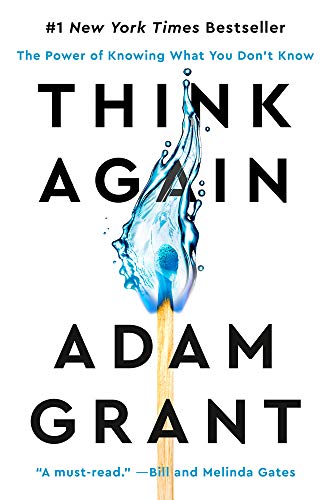
This is a very useful book especially given the current fractious times that we live in. My guess is just about all of us needs to spend some time “re-thinking.” As the author correctly points out, “We live in an increasingly divisive time. For some people a single mention of kneeling during the national anthem is enough to end a friendship. For others a single ballot at a voting booth is enough to end the marriage. Calcified ideologies are tearing American culture apart.”
Re-thinking is not only useful for politics and debate but for every aspect of your life, including financial management, marriage, children, career, social relationships etc.
Grant provides a number of interesting people, scenarios and examples where re-thinking took place with very positive results. Probably the best example was the black musician Daryl Davis who persuaded white supremacists to abandon not only their membership in the Ku Klux Klan but more importantly their racist outlooks.
This is an important book that all of us could benefit from.
I have included some of my notes from the book:
This book is an invitation to let go of knowledge and opinions that are no longer serving you well, and to anchor your sense of self in flexibility rather than consistency.
Part of the problem is cognitive laziness. Some psychologists point out that we are mental misers: we often prefer the ease of hanging onto old views over the difficulty of grappling with new ones.
Most of us take pride in our knowledge and expertise, and in staying true to our beliefs and opinions. That makes sense in a stable world, where we get rewarded for having conviction and our ideas. The problem is that we live in the rapidly changing world, where we need to spend as much time rethinking as we do thinking. ( e.g. Mike Lazardis BlackBerry CEO)
Research reveals that the higher you score on an IQ test, the more likely you are to fall for stereotypes, because you’re faster at recognizing patterns. And recent experiments suggest that the smarter you are, the more you might struggle to update your beliefs.
When we are in scientific mode, we refuse to let our ideas become ideologies. We don’t start with answers or solutions; we lead with questions and puzzles.
We should all be able to make a long list of areas where we are ignorant. Recognizing our shortcomings opens the door to doubt.
In a meta-analysis of 95 studies involving over 100,000 people, women typically underestimated their leadership skills, while men overestimated their skills.
David Dunning and Justin Kruger published a modest report on skill and confidence that would soon become famous. They found that many situations, those who can’t… Don’t know they can’t. It’s when we lack confidence that we are most likely to be brimming with overconfidence.
Patient mortality rates in hospitals seem to spike in July, when new residents take over. It’s not their lack of skill alone that proves hazardous; it’s there over estimation of that skill.
“Arrogance is ignorance plus conviction.” Tim Urban
Achieving excellence in school often requires mastering old ways of thinking. Building an influential career demands new way of thinking.
Valedictorians aren’t likely to be the future’s visionaries education researcher Karen Arnold explains. They typically settle into the system instead of shaking it up.
Good teachers introduce new thoughts, but great teachers introduce new ways of thinking. Ultimately education is more than the information we accumulate in our heads. It’s the habits we develop as we keep revising our drafts and the skills we build to keep learning.
Takeaways:
Think like a scientist. When you start forming an opinion, resist the temptation to preach, prosecute or politick.
Define your identity in terms of values, not opinions.
Seek out information that goes against your views.
Embrace the joy of being wrong.
Build a challenge network, not just a support network.
Learn something new from each person you meet.
Ask “what evidence would change your mind?”
Make time to think again.
 Esot-eric