
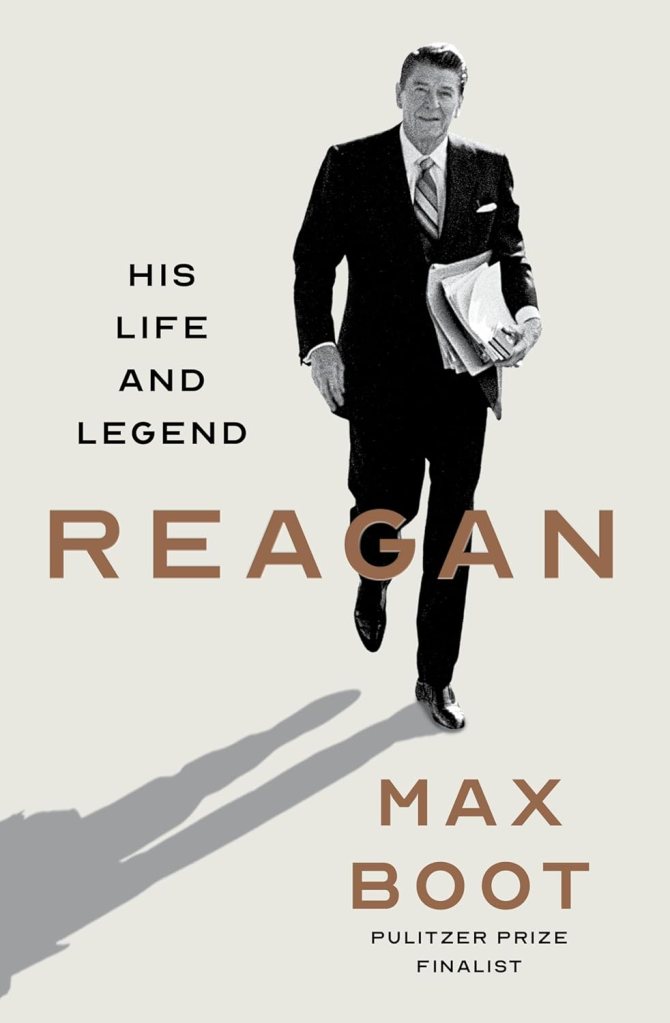
Max Boot’s biography, Reagan: His Life and Legend, offers a well-written and balanced examination of Ronald Reagan as President, Governor of California, husband, and father. While the book sheds light on Reagan’s admirable traits, it doesn’t shy away from his flaws, making it a nuanced portrayal that might not have pleased Reagan or his wife, Nancy, if they were alive to read it.
Reagan’s admirers—particularly those who regard him as one of the greatest U.S. Presidents—may find aspects of this book unsettling. While Boot acknowledges Reagan’s good qualities, he also highlights numerous shortcomings, presenting a more complex figure than the idealized version often celebrated.
The biography reinforced my belief that Reagan, though a decent man, was neither a particularly intelligent individual nor an exceptional leader. He lacked intellectual curiosity, with Reader’s Digest reportedly being his preferred reading material. Reagan, at heart, was an actor, and much of his success stemmed from his ability to follow direction—something he desperately needed throughout his political life.
One quality I genuinely admired in Reagan was his courage following the 1981 assassination attempt by John Hinckley. His ability to maintain a sense of humor even as he faced death was truly inspiring.
Reagan’s presidency benefited immensely from the presence of highly skilled advisors. For instance, Jim Baker, widely regarded as the best Chief of Staff in presidential history, played a pivotal role in keeping the administration on track. To Reagan’s credit, he recognized his limitations and leaned heavily on his team for guidance. Similarly, he often sought advice from Nancy, who was both his greatest supporter and, at times, a source of controversy in his life.
The book, at 731 pages, is lengthy but flows efficiently, offering a comprehensive look at Reagan’s life. Boot’s writing is engaging, making the biography an easy and compelling read despite its depth.
While there are faint parallels between Reagan and Donald Trump, I would caution against drawing too many comparisons. Reagan’s legacy, while flawed, is distinct in character and style from Trump’s presidency.
However, the book is not without its omissions. Boot largely sidesteps critical moments and controversies that shaped Reagan’s legacy. There’s no mention of the bombings of the U.S. Embassy, the Embassy annex, or the Marine barracks in Beirut—or the paralyzing indecision that followed. Likewise, the humiliating hostage crisis in Lebanon, the Iran-Contra affair, and the diversion of funds to the Contras are conspicuously absent.
Equally glaring is the lack of discussion on domestic issues, including scandals involving savings and loan regulators, the Department of Housing and Urban Development, and other government agencies. Boot also neglects to address Reagan’s rollback of civil rights laws, his failed nomination of Robert Bork to the Supreme Court, or the infamous visit to Bitburg Cemetery. The administration’s tax cuts, social welfare reductions, and their role in growing income inequality and the hollowing out of the middle class are similarly omitted.
On foreign policy, Boot overlooks Reagan’s apathy toward the AIDS pandemic, his opposition to sanctions on South Africa, and the dangerous escalation of tensions with the Soviet Union during the early 1980s fueled by his military buildup and incendiary rhetoric.
While Boot succeeds in painting a vivid picture of Reagan’s life and personality, these omissions leave the portrait incomplete. For readers seeking a full accounting of Reagan’s presidency, these gaps may feel significant. Nonetheless, the book offers a fascinating exploration of Reagan’s life, warts and all.
 Esot-eric