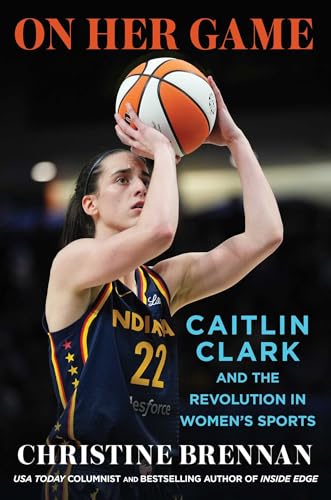
On Her Game is a compelling homage to Caitlin Clark, the dazzling college basketball star whose impact on women’s sports has transcended the court. In just four years at the University of Iowa, Clark became a national phenomenon: a 3.64 GPA marketing major, multiple-time All-American, record-setting scorer, and the face of a sport in transformation. She led her team to the Final Four, sold out arenas, and inspired young fans—both girls and boys—to wear her jersey.
Clark’s influence extended beyond basketball. With millions in endorsement deals, a sharp media presence, and a spotless off-court reputation, she quickly became a symbol of excellence and marketability in women’s sports. Articulate, humble, and team-oriented, she embraced her role as an ambassador of the game with poise.
So why has Clark—and this book—stirred controversy?
Christine Brennan, a veteran journalist with a well-earned reputation for fairness, explores the complex cultural tensions that have surrounded Clark’s rise. She notes that Clark’s identity as a white, attractive, straight woman in a league where many stars are Black and openly gay has led to resentment in some quarters. A handful of critics—players, coaches, and analysts—dismissed her collegiate dominance and questioned whether her game would translate to the pros. Early in her WNBA career, she faced not only physically intense defenses but also moments that bordered on bullying.
Some veteran players treated her with noticeable coldness. I draw parallels to the experience of Pete Maravich, another flamboyant scorer whose transition from college to the pros in 1970 was also met with skepticism and envy—particularly from Black teammates and established NBA stars who resented the media attention he received.
Interestingly, Brennan herself came under fire from some WNBA figures who accused her of pushing an agenda. Yet her reporting includes attempts to speak with those critical of Clark, many of whom declined to go on record. Brennan does not shy away from addressing racial dynamics, including examples of racism aimed at Clark. She also argues that leaving Clark off the 2024 U.S. Olympic team was a mistake—one that speaks more to league politics than performance.
Brennan’s book is sharp, fair, and timely. It raises important questions about race, gender, power, and the uneasy growing pains of a league adjusting to sudden mainstream attention.
As a fan of Caitlin Clark, I found On Her Game to be both informative and affirming. I hope Clark continues to thrive in the WNBA and that the league’s leadership recognizes the opportunity she represents. Stars like Clark don’t come along often—and when they do, they have the power to elevate not just a team or a league, but an entire sport.
Daryl Morey was supposed to be the General Manager genius who would push the 76ers to a NBA world championship. Instead, the team is locked into an inescapable contract salary straitjacket that not even Houdini can breakthrough. Suggest Sixers walk across Pattison Ave and talk to the GM who knows how to build championship teams.
Joel Embiid and Paul George are toast. Current biggest concern: Tyrese Maxey does not burn out from carrying team on his back.
Fire Nick Nurse? Nah! Red Auerbach could not improve win-loss record given lack of talent.
If Nick Nurse is fired or quits, I’d try to hire the current Detroit Pistons coach JB Bickerstaff.
Only Cooper Flagg from Duke looks like a player worth going into the tank for in the draft.
Last 10 #1 NBA Drafts and My Performance Grades on their Careers
Karl-Anthony Towns (A)
Ben Simmons (D-)
Markelle Fultz (D)
Deandre Ayton (C)
Zion Williamson (C+)
Anthony Edwards (A+)
Cade Cunningham (B-)
Paolo Banchero (A)
Victor Wembanyama (A)
Zaccharie Risacher N/A)
Note: the two lowest draft grades belong to 76ers first round picks…
Not overwhelmed yet with either Dylan Harper or Ace Bailey from Rutgers, who are projected as #2 and 3 NBA draft picks. Overrated? Maybe. They certainly show potential but I’d rather see them play another year of college ball to sharpen their games even if it was not at Rutgers.
At the start of the college basketball season, I was hoping that Rutgers would mimic the success of the 1976 team that made it to the Final Four. Very disappointed that they are struggling just to make the play in playoff game in the Big Ten tournament.
Fran Dunphy is retiring after stints at Penn, Temple and LaSalle. In the “Big Five Mount Rushmore” of coaches, he would be along Jay Wright of Villanova, Jack Ramsey of Saint Joseph and John Cheney of Temple. Jay Wright is easily the GOAT of Big Five coaches.
I watch many pro and college basketball games with the volume muted as the analysts are so poor and boring.
Best play by play and announce team for college basketball ever: Dick Enberg and Al McGuire (1970-80s)
I spent a majority of my time this past weekend on my couch, fiddling with my remote to watch various sports events. Five observations…
I watched and enjoyed the women’s NCAA basketball tournament this season and you can credit Caitlin Clark for my avid interest. She is the female reincarnation of “Pistol” Pete Maravich, who played for LSU in the late 60s. Clark and Maravich were prolific shooters, ball handlers and passers. The women’s game continues to improve and doesn’t have the same turmoil of disgruntled players flocking to the transfer portal as the men’s game is experiencing.
I have read and viewed some pushback from WNBA players about Caitlyn Clark. I already sent some jealousy regarding Clark’s popularity and athletic notoriety. When Pete Maravich was drafted by the Atlanta Hawks, he faced hostile teammates who were upset by his popularity and style of play. I am hoping that Clark does not experience the same negativity from her teammates. It will only hurt the WNBA – – the WNBA needs Clark more than she needs them.
I had some emotional conflict during the finals of the women’s NCAA game. Part of me wanted Iowa to win so it would cement Caitlin as one of the best or maybe the best women’s player in college basketball. But most of me was a Dawn Staley fan. Staley is an excellent coach and a class act whether she wins or loses. She basically took a new team to the NCAAs, went undefeated and won the title.
I read this morning that John Calipari is preparing to move from coaching Kentucky to Arkansas. Calipari could takes some lessons from Dawn Staley on communication. Calipari has worn out his welcome at Kentucky based on mediocre results this season including early losses in the SEC tournament and the NCAA tournament. I watched Kentucky more than any other men’s college basketball team this year. I was interested in the progress of DJ Wagner and Aaron Bradshaw who both played at Camden High and were expected to be drafted into the pros this year. Based on their performance on the court, I would not draft either one. I don’t think either one benefited from their tutelage under Calipari. Both should look into the transfer portal and hopefully reinvigorate their chances to get into professional basketball. Calapri is an excellent recruiter, but a mediocre coach.
Kudos to another great performance by a female athlete. Anna Leigh Waters won her 100th PPA championship this weekend. She took gold in women’s singles, mixed doubles and women’s doubles. At 17, she is the predominant pickleball player in the women’s division. Some suggest that she is the best pickleball player, man or woman. I am hoping that she will have a competitive rival soon. Her reign reminds me of how Chris Evert dominated women’s tennis in the 1970s before Martina Navratilova started to play competitively.
Sports nostalgia tour of the American Basketball Association whose heydays were in the late 60s and 70s. The league had some great players like Dr. J, Rick Barry, George Gervin, Artis Gilmore, Dan Issel and others. Interesting stories about how they tried to create the league. Poor Pat Boone was one of the early investors and almost went broke. There were some smart owners and many greedy ones. George Mikan was the ABA’s first commissioner and insisted that the league’s headquarters be situated in Minnesota where he lived.
So many characters Marvin Barnes, Johnny Neumann, John Brisker etc. played in the league. The book details many of their antics. I remember Rick Mount, one of the best shooting guards in college at Purdue. Unfortunately his college game did not translate that well into the pros.
The financial status of the teams and the league were always in peril. They did not have a national TV contract like the NBA. Many coaches and players suffered returned checks or did not get paid at all.
I did not realize or remember that ABA teams played NBA teams in exhibition games and competed fairly well. There were some excellent ABA coaches including Hubie Brown, Larry Brown, Stan Albeck and Doug Moe. (Even Wilt Chamberlain was an ABA coach but not a very good or devoted one.)
There are a large number of amusing anecedotes and stories. This is a very entertaining sports book about a very interesting time in professional basketball.
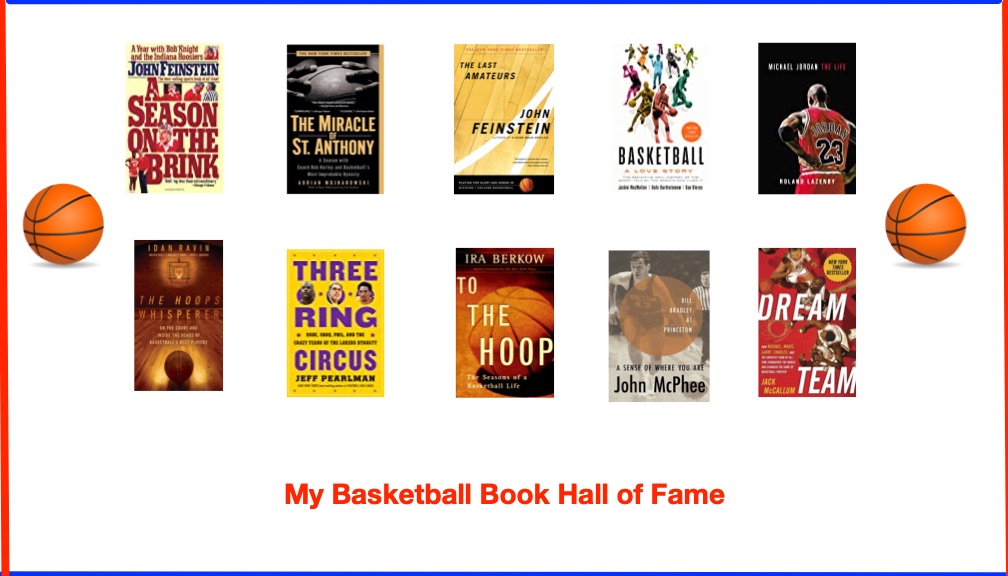
It’s March Madness time so I thought I would share a list of the top books that I have enjoyed about basketball. The first ten books represent my “top seeds” but let me offer at the outset that any basketball (or any other sport) books written by John Feinstein are Hall of Fame worthy.
A Season on the Brink by John Feinstein
The Miracle of St. Anthony by Adrian Wojnarowski
The Last Amateurs: Playing for Glory and Honor in Division I College Basketball by John Feinstein
Basketball: A Love Story by Jackie MacMullan, Rafe Bartholomew, Dan Klores
Michael Jordan: The Life by Roland Lazenby
The Hoops Whisperer by Idan Ravin
Three-Ring Circus: Kobe, Shaq, Phil, and the Crazy Years of the Lakers Dynasty by Jeff Pearlman
To the Hoop: Seasons of a Basketball Life by Ira Berkow
A Sense Of Where You Are by John McPhee
Dream Team by Jack McCallum
A March to Madness: A View from the Floor in the Atlantic Coast Conference by John Feinstein
Pistol: The Life of Pete Maravich by Mark Kriegel
The Breaks of the Game by David Halberstam
The Jordan Rules by Sam Smith
Showtime by Jeff Pearlman
Eleven Rings by Phil Jackson
The Book of Basketball: The NBA According to The Sports Guy by Bill Simmons
Last Dance: Behind the Scenes at the Final Four by John Feinstein
Unfinished Business: On and Off the Court With the 1990-91 Boston Celtics by Jack McCallum
The Back Roads to March: The Unsung, Unheralded, and Unknown Heroes of a College Basketball Season by John Feinstein
This is a story that took place more than 45 years ago. In a 30 minute span, I may have inadvertently offered the best advice that I ever offered anyone not only about basketball but also life and in return, I received a lasting life lesson and one of the nicest things ever said to me, all from a young boy who just wanted to shoot baskets.
When people need to clear their head, some may pray, some may meditate and others may go for a long walk or run. In my 20’s and 30’s, I would pick up my basketball and head for the courts to shoot some hoops. Shooting baskets was a very centering practice and often served as my moment of Zen. Bounce, Balance, Aim, Release, Follow Through, Retrieve the basketball and Repeat. So on a sunny summer afternoon, I found the basketball court at Memorial Park in Cinnaminson empty. There was no one to disturb me and I was left alone to empty my mind and forget my worries.
Photo by Stephanie Young Mertzel
Routinely when I practiced alone, I would start with bank shots off the backboard and then move further back until I felt warmed up. I would then shoot set shots trying to find a rhythm and pace. I would then practice lay-ups and jump shots before I finished with shooting foul shots. I would be so focused on this ritual that I would often lose track of time and not notice people or activities around me.
But not this day…
After shooting for about ten minutes, in the corner of my eye, I caught a young boy maybe nine or ten sitting silently on the side. He watched me for a while and every now and then I heard a low “Wow” or see a shake of his head in approval when I hit a basket. I really was in “flow” and I did not want to be disturbed and have to share my time on the court with anyone. Every now and then the ball would roll over to where he was sitting and he would slowly get up and roll the ball back to me.
I was able to largely avoid the youngster until I noticed that he now stood and was mimicking how I was shooting as if to copy the shooting motion. The boy was mostly silent to me as if he knew that I was in my own world and he was trying not to disturb it. But I could tell he wanted to shoot baskets.
In my mind, the young boy sparked a memory of my youth. It was of another young boy, about his age, fatherless, who also stood silently at a park or ball field hoping that someone would let him play catch or toss a football around. That shy young boy was also silent not wishing to intrude but also hoping that he would be invited to play.
I motioned the young boy to come over and asked him if he wanted to shoot. I noticed that as he walked over, his balance seemed unsteady. One of his legs appeared to drag. I softly tossed him the basketball and noticed he had some difficulty in catching it. When he dribbled the ball, he did it slowly with two hands as if he never touched a basketball before. When he spoke, I detected a slight lisp or speech impediment.
His first few shoots did not touch the rim. His shooting motion seemed forced and I wondered if he suffered some type of physical disability. I could tell he was becoming discouraged as he kept missing. I kept handing him the ball silently after he missed shot after shot. I sensed his frustration. He stopped after one bad miss and handed me the ball and said, “Thank you” and turned to sadly walk away.
“Don’t leave,” I urged the retreating youngster. “Keep shooting! Everybody misses at first. Don’t give up.” I then showed him how to bend his knees and use his arms to aim the ball to propel the shot. He struggled for a few more shots where he hit nothing. Then one of his shots bounced around the rim. He wanted to stop and I told him “Keep shooting.” Finally with one big heave he made a basket. He seemed very relieved as I smiled at his success. “All huge journeys begin with one small step,” I told him.
To compensate for his poor arm strength, I showed him the Rick Barry style of shooting foul shots underhanded where he could use both arms to power the shot to reach the rim. He was better able to reach the rim and he made a few baskets bringing a slow smile to his face. What was an exercise in futility for him now became a challenge he gladly accepted.
I had to leave but I urged him to keep practicing. I could sense a bit of sadness in his eyes as I said it. I asked him if he had a basketball at home and he said he did not. I wondered what kind of home life he had and if kids his age would play sports with him. He did not appear to have the athletic and mobility skills that kids his age would have. I sensed that he may not have been invited to play any sports.
I handed him my basketball. I told him the basketball was his but he needed to keep shooting to get better. It was as if I was giving him a new bicycle for Christmas. His face lit up with a smile. I did not realize at the time that I was providing him a lesson not just for basketball, but for life. You will face frustrations especially when you attempt new things. You will have bad streaks where you will get discouraged. His struggles may have been more challenging given his physical limitations.
As I grabbed my towel to leave, I asked him if he watched basketball on television. He shook his head yes. I then asked him if there was a player he wanted to be like. He paused, looked down at the basketball in his hands, raised his head slowly and answered, “You.”
The boy’s answer stunned me. I was going to try to say something witty and self deprecating but I could not. I could not speak. I know the youngster appreciated my time and attention that I provided. I nodded my head and smiled my thanks and headed for my car. The boy may have thought as I walked away that I was using the towel to wipe sweat from my brow. I was wiping my eyes.
Never been a coach, never was fortunate to be a father but fortunate to have that opportunity to make a small impression on that boy’s life. I envy all of you who have or had greater opportunities to make positive impressions on a young boy or young girl’s life. I just shared mine…
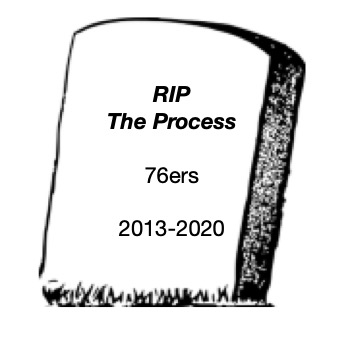
The 76ers are a high priced street pick up team. There were so many mistakes on personnel decisions. Not sure why they did not move heaven and earth at the end of last season to keep Jimmy Butler. This season, there was no “go to guy” when you needed a critical basket at the end of a game.
This year’s NBA draft offers little relief. Even with high draft picks, the 76ers have really mucked it up. Remember Michael Carter Williams, Nerlins Noel, Jahil Okafor, Timothy Luwawu-Cabarrot, Landry Shamet and Markelle Fultz (instead of Jayson Tatum)???
The NBA East has four of the best coaches in basketball. Brad Stevens (Celtics), Nick Nurse (Toronto), Erik Spoelstra (Heat) and Mike Budenholzer (Bucks) are far superior coaches than Brett Brown. Good coaching usually manifests itself after halftime and particularly in the last few minutes of the fourth quarter. Sounds like the 76ers never bought in to Brown’s substitutions patterns or to his strategies when games were on the line.
Did anyone watch the Clippers-Mavs game that followed the 76ers-Celtics today? Is there anyone who would rather have either Embid or Simmons than Luke Doncic?
I am not interested in any “retreads” to coach the 76ers if they release Brett Brown. So I’m not interested in Jason Kidd, Tyronn Lue, Mark Jackson or Luke Walton. I might be interested in a certain local college coach who has demonstrated the ability to win the big game (twice) and might be looking for a new challenge. It also helps that his players do well in the NBA draft and in competition.
The right of first refusal to the 76ers job if Brett Brown is released is Jay Wright.


 Esot-eric